The objective is to understand the mechanisms of particle formation and to distinguish between its natural and anthropogenic causes
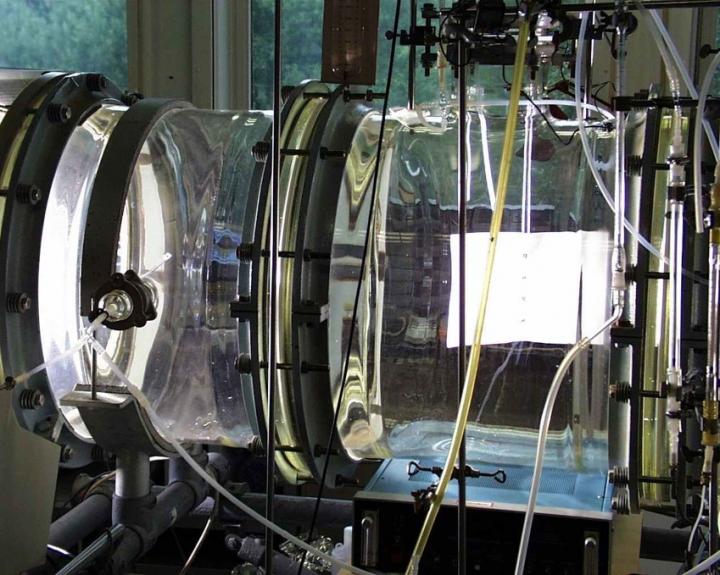
Credit: photo/©: Hoffmann group, JGU
The formation of new particles and their subsequent growth in the troposphere are important processes shaping the composition of the atmosphere and influencing climate change. Chemist Professor Thorsten Hoffmann of Johannes Gutenberg University Mainz (JGU) has obtained approval from the German Research Foundation (DFG) for a Reinhart Koselleck Project, in which he will explore an alternative pathway of the growth of particularly small-scale particles. The project “Chemistry in Nanometer Particles: Unique Breeding Sites for Oligomers?” will run for a period of five years and is being funded to the tune of some EUR 915,000. Reinhart Koselleck Projects are designed to support particularly innovative and high-risk research.
About half of cloud condensation nuclei in the atmosphere result from the formation of new particles. This process, also known as nucleation, determines cloud characteristics and the energy balance of the Earth. Ultrafine atmospheric particles less than 100 nanometers in diameter also pose health risks as they can penetrate deep into the respiratory system. Although researchers have gained new insights into the first stages of particle formation in recent years, there is still an unanswered question: What exactly drives the further growth of nanoparticles after their initial generation?
High pressure promotes chemical reactions that result in the formation of oligomers
Professor Hoffman and his research team will be adopting a new approach in order to explore this issue. They postulate that the particle embryos themselves provide a unique environment that influences chemical reactions and facilitates growth. One particular characteristic of nanoparticles is their increased Laplace pressure, i.e., the difference in pressure between the inside and outside of a curved surface that is induced by surface tension. As a rule, the smaller the particle the higher the pressure.
“Chemical reactions that lead to the formation of larger molecules from smaller building blocks are promoted by higher pressure. This means that the reactions that we call oligomerization probably play an important role, particularly within extremely small particles”, explained Hoffmann. Although the pressure in nanoparticles cannot be directly measured, there are numerous indications to the effect. The internal pressure in particles with a diameter of 10 nanometers is some 200 bar, which is equivalent to the pressure at ocean depths of 2,000 meters.
Chemical reactions influenced by the size of particles may thus play a crucial role in the life cycle of atmospheric aerosols. They would explain how initial particle embryos grow into larger particles that have a better chance of survival and can eventually form the nuclei around which cloud droplets can form. “It is our intention to study the critical ‘infant’ and ‘young children’ phases – as it were – of the particles when they still are dependent on processes that will enable them to grow rapidly to larger sizes at which as ‘adults’ they undertake their tasks in the atmosphere,” added Hoffmann. The team is using high-resolution mass spectrometry for this purpose, which is a huge challenge, because the organic material available is in the range of just a billionth to a trillionth of a gram in each case.
“Our goal is to understand the mechanisms of particle formation. This should ultimately enable us to differentiate between the influences of natural sources, such as forests, and of human-induced effects,” Hoffmann summarized. However, even though the research is primarily concerned with aspects of atmospheric chemistry, the knowledge acquired about size-dependent chemical reactions will also contribute to a better understanding of equilibrium reactions in organic nanoreactors and – in a very general sense – provide further insights into the origin of life.
###
Reinhart Koselleck Project funding for particularly innovative research projects
Reinhart Koselleck Projects funded by the German Research Foundation (DFG) support research that is exceptionally innovative and high-risk. The funding is awarded to outstanding researchers with a proven scientific track record.
Media Contact
Dr. Thorsten Hoffmann
[email protected]
Original Source
http://www.