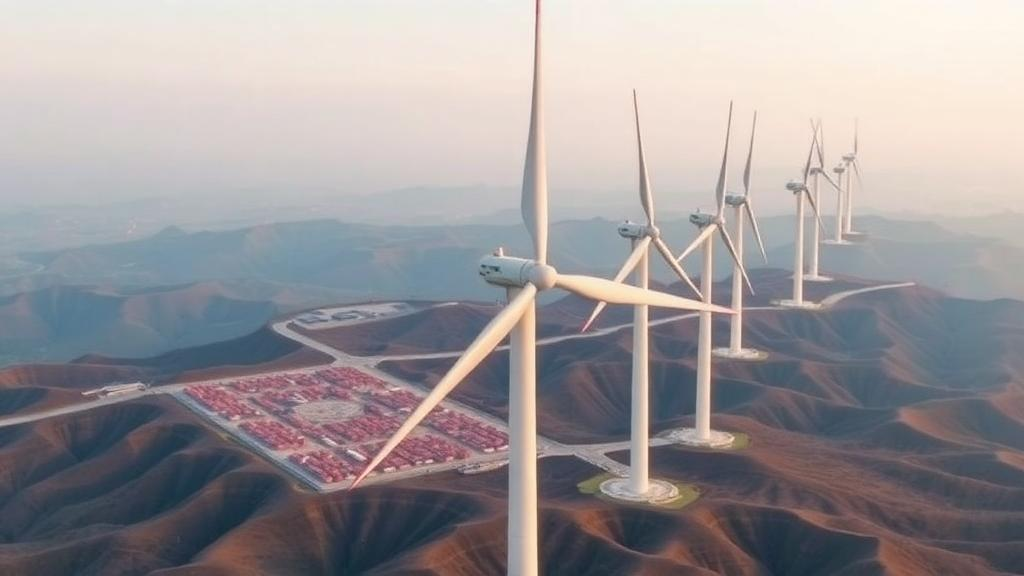
China’s vast fleet of wind turbines is beginning to age out, and a new study projects that the wave of decommissioned turbine waste will swell dramatically over the coming decades. Researchers built a granular farm-level database covering 6,712 wind power projects across China, capturing technical specifications, geographic distribution, and operational timelines. Using this database together with the Global Trade Analysis Project model calibrated to China’s carbon neutrality targets, they projected national and provincial installed-capacity expansion, decommissioning volumes, and material flows through 2050.
The projections show that decommissioned wind power waste flows will increase rapidly after 2030. National annual decommissioned capacity is expected to rise from 12.00 gigawatts in 2030 to 21.92 gigawatts in 2035, and then to 64.40 gigawatts by 2050. The waste stream will be concentrated mainly in early-deployment and energy-base provinces such as Inner Mongolia, Xinjiang, Gansu, and Hebei, giving those regions a central role in any recycling strategy.
To assess what can be done with this growing stream of retired blades, towers, and other components, the team conducted a comparative analysis of seven recycling technology pathways. Each pathway was evaluated for economic feasibility, resource recovery efficiency, and carbon mitigation potential. The results indicate that recycling this waste can help relieve pressure on critical material supplies while generating substantial resource and environmental co-benefits.
The carbon numbers are striking. By around 2035, material recovery from decommissioned turbines is expected to avoid approximately 4.45 million tons of CO2 emissions. By 2050, as decommissioning volumes climb, that mitigation figure is projected to increase to approximately 14.03 million tons of CO2.
The study also identifies a practical tension.
According to the authors, this is the first spatially explicit techno-economic roadmap for wind turbine waste management in China. The work proposes actionable strategies for advancing the transition toward what the researchers describe as a circular renewable-energy ecosystem, in which materials from retired turbines re-enter supply chains rather than becoming landfill.
The stakes are high because China dominates global wind power capacity, so the sheer scale of its eventual end-of-life turbine waste threatens both the renewable energy transition and environmental sustainability if left unmanaged. The study frames this mounting challenge as a critical knowledge gap that its farm-level database and model-based projections are designed to address.
Because the findings are model-based projections rather than observed outcomes, the reported figures represent anticipated waste volumes and emission savings under the study’s assumptions, including calibration to China’s carbon neutrality targets. Even so, the analysis offers policymakers and industry a quantified picture of where decommissioning will occur, when it will accelerate, and how much carbon recycling could save, providing a planning foundation as the first large cohorts of Chinese wind turbines approach the end of their operational lives.
Subject of Research: Economic viability and carbon mitigation potential of recycling retired wind turbine components in China
Article Title: Economic viability and carbon mitigation potential of recycling retired wind turbine components in China
Article References: Li, H., Wang, S., Li, Y., Zheng, T., Lu, X., Lu, B., Wang, F., Hu, H., Xu, K., & Wang, Z. (2026). Economic viability and carbon mitigation potential of recycling retired wind turbine components in China. Journal of Industrial Ecology. https://doi.org/10.1007/s44498-026-00197-8
Image Credits: AI Generated
DOI: 10.1007/s44498-026-00197-8
Keywords: wind turbines, recycling, China, carbon mitigation, decommissioning, circular economy, techno-economic analysis, material recovery, GTAP model, renewable energy, Economic, viability
News Source: Faith Mcneil. (October 29, 2026). Recycling Retired Wind Turbines Could Cut Millions of Tons of CO2 in China. Scienmag.