


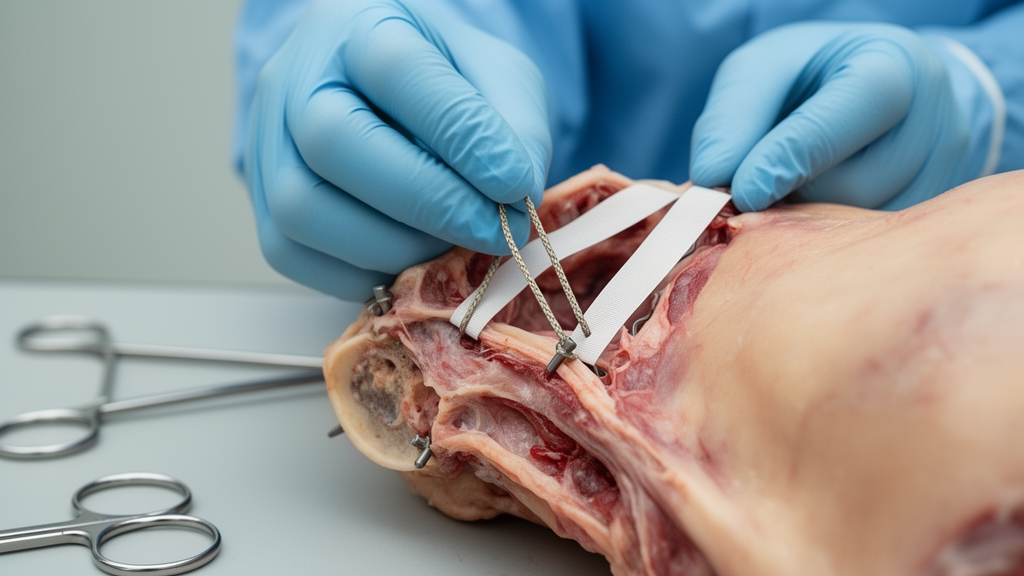
When surgeons repair a torn rotator cuff or a torn labrum in the shoulder, they often rely on small interference-fit anchors that wedge a suture against bone to hold the repair in place. A long-standing question has been whether the shape of that suture matters: the traditional round, wire-like braided suture, or the newer flat tape-style suture that has grown popular in operating rooms. A controlled laboratory study published in Archives of Orthopaedic and Trauma Surgery now reports that, at the suture-anchor-bone interface, the two designs performed largely the same when tested in human cadaveric shoulders under controlled loading.
The research team, led by James D. Dimitroff with colleagues including Conor Smith, Stefan Hanish, Lasun O. Oladeji, Will Bezold, Clayton W. Nuelle and Matthew J. Smith, set out to fill a specific gap. Prior biomechanical work had mostly examined how tape and round sutures behave at the suture-tendon interface, where tape sutures show a wider contact area, increased footprint contact pressures, and up to 31% higher load to failure. But no study had directly compared how the two suture shapes perform inside interference-fit anchors, which achieve fixation by compressing the suture against bone within the anchor body. Because biomechanical studies have shown that the load needed to cause suture slippage is frequently lower than the force required to dislodge the anchor from bone, suture slippage remained a plausible failure mode worth testing.
To answer the question, the investigators used fresh-frozen human cadaveric shoulders from a commercial source, with a mean donor age of 44.4 years and a range of 32 to 50 years. For the glenoid model, which simulates labrum repair, four matched pairs of shoulders were used, with six standardized anchor sites per glenoid along the posterior rim, from the 12 o’clock to the 6 o’clock position. For the rotator cuff model, five matched pairs of humeri were used, with three anchor sites per humerus along the greater tuberosity footprint. One glenoid pair was excluded before testing because improper storage had rendered it unsuitable. Notably, the glenoid specimens had previously undergone postmortem anterior reconstruction, either a Latarjet procedure or distal tibial allograft, as part of an unrelated investigation; the prior hardware was removed and testing was confined to the untouched posterior glenoid.
In the glenoid model, three suture-anchor combinations were tested, all using short 2.9-mm BioComposite PushLock anchors: one loaded with 1.3-mm SutureTape, one with 1.5-mm LabralTape, and one with #2 FiberWire, a round suture. Each construct was tested 16 times, for 48 completed tests, though predefined exclusion criteria removed six tests with identifiable procedural errors, leaving final analyzed samples of 13, 14 and 15. In the humerus model, five clinically used manufacturer-recommended combinations were tested: 4.75-mm DX Knotless SwiveLock anchors with 1.7-mm SutureTape or 2-mm FiberTape or #2 FiberWire, and 4.75-mm Omega Self-Punching Knotless anchors from a second manufacturer with #2 round Force Fiber or 2-mm flat XBraidTT. Thirty humeral tests were allocated so each manufacturer’s constructs were equally represented overall, with final sample sizes of five, five, five, seven and eight.
Each specimen followed a standardized protocol. After a preload of 5 N held for 120 seconds to eliminate slack and allow viscoelastic equilibration, constructs underwent cyclic loading between 10 and 50 N at 0.8 mm/s for 100 cycles, a range chosen to stay below the suture pullout threshold identified in pilot testing. Then each construct was loaded to failure at 1 mm/s, a quasi-static rate that permits reliable identification of the yield point and ultimate failure. The researchers recorded cyclic displacement, displacement and force at yield, ultimate failure strength, stiffness, and force at fixed displacements of 1, 2 and 5 mm. In every single case, failure occurred by pullout of the suture from the anchor; no anchor pulled out of the surrounding bone, which is precisely the interface the study was designed to probe.
Because multiple anchor sites were tested within each cadaveric specimen, the measurements were not independent, so the team used a linear mixed-effects model rather than a simple analysis of variance, treating suture type and anchor position as fixed effects and specimen as a random effect. Pairwise conclusions rested on Tukey-adjusted comparisons that control the family-wise error rate, an important distinction because a significant overall model effect does not always survive correction for multiple testing. The a priori power analysis, based on yield force, required a minimum of five specimens per construct to detect a 15 N difference with 80% power.
The glenoid results were strikingly uniform. There were no significant differences among suture types in cyclic displacement at cycles 1, 50 or 100, in displacement at yield, in yield force, in force at 1 mm or 5 mm of displacement, or in ultimate failure strength. Stiffness and force at 2 mm displacement did show significant overall model-level effects, but Tukey-adjusted pairwise comparisons found no significant differences between any individual suture types for either outcome. In plain terms, whether the anchor gripped a flat tape or a round wire suture made no measurable difference at this interface in the labrum model.
The humerus model told a slightly more nuanced story. Displacement at cycle 50 and cycle 100 differed overall across groups, but post hoc pairwise comparisons were not significant for these displacement outcomes. Ultimate failure strength, yield force and stiffness did differ significantly across groups, and here the pairwise analysis identified one specific contrast: the 2-mm FiberTape construct showed greater ultimate strength, higher yield force and greater stiffness than the 2-mm XBraidTT construct. The authors emphasize that both of these are tape-type sutures, from different manufacturers with different anchor systems, so this difference cannot be attributed to suture shape alone. Because each manufacturer’s suture was tested only in its own anchor system, the independent effects of suture geometry and anchor design could not be completely separated, meaning the observed differences may reflect the combined influence of both variables.
Taken together, the findings did not support the team’s original hypothesis that flat tape sutures, with their low-profile geometry when compressed beneath an interference-fit anchor, would be more susceptible to slippage and show less pullout strength than round sutures. The authors conclude that suture shape did not meaningfully influence interference-fit fixation properties in the glenoid and humeral models evaluated, and that tape-type and round-type sutures demonstrated comparable biomechanical performance at the suture-anchor interface within the tested constructs. They suggest that intrinsic material advantages seen when sutures are tested in isolation may be mitigated by the complex interactions between suture, anchor and bone, and that optimizing repair biomechanics requires a system-level perspective on the entire construct.
The study has limitations the authors spell out carefully. All glenoid specimens had undergone prior postmortem anterior reconstruction, which may have altered glenoid architecture or bone quality and could limit generalizability to native anatomy. Constructs were loaded axially along the anchor axis, which does not fully replicate the tangential forces experienced in vivo. As a cadaveric investigation, the work speaks only to time-zero biomechanics and cannot inform biological healing, remodeling, repair durability or patient outcomes. Bone mineral density measures were not available, the sample size was limited, and the loading protocol cannot fully reproduce the multidirectional, repetitive stresses of real shoulders. The authors note that future studies incorporating varying bone quality and in vivo animal or clinical models will be needed to confirm the findings. For now, the practical message is that surgeons may not need to weigh suture performance at the suture-anchor interface when choosing a suture design, and can instead direct attention toward the suture-tendon interface, the most common point of failure in both biomechanical studies and clinical practice.
Subject of Research: Biomechanical comparison of round versus tape sutures in interference-fit anchors for rotator cuff and glenoid labrum repair using human cadaveric shoulders
Article Title: Round versus tape sutures with interference fit anchors perform similarly in cadaveric glenoid and greater tuberosity biomechanical testing
Article References: Dimitroff, J. D., Smith, C., Hanish, S., Oladeji, L. O., Bezold, W., Nuelle, C. W., & Smith, M. J. (2026). Round versus tape sutures with interference fit anchors perform similarly in cadaveric glenoid and greater tuberosity biomechanical testing. Archives of Orthopaedic and Trauma Surgery, 146(1), Article 362. https://doi.org/10.1007/s00402-026-06524-9
Image Credits: AI Generated
DOI: 10.1007/s00402-026-06524-9
Keywords: rotator cuff, glenoid labrum, interference-fit anchor, suture tape, biomechanics, cadaveric study, suture pullout, shoulder surgery, arthroscopic repair, load to failure, linear mixed-effects model, greater tuberosity
News Source: Ophelia Keating. (October 30, 2026). Round and tape sutures hold equally well inside shoulder anchors, cadaver study finds. Scienmag.



