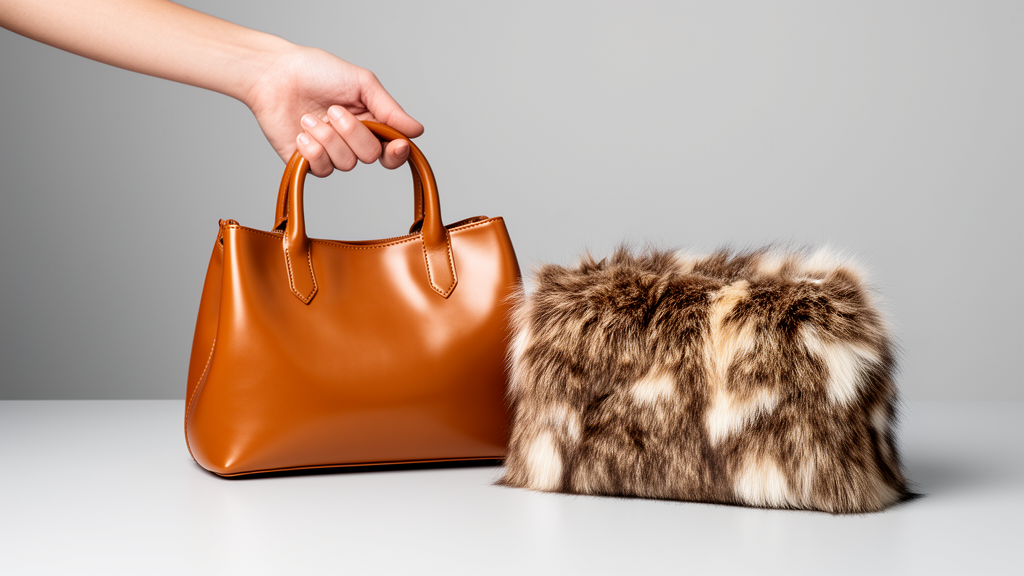
A large online experiment with 487 U.S. women has found that the perceived realism of vegan materials cuts in opposite directions depending on which material is being advertised. In a study published in the journal Fashion and Textiles, researchers at the center of the work reported that handbag advertisements featuring vegan leather drew more favorable advertising attitudes and stronger purchase intentions than ads featuring vegan fur, and that higher perceived material authenticity amplified the positive response to vegan leather while dampening the response to vegan fur.
The research team, led by Sunwoo Kim with colleagues Songmee Kim and Chorong Youn, framed the study around a question that earlier vegan fashion research had largely sidestepped. Prior work had concentrated on ethical motives such as moral attitudes and environmental responsibility. The new study instead asked how the symbolic values attached to specific vegan materials interact with a specific product category, in this case women’s handbags, a fashion item the authors describe as carrying especially salient status-related meanings alongside identity expression and creative styling.
To build the theoretical scaffolding, the researchers combined three frameworks. The Value-Attitude-Behavior framework, originally developed by Homer and Kahle in 1988, treats abstract consumer values as shaping attitudes, which in turn shape behavioral intentions; here the symbolic value of a material-product combination was expected to influence attitude toward the advertisement and, through it, purchase intention. Schematic processing theory supplied the idea that consumers interpret advertising stimuli through pre-existing mental schemas, such as material-based expectations and product category norms. Cognitive dissonance theory, attributed to Festinger, motivated the prediction that a highly realistic vegan fur might clash with anti-cruelty values and produce psychological discomfort.
The experiment used a 2 by 2 between-subjects design crossing material type, vegan leather versus vegan fur, with material authenticity, low versus high, defined as the extent to which consumers perceive an artificial material as visually or tactilely similar to its natural counterpart. Four fictitious print advertisements for women’s handbags were generated with the AI tools Midjourney and DALL·E, producing 112 candidate images that were then retouched in Photoshop to resemble realistic fashion advertising visuals. A fictitious brand logo, VEGCHIC, and a constant tagline reading “Chic. Ethical. Vegan.” were applied, with backgrounds, lighting, color tones and advertising messages held constant across conditions so that only the material and its apparent realism varied.
Manipulation checks supported the design. In a January 2024 pretest with 96 U.S. women recruited through CloudResearch, vegan leather handbags were rated significantly higher on perceived status symbolism than vegan fur handbags, with means of 4.28 versus 2.67 on a 7-point scale. Authenticity ratings also separated the low and high conditions for both materials. In the main experiment, again fielded in January 2024 via CloudResearch, 487 U.S. women aged 20 or older, with a mean age of 41.32 and 80.5 percent Caucasian, were randomly assigned to one of the four conditions, and the manipulation checks were repeated successfully.
The headline behavioral result was straightforward. In an ANCOVA controlling for fashion involvement, participants shown vegan leather handbags reported significantly higher purchase intention, with a mean of 4.11, than those shown vegan fur handbags, whose mean was 3.16. Fashion involvement itself exerted a significant effect on purchase intention, underscoring that personally engaged consumers responded more strongly across the board. A mediation analysis using SPSS PROCESS Macro Model 4 with 5,000 bootstrap samples then showed that status symbolism raised advertising attitude, which in turn strongly predicted purchase intention; the bootstrapped indirect effect was significant at a point estimate of .727 with a 95 percent confidence interval of .440 to 1.007, while the direct effect was only marginally significant.
The moderation results revealed the study’s most striking asymmetry. For advertising attitude, the interaction between material type and authenticity was significant. Vegan leather ads were evaluated more favorably when the material looked highly authentic, with a mean of 5.14 versus 4.41 in the low-authenticity condition. Vegan fur ads moved the opposite way, earning less favorable attitudes when the fur looked highly authentic, at 3.70 versus 4.16 for the less realistic version. For purchase intention, the same directional pattern appeared but the overall interaction was only marginally significant, so the authors treat those hypotheses as partially supported and note that authenticity shaped attitudinal evaluations more clearly than downstream purchase intentions.
A moderated mediation analysis using PROCESS Model 8 completed the picture. Under low material authenticity, the indirect path from status symbolism through advertising attitude to purchase intention was statistically non-significant, with an indirect effect of .234 and a confidence interval spanning zero. Under high authenticity, the indirect effect became significant and much larger, at 1.231 with a confidence interval of .838 to 1.634, and the index of moderated mediation was significant. In other words, realism conditioned whether the symbolic advantage of vegan leather could be converted into purchase intention through advertising attitude at all.
The authors interpret these patterns through symbolic congruity rather than any inherent virtue of realism. Vegan leather, typically made from polyurethane or plant-based synthetics, can closely mirror the structured, refined look of natural leather and thereby inherits that material’s long-standing associations with luxury, professionalism and prestige. Highly realistic vegan fur, by contrast, may activate schemas of animal cruelty among ethically conscious consumers, creating dissonance between cruelty-free positioning and visual cues resembling the very product some shoppers seek to avoid. The team emphasizes that vegan fur is not uniformly stigmatized; in other contexts such as streetwear or Y2K aesthetics it can signal fashion-forwardness and subcultural creativity, and symbolic meanings emerge relationally from material, category and sociocultural context rather than residing in the material itself.
The researchers are explicit about the boundaries of the evidence. The sample was predominantly middle-aged, Caucasian and U.S.-based, only women’s handbags were tested, the advertisements were fictitious and AI-generated despite retouching, and the cognitive dissonance and schema mechanisms were not measured directly, making the results consistent with rather than definitive proof of those explanations. They also caution against broad managerial prescriptions, while suggesting that brands tailor authenticity cues by material: realistic textures may strengthen vegan leather’s luxury congruity, whereas vegan fur communication may benefit from stylized designs, synthetic aesthetics or explicit cruelty-free messaging. Future work, they write, should test other product categories, cultures and demographics, examine fashion involvement as a moderator, and replicate the findings with real brands and field settings.
Subject of Research: An experimental study of how status symbolism and perceived material authenticity shape U.S. women's responses to vegan leather and vegan fur handbag advertisements.
Article Title: Status symbolism in vegan fashion: an experimental study on the role of vegan material authenticity
Article References: Kim, S., Kim, S., & Youn, C. (2026). Status symbolism in vegan fashion: an experimental study on the role of vegan material authenticity. Fashion and Textiles, 13(1), Article 30. https://doi.org/10.1186/s40691-026-00478-7
Image Credits: AI Generated
DOI: 10.1186/s40691-026-00478-7
Keywords: vegan fashion, vegan leather, vegan fur, handbag advertising, material authenticity, status symbolism, consumer behavior, cognitive dissonance, purchase intention, advertising attitude, experimental study, sustainable fashion
News Source: Denise Maddox. (October 29, 2026). Realistic Vegan Leather Wins Shoppers, but Lifelike Vegan Fur Backfires in Handbag Ads. Scienmag.