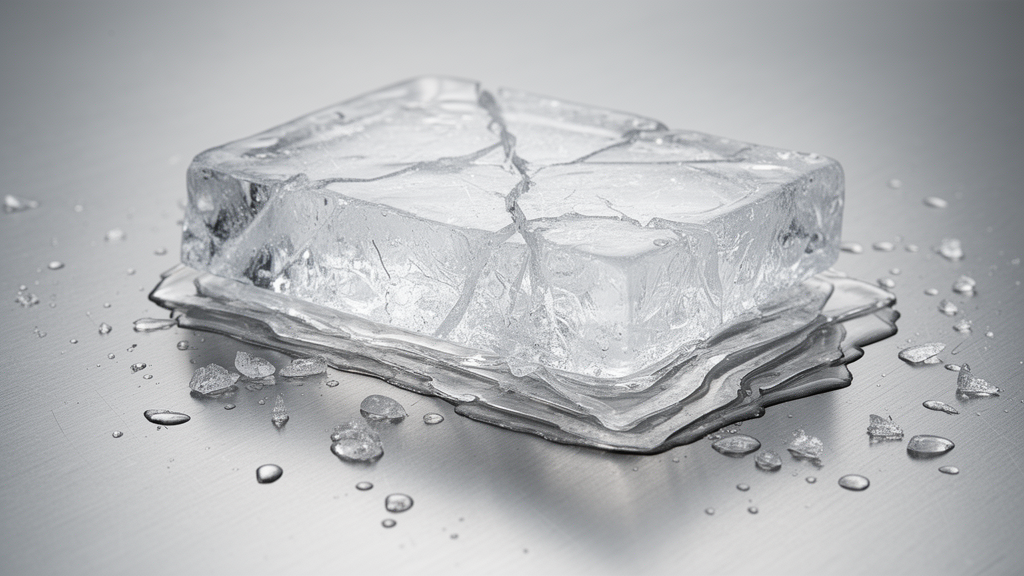
In laboratory experiments at the University of Texas at Dallas, researchers found that rapidly cooling ice attached to metal, glass and plastic produced sharply different results. Ice released easily from the cooled metal, remained firmly attached to glass and adhered to plastic. The study indicates that thermal conductivity—a material’s ability to transfer heat—can be a critical factor in determining whether ice remains attached to a surface. On the metal, the ice cooled and contracted enough for cracks to form, reducing adhesion to nearly zero.
The finding offers a possible alternative to the conventional use of heat for deicing. Heating can melt ice, but supplying enough heat in very cold environments can be difficult and energy intensive. Deicing procedures can also involve changing the chemistry of surfaces to prevent ice from sticking, although those methods can become less effective in extreme cold, when ice can still form strong bonds with the surface. The new experiments suggest that, under extreme cold, engineers may sometimes be able to make ice colder rather than warmer so that thermal contraction and mechanical mismatch fracture it away from the substrate. The researchers said additional research is needed before the approach could be incorporated into practical deicing systems.
Lu, who directs the Mechanics of Advanced Materials Laboratory at UT Dallas, said the experiments show that rapid cooling can make ice much easier to remove under extremely cold conditions. The team was conducting experiments to develop ice-resistant surfaces for cold environments when it tested whether rapid temperature changes could weaken ice adhesion. Its central observation was unexpected: metal and glass have similar thermal expansion properties, so the researchers expected ice to behave similarly on both surfaces. Instead, ice detached readily from the metal but remained firmly attached to the glass, an outcome Lu said puzzled the team for a long time.
As the researchers investigated the unexpected behavior, they determined that the thermal conductivity of the substrate played a critical role in whether the ice would detach. The way a surface transfers heat determines the temperature change at the ice-substrate interface. In general, a material that transfers heat more efficiently can cool the ice more rapidly. In these experiments, the metal conducted heat more efficiently than the glass or plastic. Ice touching steel therefore became colder much faster than ice touching glass, and the researchers found that the thermal properties of the substrate could explain the contrasting outcomes.
The team’s explanation focused on the coupling between heat transfer and mechanical stress at the interface. Many materials, including solid ice, contract as they get colder, but the amount of change in size depends on the material. Because the ice and metal were bonded together, they could not contract independently. The researchers described the ice as wanting to shrink more than the steel beneath it, while the bond held it in place. That constraint placed the ice under tensile stress. As the temperature fell, the mismatch between the contraction of the ice and the substrate generated stresses that fractured the ice and weakened its grip on the surface. The mechanism involved both the rapid temperature change and the differing responses of the bonded materials.
The results challenge the conventional view that deicing must always involve adding heat. Lu said that on a surface with very high thermal conductivity, engineers may not want to warm the ice; in some cases, they may actually want to cool it. A larger temperature drop can create greater stresses in the ice, which, together with the mismatch in how the materials contract, can cause the ice to fracture. The study therefore points to heat removal, rather than heating, as a possible mechanism under the tested conditions. It does not establish that every conductive surface will detach ice or that the effect can replace established deicing methods in all circumstances.
To go beyond the experimental observations, the researchers developed a model that predicts how different materials will behave during rapid cooling. Such a model could help engineers evaluate candidate surfaces and inform the design of future deicing systems. The model is intended to describe the behavior of materials under rapid-cooling conditions, where the thermal response of the substrate affects the temperature and contraction of the bonded ice. The researchers did not present the model as a complete solution for operating aircraft or wind turbines. Its practical value would need to be established through additional testing and development under conditions beyond the laboratory experiments reported here.
The researchers also tested composite materials relevant to aircraft and wind-turbine blades. Carbon-fiber composites, which have higher thermal conductivity than glass-fiber composites, created weaker ice interfaces and made the ice easier to detach. This result extended the reported relationship between efficient heat transfer and reduced ice adhesion beyond the simple metal, glass and plastic substrates in the initial comparison. The experiments did not show that carbon-fiber blades already deice themselves, nor did they demonstrate a system that could clear an entire aircraft or turbine. They showed, in the tested materials and conditions, that differences in thermal conductivity within composite classes could influence how strongly ice adhered.
The work, published in the journal Newton under the title “Thermo-mechanical coupling at ice-substrate interface,” is an experimental study of ice adhesion to different substrates. The researchers cooled ice on metal, glass and plastic to minus 76 degrees Fahrenheit, or minus 60 degrees Celsius, while investigating whether rapid temperature changes could weaken adhesion. They also examined composite materials and developed a model of the thermo-mechanical behavior. The principal observed outcome was the ease with which ice detached; the proposed mechanism involved faster cooling at the interface, differential contraction, tensile stress and fracture. The findings suggest that the speed at which a surface conducts heat can be important in determining whether ice will detach under extreme cold.
Ice accumulation on aircraft, wind turbines and power infrastructure can ground flights, reduce energy production and damage equipment. Those consequences explain why a method that weakens ice’s attachment could interest engineers. The experiments do not show that a high-conductivity surface prevents ice from forming, nor do they establish the full range of temperatures, cooling rates, ice thicknesses or bond strengths over which the observed effect will occur. The results also do not demonstrate that fracture alone would clear equipment in every operating environment. Additional research is needed to determine how the approach performs in realistic settings and whether it can be integrated safely with operating systems. Until then, the supported conclusion is narrow but striking: under extremely cold, rapidly cooled conditions, making ice colder can help remove it from a surface that conducts heat efficiently.
Subject of Research: How thermal conductivity and rapid cooling affect ice adhesion to materials in extreme cold.
Article Title: Study: Why colder temps can be better for removing ice
Article References: Study: Why colder temps can be better for removing ice. Original publication (Bibliographic details unavailable.)
Image Credits: AI Generated
DOI: Not provided
Keywords: ice adhesion, thermal conductivity, rapid cooling, deicing, ice fracture, metal surfaces, composite materials, thermo-mechanical coupling, aircraft deicing, wind turbine blades, colder, temps
News Source: Bethany Barker. (October 26, 2026). Rapid Cooling Can Weaken Ice’s Grip on Conductive Surfaces. Scienmag.