

• HOME
  • NEWS
  • EXPLORE
    • CAREER
      • Companies
      • Jobs
    • EVENTS
    • iGEM
      • News
      • Team
    • PHOTOS
    • VIDEO
    • WIKI
  • BLOG
  • COMMUNITY
    • FACEBOOK
    • INSTAGRAM
    • TWITTER
Wednesday, April 1, 2026
BIOENGINEER.ORG
No Result
View All Result
  • Login
  • HOME
  • NEWS
  • EXPLORE
    • CAREER
      • Companies
      • Jobs
        • Lecturer
        • PhD Studentship
        • Postdoc
        • Research Assistant
    • EVENTS
    • iGEM
      • News
      • Team
    • PHOTOS
    • VIDEO
    • WIKI
  • BLOG
  • COMMUNITY
    • FACEBOOK
    • INSTAGRAM
    • TWITTER
  • HOME
  • NEWS
  • EXPLORE
    • CAREER
      • Companies
      • Jobs
        • Lecturer
        • PhD Studentship
        • Postdoc
        • Research Assistant
    • EVENTS
    • iGEM
      • News
      • Team
    • PHOTOS
    • VIDEO
    • WIKI
  • BLOG
  • COMMUNITY
    • FACEBOOK
    • INSTAGRAM
    • TWITTER
No Result
View All Result
Bioengineer.org
No Result
View All Result
Home NEWS Science News Cancer

Quick MRI exam effectively detects cancer in dense breasts

Bioengineer by Bioengineer
September 6, 2025
in Cancer
Reading Time: 2 mins read
0
Breast MRI
Share on FacebookShare on TwitterShare on LinkedinShare on RedditShare on Telegram

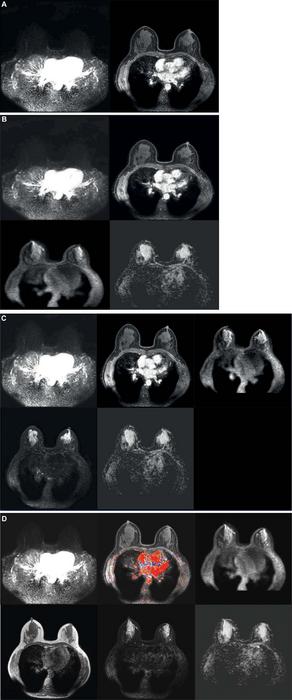
The investigative team applied a meticulously designed incremental approach, analyzing a series of MRI sequences that cumulatively build the complete imaging protocol. Initially, the dynamic contrast-enhanced T1-weighted sequences were acquired within the first 120 seconds post-contrast injection, balancing high temporal resolution with acceptable spatial detail. Subsequent sequences incorporated diffusion-weighted imaging, which provides functional insights into tissue cellularity and helps distinguish malignancies from benign lesions. This was followed by T2-weighted imaging to offer additional anatomical context and tissue characterization. Finally, the protocol was augmented with non-fat-saturated precontrast T1 images and multiple dynamic phases beyond the initial 120-second window, complemented by kinetic curve analysis that categorizes enhancement patterns into persistent, plateau, or washout types, all of which hold diagnostic significance.

Seven expert radiologists, each with over 16 years of experience, embarked on a comprehensive multireader analysis, examining a total of 2,072 MRI interpretations using these incremental sequences from the Dense Tissue and Early Breast Neoplasm Screening (DENSE) Trial. The robust dataset allowed a granular evaluation of the diagnostic performance at each protocol step. Radiologists assigned Breast Imaging Reporting and Data System (BI-RADS) scores after each reading phase to assess whether patients should be recalled for additional testing, providing a clinically relevant endpoint to the incrementally acquired data.

Expanding the reach of MRI in national breast cancer screening programs could markedly improve early detection rates in high-risk populations, ultimately contributing to reduced mortality. The nuanced trade-off between scan duration and image informativeness highlighted by this study provides a clinical roadmap for optimizing breast MRI protocols, potentially ushering in a new standard that balances precision with practicality.

Subject of Research: People

Article Title: Multireader Diagnostic Accuracy of Abbreviated Breast MRI for Screening Women with Extremely Dense Breasts

News Publication Date: 20-May-2025

Web References:

Radiology Journal
Radiological Society of North America (RSNA)
RadiologyInfo.org

Image Credits: Radiological Society of North America (RSNA)

Keywords: Breast cancer, Radiology, Patient monitoring, Medical imaging

Tags: abbreviated breast MRI protocolsbreast cancer screening advancementsdense breast tissue cancer detectiondiagnostic accuracy in breast imaginghigh-risk population breast screeninglogistical barriers in cancer screeningMRI scanning time reductionRadiology journal publicationrevolutionizing breast cancer detection methodssensitivity and specificity in MRItraditional mammography limitationsUtrecht University Medical Center research

Share12Tweet8Share2ShareShareShare2

Related Posts

Phase 1: Ceralasertib, Durvalumab in NSCLC and HNSCC

April 1, 2026

Genetic Variants Driving Rapid Immune Response Associated with Earlier Breast Cancer Onset in BRCA1 Mutation Carriers

April 1, 2026

University of Cincinnati Scientists Reveal Definitive Connection Between Chronic Kidney Disease and Periodontal Disease

March 31, 2026

Impact of Food Deserts on Post-Breast Reconstruction Complications

March 31, 2026

POPULAR NEWS

  • blank

    Revolutionary AI Model Enhances Precision in Detecting Food Contamination

    96 shares
    Share 38 Tweet 24
  • Imagine a Social Media Feed That Challenges Your Views Instead of Reinforcing Them

    1006 shares
    Share 398 Tweet 249
  • Promising Outcomes from First Clinical Trials of Gene Regulation in Epilepsy

    51 shares
    Share 20 Tweet 13
  • Popular Anti-Aging Compound Linked to Damage in Corpus Callosum, Study Finds

    43 shares
    Share 17 Tweet 11

About

We bring you the latest biotechnology news from best research centers and universities around the world. Check our website.

Follow us

Recent News

Urban Systems and Traffic: Unequal Two-Way Links

Loss of Luminal Lineage Fuels Resistance to ERα Antagonists

Adults with Unknown Autoinflammation Mimic Still’s Disease

Subscribe to Blog via Email

Enter your email address to subscribe to this blog and receive notifications of new posts by email.

Join 78 other subscribers
  • Contact Us

Bioengineer.org © Copyright 2023 All Rights Reserved.

Welcome Back!

Login to your account below

Forgotten Password?

Retrieve your password

Please enter your username or email address to reset your password.

Log In
No Result
View All Result
  • Homepages
    • Home Page 1
    • Home Page 2
  • News
  • National
  • Business
  • Health
  • Lifestyle
  • Science

Bioengineer.org © Copyright 2023 All Rights Reserved.
