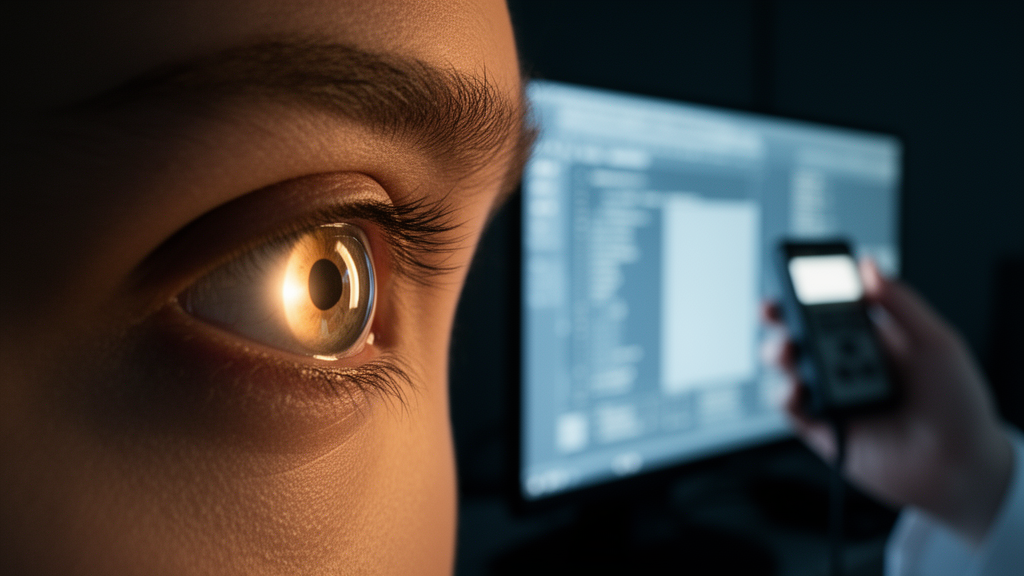
Pupil diameter has long tempted researchers as a window into emotional arousal, but it has always come with an awkward catch: the pupil also constricts and dilates in response to light. A video clip shown on a bright screen makes the pupil smaller for reasons that have nothing to do with how the viewer feels, and ambient room lighting adds yet another layer of distortion. That confounding influence of luminosity has been a major obstacle to using pupillometry as a practical measure of affective state. A new study published in the journal Brain Informatics reports a way to model and subtract the light-driven component of pupil size, leaving behind a residual signal that tracks self-reported arousal far more faithfully than the raw measurement.
The work, led by Zeel Pansara and Vito De Feo with colleagues including Gabriele Navyte, Tatiana Freitas Mendes, Camila Bottger, Edoardo Franco, Luca Citi, Erik S. Jacobi, Giulia L. Poerio, Helge Gillmeister and Caterina Cinel, was designed to quantify the effect of luminosity on pupil dilation rather than simply acknowledge it as noise. The team developed a model that predicts how much of a person’s pupil size at any moment is explained by the brightness of the screen they are watching. Crucially, the model adapts to individual physiological differences and to different types of monitors through a brief pre-experimental calibration, so it does not assume that every viewer or every display behaves identically.
To test whether this correction actually improves arousal prediction, the researchers showed 32 video clips with different content and emotional intensity to 45 participants. After each clip, the participants reported their level of emotional arousal. The recorded pupil signal from each viewing was then decomposed: the component predicted from screen luminosity was estimated and subtracted from the total recorded pupil size, yielding a luminosity-corrected, arousal-sensitive residual. From that residual, the team predicted each participant’s self-reported arousal for each video using two models, first a simple linear regression and then an Extreme Gradient Boosting model.
The difference between corrected and uncorrected signals was stark. With the linear regression model, using the luminosity-corrected pupil size produced a correlation between predicted and self-reported arousal of r = 0.65 ± 0.12 and an R2 of 0.43 ± 0.12. The uncorrected pupil size, by contrast, showed virtually no predictive power, with r = 0.26 ± 0.15 and R2 = 0.09 ± 0.089. In other words, most of the apparent relationship between raw pupil diameter and emotion in this setting was an artefact of brightness rather than a genuine reflection of arousal.
The gains grew larger when the researchers switched to the more flexible machine-learning approach. Using the Extreme Gradient Boosting model on the luminosity-corrected signal, the correlation between predicted and self-reported arousal rose to r = 0.765 ± 0.047, with an R2 of 0.556 ± 0.085. The authors conclude that modelling and attenuating luminosity-driven pupil variation is crucial for improving the prediction of self-reported arousal from pupillary responses.
The study appears in Brain Informatics and was published on 29 September 2026 as open access research. The publisher notes that the article is being shared early to provide faster access to peer-reviewed, accepted research; it is citable and carries a permanent DOI, and this version is subject to further edits before the final Version of Record replaces it automatically.
What makes the result notable is the specificity of the correction. Rather than treating luminosity as an unavoidable confound to be minimised experimentally, the model estimates the pupil-size component predicted from screen brightness as a continuous function and removes it from the recorded signal. The residual that remains is, by construction, the part of pupil dynamics not explained by light, and the validation shows that this residual carries the emotional information that the raw signal obscures. The calibration step, which adapts the model to individual physiology and monitor characteristics, addresses two of the largest sources of variability that have limited practical applications of pupil-based affect measurement.
For researchers hoping to read emotional states from the eye, the message of the new study is that the raw pupil diameter is a poor predictor until the light response is accounted for. Once the luminosity-driven component is modelled, calibrated to the individual and their display, and subtracted, the remaining signal predicts self-reported arousal with correlations approaching 0.77 under the gradient-boosting model.
Subject of Research: A computational method for removing the luminosity confound from pupillary responses to predict self-reported emotional arousal
Article Title: Quantifying emotional arousal through pupillary response: a novel approach for isolating the luminosity effect and predicting affective states
Article References: Pansara, Z., Navyte, G., Mendes, T. F., Bottger, C., Franco, E., Citi, L., Jacobi, E. S., Poerio, G. L., Gillmeister, H., Cinel, C., & De Feo, V. (2026). Quantifying emotional arousal through pupillary response: a novel approach for isolating the luminosity effect and predicting affective states. Brain Informatics. https://doi.org/10.1186/s40708-026-00332-y
Image Credits: AI Generated
DOI: 10.1186/s40708-026-00332-y
Keywords: pupillometry, emotional arousal, luminosity correction, pupil size, screen brightness, affective computing, machine learning, Extreme Gradient Boosting, linear regression, calibration, video stimuli, Brain Informatics
News Source: Denise Maddox. (October 28, 2026). Pupil size reveals emotional arousal once screen brightness is mathematically removed. Scienmag.