Researchers have electrospun a nanofibrous mat that combines bacterial cellulose with cerium oxide nanoparticles and the nitric oxide donor S-Nitroso-N-acetyl-penicillamine (SNAP), reporting strong antioxidant and antimicrobial activity, high keratinocyte viability, partial suppression of an inflammatory cytokine, and substantial biodegradability within a week. The study, published in Biotechnology for Sustainable Materials, positions the hybrid material as a candidate for drug delivery systems, tissue engineering scaffolds, and wound dressings, while stopping short of any clinical demonstration.
The team, led by Shivam Pandey with colleagues including Sushant Singh, built the material around bacterial cellulose produced by Acetobacter xylinum, a Gram-negative bacterium prized for fermenting glucose into an extracellular mesh of cellulose fibers. Bacterial cellulose offers high purity and lacks the lignin and hemicellulose found in plant-derived cellulose, and the authors note that electrospun mats of this biopolymer show better mechanical strength, biocompatibility, and purity than plant cellulose equivalents. The researchers sourced their cellulose commercially as nata de coco coconut jelly, dissolved it in dimethyl sulfoxide, and mixed it with a pre-formed conjugate of cerium oxide nanoparticles and activated SNAP before electrospinning.
Cerium oxide nanoparticles, or CNPs, were synthesized by a wet chemical method in which cerium nitrate hexahydrate was oxidized with hydrogen peroxide, driving Ce3+ ions to Ce4+ and triggering nucleation of stable nanoparticles. The color change of the solution from yellow to colorless signaled completion of the synthesis. Ultraviolet-visible spectroscopy revealed a characteristic absorption peak at 240 nm associated with Ce3+ and a weaker secondary peak near 300 nm reflecting Ce4+ transitions, indicating coexistence of both oxidation states. This redox cycling between Ce3+ and Ce4+, enabled by high oxygen vacancy concentrations, underlies the nanoparticles’ ability to scavenge reactive oxygen species and regenerate their catalytic activity, mimicking the functions of enzymes such as catalase and superoxide dismutase.
SNAP was activated under acidic conditions at pH 3 to 4 using an optimized EDC/NHS carbodiimide protocol at a 1:5:5 molar ratio, forming the chemistry needed to covalently attach the nitric oxide donor through an amide bond. A green coloration and an ultraviolet absorption peak at 340 nm, diagnostic of the S-N bond in S-nitrosothiols, confirmed successful activation. Nitric oxide is an endogenous signaling molecule involved in neurotransmission, vasodilation, and anti-inflammatory mechanisms, and macrophages deploy it against pathogens. Its gaseous nature allows it to permeate bacterial membranes and biofilms, and its reactivity with reactive nitrogen and oxygen species lets it attack lipids, proteins, and DNA, amplifying antimicrobial effects.
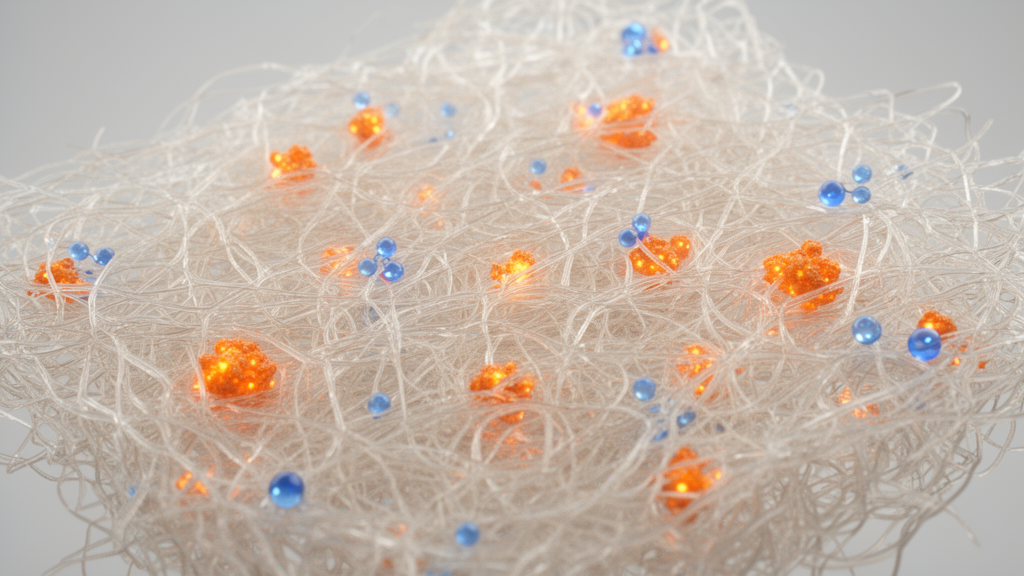
The conjugate solution was prepared by mixing cerium oxide nanoparticle solution with activated SNAP, then combining that conjugate with bacterial cellulose solution and polyethylene glycol to tune viscosity for electrospinning. The mixture was fed through a 21-gauge needle at 1.8 mL per minute under 23 kV voltage with a 12 cm working distance, and fibers were collected after three hours. Scanning electron microscopy showed a homogeneous nanofibrous morphology with an average fiber diameter of 58 nm for the composite mat, slightly finer than the 68 nm control bacterial cellulose fibers, with a more textured and rougher surface. Energy-dispersive X-ray analysis detected cerium, carbon, nitrogen, and oxygen in the mat, with cerium at 3.49 percent by weight, confirming incorporation of both the nanoparticles and the SNAP conjugate. Fourier-transform infrared spectroscopy added corroborating peaks for cellulose O-H, C-H, and C-O-C groups, Ce-O stretching between 400 and 600 cm−1, the nitroso N=O band near 1500 cm−1, and a carbonyl band near 1660 cm−1.
Antioxidant performance was quantified with a superoxide dismutase-mimicking assay in which riboflavin and methionine generate superoxide radicals that reduce nitroblue tetrazolium to a blue formazan product; scavengers suppress this color change. The CNP-SNAP-BC conjugate achieved 77.96 percent inhibition at 560 nm, outperforming bare CNPs at 62.3 percent and SNAP alone at 48.7 percent. The authors attribute this synergy to continuous redox cycling by the nanoparticles combined with additional radical scavenging by nitric oxide released from SNAP, which reacts with superoxide to form peroxynitrite.
Antimicrobial testing of the conjugate solution against Gram-positive Bacillus subtilis and Gram-negative Escherichia coli showed concentration-dependent inhibition, with 1 mM producing maximum growth suppression. The CNP-SNAP-BC conjugate inhibited 93.36 percent of Gram-positive growth but 70.97 percent of Gram-negative growth, and minimum inhibitory concentrations were reported as 0.5 mM for Gram-positive and 0.25 mM for Gram-negative bacteria. For the finished mat, a disc diffusion assay against B. subtilis yielded a 14 mm zone of inhibition after 24 hours, and microscopy of stained mat surfaces showed membrane damage, cytoplasmic leakage, and cell lysis, with a marked decrease in viable cells. The authors link the greater susceptibility of Gram-positive bacteria to ROS-mediated damage, though they describe Gram-positive cells as having thinner walls, an explanation that sits oddly with the usual structural account and should be read cautiously.
Biocompatibility was assessed with an MTT assay on HaCaT cells, a spontaneously immortalized human keratinocyte line used as an in vitro model of skin tissue interaction. Viability reached approximately 97.95 percent after exposure to the nanofiber hybrid, indicating minimal cytotoxicity in this cell culture context. Anti-inflammatory activity was probed in U937 human monocyte cells stimulated with lipopolysaccharide and then treated with 500 µg/mL of the nanofiber material. Quantitative PCR showed a 13 percent reduction in TNF-α expression relative to untreated controls, which the authors characterize as a partial anti-inflammatory effect, while IL-6 expression showed no significant decrease. The team suggests the TNF-α reduction may stem from the nanoparticles’ antioxidant capacity damping oxidative stress-driven NF-kB activation, though this remains an interpretation rather than a demonstrated mechanism.
Degradation was tracked in two parallel setups with triplicate samples. In phosphate-buffered saline at physiological temperature, a 0.8 g mat lost 78.75 percent of its mass over seven days, with loss steepest in the first two days and never exceeding roughly 10 percent per day. In a composting pit of garden soil, vegetable waste, and cow dung, a mat lost 65.71 percent of its mass over the same period. The authors attribute the rapid loss partly to SNAP and other non-cellulosic components and to structural disruptions from electrospinning that reduced crystallinity, noting that fully degrading the highly crystalline bacterial cellulose core would take weeks to months. All experiments were run in triplicate with means and standard deviations reported, and no inferential statistics were applied, so the reported differences, including the cytokine changes, rest on descriptive comparisons. The authors flag scale-up of electrospinning, in vivo animal wound healing studies, and long-term biocompatibility and immunogenicity testing for chronic implantation as planned next steps, making clear that the current evidence base is entirely in vitro.
Subject of Research: A hybrid nanofibrous mat of bacterial cellulose, cerium oxide nanoparticles, and the nitric oxide donor SNAP fabricated by electrospinning for potential biomedical use
Article Title: Nanofibrous cellulosic matte conjugated with antioxidative cerium oxide nanoparticle and S-Nitroso-N-acetyl-penicillamine (SNAP) for biomedical application
Article References: Pandey, S., Kumari, S., Gupta, S., Bit, A., Gupta, P. K., & Singh, S. (2026). Nanofibrous cellulosic matte conjugated with antioxidative cerium oxide nanoparticle and S-Nitroso-N-acetyl-penicillamine (SNAP) for biomedical application. Biotechnology for Sustainable Materials, 3(1), Article 5. https://doi.org/10.1186/s44316-026-00055-4
Image Credits: AI Generated
DOI: 10.1186/s44316-026-00055-4
Keywords: cerium oxide nanoparticles, SNAP, bacterial cellulose, electrospinning, nanofibers, antimicrobial, antioxidant, biocompatibility, biodegradability, wound dressing, nitric oxide donor, tissue engineering
News Source: Gregory Coleman. (October 29, 2026). Cerium Oxide and Nitric Oxide Donor Woven into Bacterial Cellulose Nanofibers. Scienmag.