Puerto Rico imports more than 75 percent of the food its residents consume, yet a new analysis of prices collected along the island’s entire food supply chain shows that local farmers could beat import costs on dozens of products. Economists who compiled previously unavailable private price data from distributors, supermarkets, restaurants, and farmers found that domestic producers could sell 30 of 74 surveyed agricultural goods at lower prices than the cost of importing them. The study, published in the journal Agriculture & Food Security, also estimates that substituting imports in just five of those items could have added more than 118 million dollars to Puerto Rico’s annual gross national product.
The research addresses a gap in the literature on food self-sufficiency, which the author defines as a territory’s ability to meet its food needs through domestic production. Most studies of food security under geopolitical tension, trade barriers, and environmental crises have focused on large countries with abundant land. Small countries, many of which are net food importers because of land and water scarcity, are more vulnerable to price shocks and can face food insecurity during global crises if they are isolated from large-scale producers. The central question of the new work was whether domestic food producers in such a setting can compete in price with imports at any stage of the food supply chain, rather than inferring competitiveness from aggregate self-sufficiency ratios.
Puerto Rico served as the case study because it is an upper-middle-income Caribbean economy that shares typical small-country features: land scarcity, an orientation toward industrialization, and heavy reliance on food imports. The island was colonized by the United States in 1898 and dollarized soon after. Mid-twentieth-century tax incentives attracted labor-intensive manufacturers and modernized the economy, but agriculture was left out of the growth strategy. By 2021 the sector accounted for only 0.6 percent of gross domestic product and 1.5 percent of total employment. Net agricultural income, which had represented 26 percent of total net income in 1950, fell to 1 percent by 2016. Food imports, roughly 60 percent of consumption in 1929, reached about 81 percent in the new century and totaled 4,609.3 million dollars in 2022.
To measure competitiveness directly, the researcher assembled a list of 259 types of produce usually sold in Puerto Rico, narrowed it to 100 items with high consumer demand, and then kept the 84 that could climatically be harvested on the island. Private import cost data came from Hill Brothers and Caribbean Produce, the main food distributors, and included transportation costs and tariffs, which averaged 4.7 percent for agricultural goods in 2023, although food arriving from the United States faces no tariffs. Restaurant buying costs came from a San Juan restaurant group that purchases directly from importers. Supermarket prices were averaged from the island’s largest chains, and family market prices came from a government program that encourages recipients of nutritional assistance to buy fresh produce from nearby farmers. Farmer prices, inclusive of transportation, were gathered from an online reseller platform. After excluding ten items with no available data, the final sample contained 74 products.
The analysis compared prices item by item and used paired t-tests and Wilcoxon matched-pairs signed-rank tests to assess whether average differences across the set were statistically significant. On average, farmers’ prices were 37.4 percent higher than import costs, but neither test found a statistically significant difference between the two distributions. For highly perishable items such as basil, mushrooms, and cherry tomatoes, the gap narrowed to 14.5 percent, and for mid-high perishable items such as avocado, broccoli, and watermelon, farmers were on average 4.4 percent cheaper, though neither result was statistically significant. The author notes that no large quality differences were assumed between domestic and imported produce, since neither carries a particular certification, and a robustness check recalculated all comparisons assuming each counterpart price was 10 percent lower.
The clearest openings appeared further down the chain. Farmers’ prices were generally 32.9 percent lower than supermarket prices, a statistically significant difference that grew to 41.8 percent for highly perishable and 54.5 percent for mid-high perishable goods. At the restaurant and cafeteria stage, farmers were on average 21.4 percent more expensive overall, a non-significant gap, but for mid-high perishable items they offered prices 26.2 percent lower, a statistically significant advantage. In family markets, local farmers had significantly lower prices overall and for mid-high perishable items. Direct marketing through the online reseller was the most profitable niche: farmers averaged 51.8 percent lower prices than the platform’s consumer prices, rising to 58 percent and 60.4 percent for the two perishability groups, and they could compete on nearly every item surveyed except celery and pumpkin.
Counting item by item, the study found 30 goods for which domestic farmers’ prices fell below import costs: sweet pepper, basil, eggplant, summer squash, zucchini, cauliflower, asparagus, guava, green banana, banana, tender bean, ginger, corn, mesclun, green plantain, plantain, radish, green herbs, rocket, watermelon, white mushroom, brown mushroom, portobella mushroom, tamarind, tarragon, cherry tomato, 5 × 6 tomato, grapefruit, purple taro, and benth. At the supermarket level, farmers were competitive in all of those plus 22 additional items, for a possible 52 of 74, and those advantages held even when supermarket costs were assumed 10 percent lower. Twenty-two items could be competitively sold to food service, and 24 imported goods could be substituted at the family market level, though a few advantages, including purple and yellow taro and several items at the food service stage, disappeared under the 10 percent lower-cost scenario.
The economic potential was estimated for the five competitive items that were still being heavily imported: corn, pepper, tomato, grapefruit, and taro. In 2017, domestic production covered almost none of corn consumption, 19.8 percent of pepper, roughly half of tomato, 14.8 percent of grapefruit, and 15.8 percent of taro. Substituting those imports would have generated a direct effect of 73.6 million dollars in payments to domestic farmers, and with indirect multiplier effects, using an agricultural output multiplier of 1.6 from the 2017 input-output matrix, the total could have reached 118 million dollars in economic activity in 2023. The author notes this would be recurrent activity in subsequent years, though modest relative to a gross national product of 82 billion dollars, and intended to complement rather than replace other growth strategies.
The study also examines why prices favor local production for perishables. The 30 import-level items are largely high-priced perishable crops requiring road connectivity, careful storage, and refrigerated transport, costs that raise the price of imports. Puerto Rico’s paved roads place most farms within a couple of hours of buyers, closer than the single international port in the capital. Meanwhile, cargo between US ports, including Puerto Rico, must move on US-built, US-crewed vessels under the 1920 Jones Act, which one report found raises food prices on the island by 7.2 percent on average; combined with the 4.7 percent tariff rate, trade barriers add about 11.9 percent to import costs. The competitiveness of seven products, including cauliflower, ginger, radish, and cherry tomato, may respond to these barriers, although imported agricultural inputs such as fertilizers and seeds can be harmed by the same rules.
The author recommends that the government publish weekly wholesale and retail price data so farmers and buyers can operate with near-perfect information, help farmers access land and inputs, promote organic agriculture for its higher margins, and encourage private-sector semi-processing to link farmers to the food industry. Limitations include the cost of obtaining multi-year private price data, a sample that may not represent other countries’ food preferences, and the fact that the study does not identify why self-sufficiency remains low despite revealed price competitiveness; both farmers and supermarket buyers interviewed at conferences blamed the other side’s lack of interest. Future qualitative research on buyer and farmer behavior is suggested. The findings echo studies from the Canary Islands and Scotland showing that low aggregate self-sufficiency does not prevent farmers from being price-competitive in many individual products.
Subject of Research: Price competitiveness of domestic farmers versus food imports at different stages of the supply chain in Puerto Rico
Article Title: Self-sufficiency in a Small Country? Evidence from an empirical analysis along the supply chain in Puerto Rico
Article References: Caraballo-Cueto, J. (2026). Self-sufficiency in a Small Country? Evidence from an empirical analysis along the supply chain in Puerto Rico. Agriculture & Food Security, 15(1), Article 31. https://doi.org/10.1186/s40066-026-00619-7
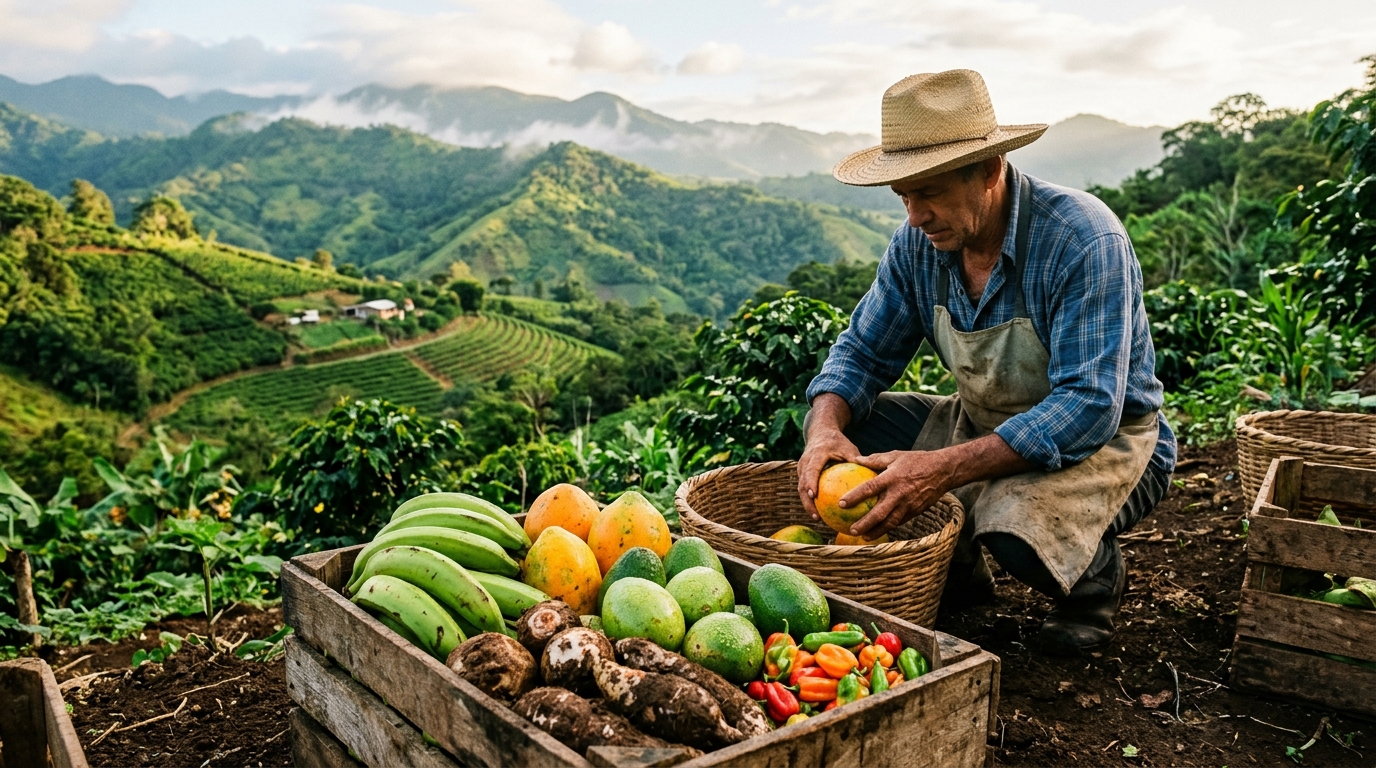
Image Credits: AI Generated
DOI: 10.1186/s40066-026-00619-7
Keywords: Puerto Rico, food self-sufficiency, supply chain, import substitution, agricultural prices, food security, small island economies, perishable crops, Jones Act, supermarkets, family markets, direct marketing
News Source: Alan Morgan. (November 6, 2026). Puerto Rican farmers can undercut imports on 30 foods, study finds. Scienmag.