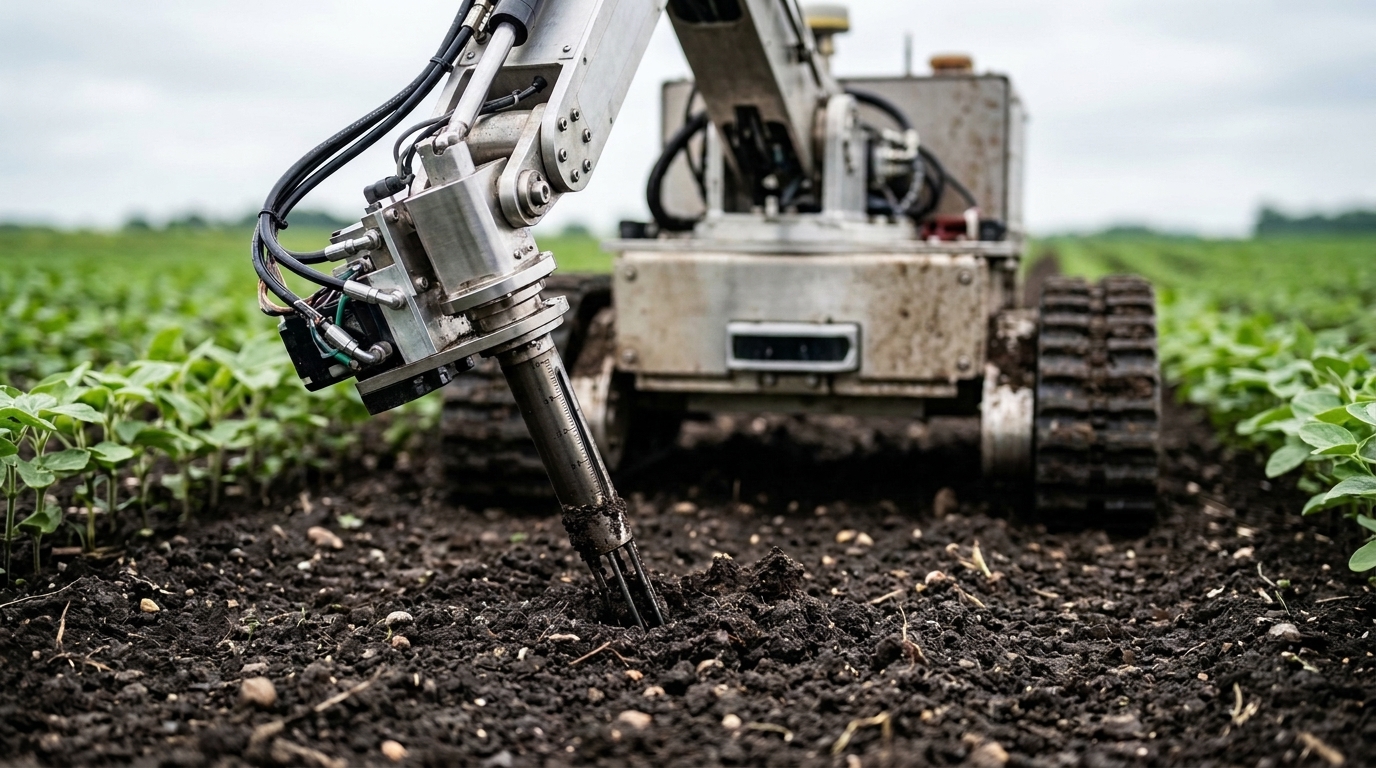
A field robot that decides for itself exactly where to push its soil sensors into the ground has been shown to match the judgment of human experts, according to a study published in the journal Artificial Intelligence in Agriculture. The research team, led by Fanguo Zeng of Huazhong Agricultural University, built a complete system that scans the soil surface with a depth camera, identifies obstacles such as stones, crop residues and green vegetation, grades the fineness of the soil, and then scores every candidate spot within reach before inserting a sensor at the best one. In field tests across rototilled fields, seedling-stage rapeseed fields and seedling-stage wheat fields in Hubei Province, China, the decision algorithm agreed with a panel of four agronomy experts on 95.78 percent of insertion points on average, reaching 96.67 percent accuracy in rototilled fields, 95.67 percent in rapeseed fields and 95 percent in wheat fields.
The problem the researchers set out to solve is deceptively simple. Most existing soil-sensing robots navigate to preset GNSS coordinates or follow grid-based paths and then insert their probes without looking closely at what is directly beneath them. When a sampling point happens to coincide with a stone, a root stubble or a patch of dense vegetation, the probe can bend or break, or the measurement can be unrepresentative of the field as a whole. Traditional laboratory analysis of soil samples remains accurate but involves complicated procedures, in-depth field sampling and long analysis cycles that limit rapid, real-time acquisition of soil parameters. Remote sensing from satellites and drones covers large areas, but data processing is complex and results are affected by cloud cover, weather and terrain. Near-ground sensors mounted on mobile platforms offer high accuracy and real-time detection, yet until now they have lacked an effective way to perceive and avoid local disturbances at the exact insertion point.
The hardware at the heart of the study is an autonomous mobile platform with four drive motors and four steering servos, a GNSS navigation unit, a Jetson Nano embedded computer and a three-axis decision-making control system. A RealSense D455 depth camera mounted beneath the chassis captures images of the soil surface within a region of interest defined by the sensor’s mechanical reach. That region is divided into a grid of four rows and five columns, with each cell sized slightly larger than the combined cross-section of the two sensors carried by the robot: a soil multi-parameter sensor that measures moisture, temperature, electrical conductivity and pH, and an oxidation-reduction potential sensor that detects the potential of the soil redox system. Once the robot arrives above a target sensing point, the camera image is analyzed, the best grid cell is chosen, and the three-axis mechanism drives the sensor vertically into the selected spot.
The perception engine is a modified semantic segmentation network the authors call GE-PIDNet. The original PIDNet architecture uses three parallel branches inspired by proportional-integral-derivative controllers: a proportional branch that extracts fine details, an integral branch that aggregates local and global context, and a derivative branch that captures high-frequency boundary features. The team made two changes. First, they replaced standard convolutions in the basic residual blocks with Ghost modules, which generate redundant features through cheap linear transformations instead of full convolutions, cutting the parameter count and floating-point operations. Second, they inserted an efficient multi-scale attention module after the second stacked Ghost module, reshaping part of the channel dimension into the batch dimension and grouping channels into sub-features so the network focuses on small stones and sparse vegetation against cluttered backgrounds.
The numbers from the ablation experiments show what those changes bought. On the study’s test set, GE-PIDNet achieved a mean pixel accuracy of 93.35 percent, a mean intersection over union of 87.18 percent, a detection speed of 66.25 frames per second and a model size of 21.87 megabytes. Compared with the original PIDNet, mean pixel accuracy rose by 10.96 percentage points, mean intersection over union by 11.48 percentage points, speed improved by 6.87 frames per second and the model shrank by 8.51 megabytes. Against mainstream alternatives trained and validated on the same data, the improved model led across the board: mean pixel accuracy exceeded BiSeNetV2 by 17.95 points, DeepLabV3+ by 7.25 points, UNet by 9.65 points and SegFormer by 6.76 points, while detection speed was higher by 8.41, 18.81, 57.79 and 42.64 frames per second respectively. The authors note that the model still misclassifies some foreign objects whose color and texture resemble vegetation, particularly yellowish residues under strong sunlight, and flag this as future work.
Beyond detecting disturbances, the system quantifies how coarse the exposed soil is, because particle size affects how consistently a probe penetrates. When soil is overly coarse, compacted or clumped, insertion resistance rises, contact between probe and particles becomes uneven, and localized abrupt changes in electrical conductivity can distort the readings. The team first uses GE-PIDNet to remove disturbance regions from the image, then extracts color statistics from the H, S and I channels, including the mean, variance and skewness of the color distribution, alongside local binary pattern texture features that capture the spatial arrangement of particles. These features are normalized and linearly weighted into a single coarseness score for each grid cell, where a larger value indicates finer and more uniform soil. The result is a spatial matrix describing soil coarseness across the field of view.
The decision layer fuses three indicators per grid cell: a hard-object index, a green-vegetation index and the soil coarseness score. The hard-object index is the proportion of pixels classified as stone, root-branch residue or other obstructions, and any cell where this exceeds 3.5 percent is excluded outright to protect the probe from bending or breakage. The vegetation index follows a piecewise rule: below a threshold, the score rises linearly with coverage, but above it the score climbs steeply toward its maximum, so cells with dense vegetation are effectively ruled out while a small amount of greenery is tolerated to avoid losing information. The three normalized indicators are then combined with weights that sum to one, and the cell with the highest fused score becomes the insertion point. Weight optimization across the independent field tests found the best combination at 0.40 for hard objects, 0.35 for green vegetation and 0.25 for soil coarseness, yielding 96.25 percent accuracy on the main test set and 95.78 percent on the independent field tests, with all tested weight combinations staying between 86.56 and 96.25 percent.
Robustness testing probed how the pipeline copes with the messiness of real fieldwork. When gamma brightness coefficients ranged from 0.67 to 1.5, accuracy held between 95 and 96.25 percent, but extreme darkness at 0.2 or strong overexposure above 1.5 dragged accuracy down to as low as 63.25 percent. Gaussian noise up to an intensity of 16 kept accuracy above 91 percent, while higher noise levels degraded texture extraction and decision consistency. Image blur proved the least damaging: with a 5-by-5 Gaussian kernel accuracy remained at 88.75 percent, and even at 25 by 25 it stayed at 81.75 percent, although severe blurring erodes the texture information needed for soil granularity classification and insertion-point localization.
The most consequential comparison came from a 30-point field experiment in which the robot’s own choice was tested against two alternatives: insertion at a fixed position beneath the robot at a preset fertilization sampling point, and manual selection by an agronomy expert. Using the expert’s measurements as the reference, the proposed method achieved coefficients of determination of 0.968 for moisture content, 0.960 for electrical conductivity, 0.954 for pH and 0.977 for oxidation-reduction potential, versus 0.933, 0.856, 0.783 and 0.879 for fixed-position insertion. Root mean squared errors fell accordingly, from 2.221 percent to 0.821 percent for moisture, from 25.263 to 13.355 microsiemens per centimeter for conductivity, from 0.055 to 0.025 for pH and from 14.082 to 6.195 millivolts for redox potential. Against laboratory reference values measured by oven-drying, potentiometric and electrode methods, the proposed method’s consistency was statistically indistinguishable from the expert’s, with coefficient-of-determination differences not exceeding 0.008 for moisture, conductivity and pH.
The authors are candid about the limits of what they built. The system perceives only visible surface disturbances, so buried stones, hardpan layers, underground roots and compacted layers can still damage a probe; they suggest ground-penetrating radar, ultrasonic sensors or force-feedback monitoring as future additions. Soil residue adhering to the sensor during continuous multi-point measurements may introduce minor errors, and the fixed scoring weights may not adapt optimally to different soil types, moisture levels and crop growth stages. The method was validated in fields with high soil surface exposure and seedling-stage crops, and its performance in post-canopy-closure crops, dense residue cover or sloped terrain remains untested. Still, the study demonstrates a complete chain from perception to decision to execution, and the measured parameters, including moisture for irrigation scheduling, electrical conductivity for salinity monitoring and pH for liming decisions, feed directly into the data foundation for variable-rate fertilization and irrigation planning.
Subject of Research: A multi-indicator scoring method that lets a field soil sensing robot autonomously select optimal sensor insertion points by detecting surface disturbances and grading soil coarseness.
Article Title: A multi-indicator scoring-based method for optimal sensor insertion point decision of field soil sensing robot
Article References: Zeng, F., Ding, Y., Zhang, Y., Dong, W., Yao, Y., Tian, Y., Luo, X., & Li, W. (2026). A multi-indicator scoring-based method for optimal sensor insertion point decision of field soil sensing robot. Artificial Intelligence in Agriculture. https://doi.org/10.1016/j.aiia.2026.09.012
Image Credits: AI Generated
DOI: 10.1016/j.aiia.2026.09.012
Keywords: soil sensing robot, sensor insertion point, GE-PIDNet, semantic segmentation, precision agriculture, soil coarseness, multi-indicator scoring, field robotics, soil moisture, electrical conductivity, deep learning, autonomous navigation
News Source: Denise Maddox. (November 6, 2026). Robot Learns Where to Stick Its Soil Sensors Safely. Scienmag.