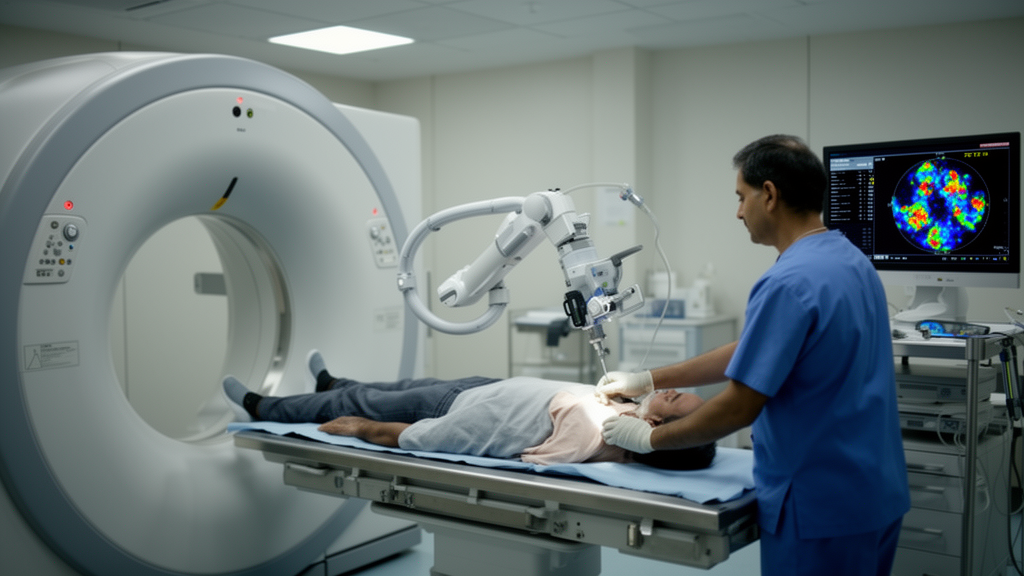
Men with suspected prostate cancer who underwent a biopsy guided by PSMA-targeted PET imaging and a robotic arm were more likely to be diagnosed with clinically significant cancer — and less likely to suffer procedural complications — than men who received a standard transrectal ultrasound-guided fusion biopsy, according to a prospective single-centre study conducted in India between January 2021 and December 2024.
The study, published in the African Journal of Urology, enrolled 216 men aged 50 to 80 years with suspected prostate cancer, defined by PSA values above 4 ng/mL, an abnormal digital rectal examination, or a PI-RADS score of 3 or higher on multiparametric MRI. All consenting patients underwent 68Ga-PSMA PET/CT. In 132 patients, the scan was used both to evaluate intraprostatic lesions and to stage for metastases. Ninety of these patients — 68 percent — showed PSMA-avid lesions with an SUVmax of 8.0 or higher and were allocated to the targeted robotic transgluteal biopsy group.
The remaining 42 patients, whose lesions showed low or negative PSMA uptake, underwent systematic 12-core transrectal ultrasound-guided biopsy. Separately, a cohort of 84 patients matched by age, PSA, and PSA density to the targeted group underwent PET/CT for metastatic staging alone and, by the study protocol, received standard TRUS-guided cognitive fusion biopsy, in which targeted cores from MRI-identified lesions were obtained under cognitive registration and supplemented by systematic sampling, for a total of 12 cores per patient.
The biopsy technique in the targeted group was distinctive. Patients were positioned prone, and the ROBIO-EX robotic arm system, a CT- and PET/CT-compatible device with five degrees of freedom, aligned a needle guide along a trajectory planned by a nuclear medicine physician on axial fused PSMA PET/CT images. After local anesthesia at the gluteal skin and prostatic capsule, an 18-gauge coaxial needle was advanced through a single transgluteal puncture, and three to four cores were taken from the most avid lesion. Needle position was confirmed by intraprocedural low-dose CT fused with the pre-acquired PET images, with no repeat PET performed unless patient movement was suspected.
In the targeted group, 86.7 percent of biopsies were positive, and clinically significant prostate cancer — defined as Gleason score of 7 or higher, tumour volume greater than 0.5 cubic centimetres, or clinical stage T3 or above — was detected in 75.7 percent of patients. In the TRUS group, 63 percent of biopsies were positive, with clinically significant cancer found in 48.1 percent, a difference the authors report as statistically significant. The TRUS approach more frequently identified Gleason 6 indolent tumours, which the researchers attribute to the random sampling nature of systematic biopsy and its known tendency toward over-diagnosis of clinically insignificant disease.
PSMA avidity itself emerged as a strong discriminator. Patients with lesions showing SUVmax of 8 or higher had positive biopsy rates of 86.7 percent and clinically significant cancer detection of 65.5 percent, compared with just 9.5 percent and 2.4 percent, respectively, among patients whose lesions showed SUVmax below 8. Among the 42 patients with non-avid lesions who underwent TRUS biopsy, only four had positive results, and only one had clinically significant cancer. The authors note that the SUVmax threshold of 8.0 aligns with prior literature linking higher tracer uptake to higher Gleason grades, and that a formal pattern-based score, such as the PRIMARY score, was not applied — lesion selection relied on SUVmax intensity alone.
Among twelve patients with PSMA-avid lesions whose targeted biopsies were negative, a subsequent TRUS biopsy detected only one case of Gleason 6 disease and no clinically significant cancer, corresponding to a reported false-negative rate of zero percent for PSMA-guided targeting, with a 95 percent confidence interval of 0 to 5.1 percent. The authors caution that this observation rests on a small subgroup with a wide confidence interval and requires confirmation in larger cohorts before it can inform decisions to forgo further biopsy.
Complications favoured the targeted approach. Periprocedural pain, hematuria, lower urinary tract symptoms, and infection were all significantly lower in the PSMA-guided group, with pain, hematuria, and lower urinary tract symptoms each significantly reduced at p values below 0.01. Intraprocedural pain was reported in 53 percent of the targeted group versus 85.5 percent of the TRUS group, while pain at 48 hours was similar between groups. No cases of febrile urinary tract infection or urinary retention occurred in the PSMA group, whereas these were observed in the TRUS group. The authors suggest that avoidance of rectal mucosal breach likely contributed to the absence of infectious complications. Gluteal hematoma occurred in 6.7 percent of targeted cases; all six were minor and self-limiting, managed conservatively with observation and compression, and none required drainage, transfusion, or intervention. The mean procedure time for targeted biopsy was 20.7 minutes.
The study’s design carries important caveats that the authors themselves enumerate. It was a single-centre, non-randomized investigation, so group allocation followed PSMA avidity rather than randomization, creating the possibility of selection bias. The two arms also differed in sampling intensity: the targeted group received only three to four cores from a single PSMA-avid lesion, while the comparator group received twelve systematic and targeted cores. The authors acknowledge that this design asymmetry, rather than PSMA guidance alone, may have contributed to some of the observed difference in detection rates. The single-puncture, purely targeted approach may also have underestimated tumour heterogeneity and missed lesions with low or absent PSMA expression. Multiparametric MRI-guided biopsy was not directly compared with the PSMA-guided technique; the authors state that TRUS cognitive fusion biopsy was chosen as the comparator because it remains the standard-of-care approach at most Indian centres, where dedicated software-based MRI-fusion platforms are not universally available or affordable.
The authors conclude that, in this prospective cohort, 68Ga-PSMA PET/CT-guided robotic single-puncture transgluteal biopsy was associated with improved detection of clinically significant prostate cancer, reduced identification of indolent disease, and fewer periprocedural complications compared with TRUS cognitive fusion biopsy, and they call for confirmation in randomized, multicentre studies. They also note that long-term outcomes and cost-effectiveness were not evaluated, and that emerging fluorine-18-labelled PSMA tracers, with their improved spatial resolution and longer half-life, may further enhance lesion detection in future applications of this approach.
Subject of Research: PSMA PET/CT-guided robotic transgluteal prostate biopsy compared with TRUS-guided fusion biopsy for detecting clinically significant prostate cancer
Article Title: 68-Gallium PSMA PET/CT–guided robotic arm–assisted transgluteal prostate biopsy versus TRUS-guided fusion biopsy: diagnosis of clinically significant cancer and comparative morbidity in a prospective Indian cohort
Article References: Sureka, S. K., Ranjan, A., Nazar, A. H., Yadav, A., Misra, A., Rustagi, S., Singh, U. P., Garg, S., Anand, A., & Pratap, P. (2026). 68-Gallium PSMA PET/CT–guided robotic arm–assisted transgluteal prostate biopsy versus TRUS-guided fusion biopsy: diagnosis of clinically significant cancer and comparative morbidity in a prospective Indian cohort. African Journal of Urology, 32(1), Article 69. https://doi.org/10.1186/s12301-026-00618-x
Image Credits: AI Generated
DOI: 10.1186/s12301-026-00618-x
Keywords: prostate cancer, PSMA PET/CT, transgluteal biopsy, robotic biopsy, TRUS fusion biopsy, clinically significant prostate cancer, SUVmax, periprocedural complications, mpMRI, India, diagnostic accuracy, urology
News Source: Ophelia Keating. (October 29, 2026). PSMA PET-guided robotic transgluteal biopsy outperforms TRUS fusion biopsy in Indian cohort. Scienmag.