


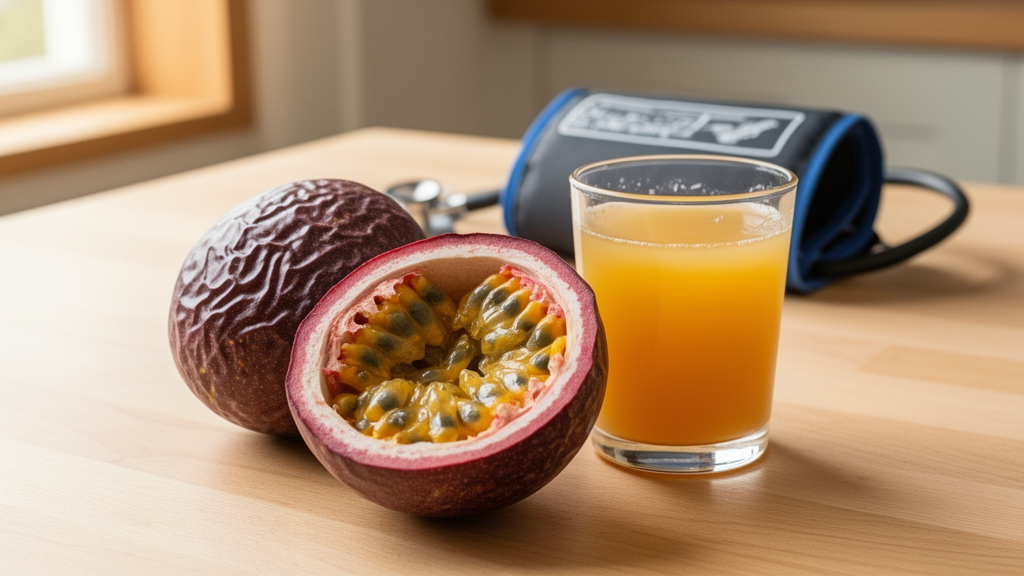
Passion fruit, the tangy staple of juices and desserts, may do more than flavor drinks. A systematic review published in Clinical Phytoscience concludes that Passiflora edulis holds promising blood pressure-lowering potential, drawing on eight studies that span rat models, isolated artery rings, and two small human trials. The review, led by Tharushi Rajapakshe and colleagues including senior author Priyanga Ranasinghe, is the first to systematically pull together the preclinical and clinical literature on this plant’s cardiovascular effects, and its verdict is cautiously encouraging: consistent signals across species and preparations, but a clinical evidence base too small and too heterogeneous to support any therapeutic recommendation.
The research team searched PubMed, Web of Science, and Scopus for studies testing any part of the passion fruit plant against blood pressure or vascular outcomes. Eight studies published between 2007 and 2023 met the inclusion criteria, originating from the United States, Japan, Brazil, Colombia, India, and Thailand. Six were preclinical investigations in spontaneously hypertensive rats and related models, involving 8 to 48 animals each, while two were randomized clinical trials with 30 to 40 participants apiece. Because the studies differed so widely in populations, extracts, doses, and measurement techniques, the authors could not pool the data statistically; the review is a narrative synthesis rather than a meta-analysis.
The preclinical findings were strikingly consistent. In Japanese work by Ichimura and colleagues, a single dose of passion fruit rind extract significantly lowered systolic blood pressure in hypertensive rats within one hour, with effects persisting up to seven hours at higher doses. A United States study of purple passion fruit peel extract found significant reductions in mean arterial pressure, systolic pressure, and diastolic pressure across all dose groups after five days of supplementation, with heart rate also falling at the two higher doses. In another trial, eight weeks of the peel extract at 50 milligrams per kilogram lowered systolic pressure by 11.5 millimeters of mercury in female hypertensive rats. Seed extract fed to rats on a high-fat diet for over sixteen weeks additionally improved cardiac structure and function, shrinking the left ventricular end-systolic dimension and improving ejection fraction and fractional shortening.
Experiments on isolated blood vessels added mechanistic depth. Seed extracts proved far more potent vasorelaxants than whole fruit preparations: in Thai studies using aortic rings from Sprague-Dawley rats, the seed ethanolic extract produced maximum relaxation of 70 to 86 percent depending on concentration, while the whole fruit extract managed only 20 to 31 percent. Peel extracts relaxed artery rings too, with hydroethanolic preparations outperforming aqueous ones, particularly in vessels stripped of their endothelium, pointing to a direct action on vascular smooth muscle. Seed extracts also protected against chemically induced hypertension in Wistar rats over seven weeks, limiting the blood pressure rise caused by an inhibitor of nitric oxide synthesis.
The review proposes four complementary mechanisms behind these effects. The first centers on gamma-aminobutyric acid, or GABA, an inhibitory neurotransmitter abundant in the rind at 2.4 to 4.4 milligrams per gram of dry weight. GABA signaling in central cardiovascular control centers can suppress sympathetic nervous outflow, which the authors link to the rapid blood pressure drops seen within hours of rind extract administration. The second mechanism involves nitric oxide, the endothelial gas molecule that relaxes blood vessels. Luteolin and piceatannol, flavonoid and stilbenoid compounds identified in the extracts, appear to enhance nitric oxide production by promoting phosphorylation of endothelial nitric oxide synthase and, in piceatannol’s case, by inhibiting arginase, an enzyme that competes for the nitric oxide synthase substrate L-arginine. Elevated nitric oxide activates soluble guanylate cyclase in smooth muscle cells, raising cyclic GMP and lowering intracellular calcium, which relaxes the vessel wall.
The third mechanism operates independently of the endothelium: activation of potassium channels. Using selective channel blockers, researchers showed that peel extract relaxation of mesenteric artery rings was significantly attenuated when calcium-activated, ATP-sensitive, or voltage-dependent potassium channels were inhibited, with calcium-activated channels playing the predominant role. Opening these channels hyperpolarizes the smooth muscle membrane, closes calcium channels, and reduces intracellular calcium, producing vasodilation even in vessels without functional endothelium. The fourth mechanism implicates the renin-angiotensin system, a hormonal cascade central to blood pressure regulation. Passion fruit seed extracts inhibited angiotensin II-induced contraction of aortic rings in a concentration-dependent manner, and the review’s authors note that at comparable concentrations the extract achieved greater suppression of angiotensin II-mediated contraction than losartan, a standard angiotensin receptor blocker, an effect attributed to the extracts’ high phenolic content.
The human evidence, though limited, is what gives the review its translational claim. In a randomized, double-blind, placebo-controlled trial in India, 40 patients with type 2 diabetes received 220 milligrams per day of peel extract or placebo. The treated group showed a significant mean systolic reduction of 7.7 millimeters of mercury, along with improvements in fasting and postprandial blood glucose, while diastolic pressure did not change significantly. A second four-week trial enrolled 30 hypertensive adults aged 40 to 75 with stage 1 or 2 essential hypertension, randomizing them to 400 milligrams per day of peel extract or placebo. The treated group achieved reductions of 30.9 millimeters of mercury in systolic and 24.6 millimeters of mercury in diastolic pressure, and 86.7 percent of participants reached clinically meaningful thresholds of at least 10 and 9 millimeters of mercury respectively. Neither trial reported adverse effects or electrocardiographic changes in the intervention arms.
Those headline numbers deserve careful framing. The review’s own risk-of-bias assessment tempers enthusiasm considerably. Both clinical trials showed variable methodological quality: the hypertension trial was judged to have some concerns overall, mainly due to insufficient reporting of the randomization process and the absence of a publicly available protocol, while the diabetes trial was judged at high risk of bias because of incomplete outcome data from participant attrition and the exclusion of withdrawals from the primary analysis.
Subject of Research: Systematic review of preclinical and clinical evidence on the blood pressure-lowering potential of Passiflora edulis
Article Title: Translational evidence for the antihypertensive potential of Passiflora edulis: a systematic review of preclinical and clinical studies
Article References: Rajapakshe, T., Weerasekara, P., Abayawickrama, V., & Ranasinghe, P. (2026). Translational evidence for the antihypertensive potential of Passiflora edulis: a systematic review of preclinical and clinical studies. Clinical Phytoscience, 12(1), Article 21. https://doi.org/10.1186/s40816-026-00436-2
Image Credits: AI Generated
DOI: 10.1186/s40816-026-00436-2
Keywords: Passiflora edulis, passion fruit, hypertension, blood pressure, systematic review, vasorelaxation, GABA, nitric oxide, potassium channels, renin-angiotensin system, phytotherapy, preclinical studies
News Source: Ophelia Keating. (October 29, 2026). Passion Fruit Shows Blood Pressure Promise, but Human Evidence Remains Thin. Scienmag.



