• HOME
  • NEWS
  • EXPLORE
    • CAREER
      • Companies
      • Jobs
    • EVENTS
    • iGEM
      • News
      • Team
    • PHOTOS
    • VIDEO
    • WIKI
  • BLOG
  • COMMUNITY
    • FACEBOOK
    • INSTAGRAM
    • TWITTER
Monday, October 5, 2026
BIOENGINEER.ORG
No Result
View All Result
  • Login
  • HOME
  • NEWS
  • EXPLORE
    • CAREER
      • Companies
      • Jobs
        • Lecturer
        • PhD Studentship
        • Postdoc
        • Research Assistant
    • EVENTS
    • iGEM
      • News
      • Team
    • PHOTOS
    • VIDEO
    • WIKI
  • BLOG
  • COMMUNITY
    • FACEBOOK
    • INSTAGRAM
    • TWITTER
  • HOME
  • NEWS
  • EXPLORE
    • CAREER
      • Companies
      • Jobs
        • Lecturer
        • PhD Studentship
        • Postdoc
        • Research Assistant
    • EVENTS
    • iGEM
      • News
      • Team
    • PHOTOS
    • VIDEO
    • WIKI
  • BLOG
  • COMMUNITY
    • FACEBOOK
    • INSTAGRAM
    • TWITTER
No Result
View All Result
Bioengineer.org
No Result
View All Result
Home NEWS Science News Health

Prostate cancer regulator plays role in COVID-19, providing a promising treatment lead

Bioengineer by Bioengineer
December 21, 2020
in Health
Reading Time: 3 mins read
0
IMAGE
Share on FacebookShare on TwitterShare on LinkedinShare on RedditShare on Telegram

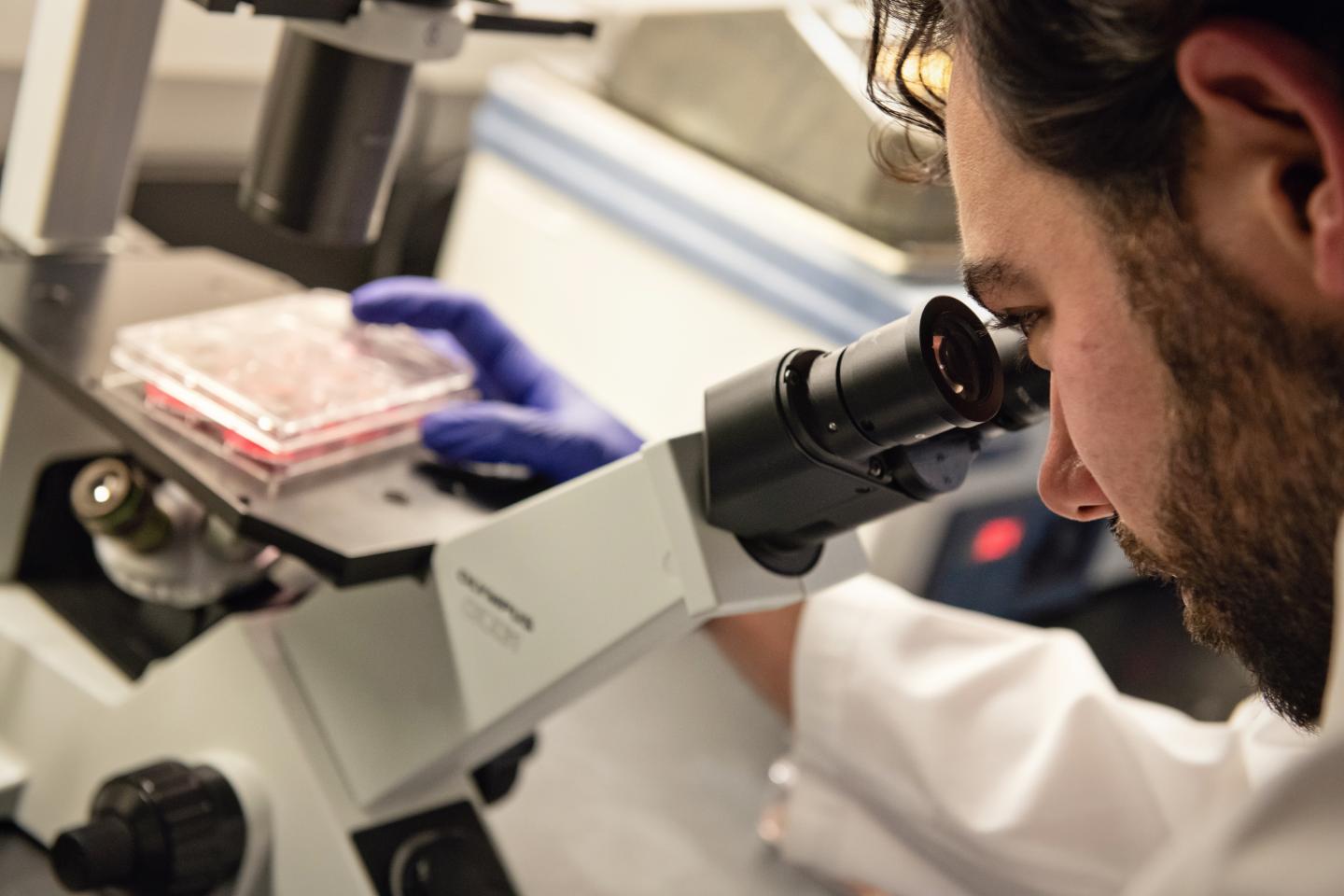
Clinical trials underway are testing whether drugs that target the androgen receptor — successful in controlling prostate cancer — could also work against the coronavirus
IMAGE

Credit: University of Michigan Rogel Cancer Center

ANN ARBOR, Michigan — By taking a lesson from prostate cancer, researchers now have a promising lead on a treatment for COVID-19.

Two proteins, ACE2 and TMPRSS2, help the coronavirus gain entry and replicate within cells. TMPRSS2 is well-known to Arul Chinnaiyan, M.D., Ph.D. His lab discovered that TMPRSS2 fuses with the ETS gene to drive more than half of all prostate cancers. They also knew that TMPRSS2 was regulated by the androgen receptor.

So when cancer research shut down in the spring, Chinnaiyan’s lab turned its attention to the coronavirus. With a grant from the National Cancer Institute, the team used its existing knowledge and resources to determine how TMPRSS2 was regulated in the lungs.

They found that, just like in prostate cancer, TMPRSS2 is regulated by the androgen receptor in the lungs. And notably, blocking the androgen receptor led to lower expression of TMPRSS2 as well as ACE2, which led to decreased coronavirus infection in mice and cellular models. Results are published in PNAS.

“What’s especially appealing about this is that anti-androgen treatments are already FDA-approved. This opens the door to look at these drugs, which we know work in prostate cancer, as potential COVID-19 treatments,” says Chinnaiyan, director of the Michigan Center for Translational Pathology.

Using cell lines infected with SARS-CoV-2, the virus that causes COVID-19, researchers found that inhibitors of androgen receptor, including enzalutamide, apalutamide and darolutamide, inhibited the coronavirus infection.

They also tested a class of drugs designed to inhibit or degrade BET proteins. BET protein activity is essential for androgen signaling and these drugs are being looked at for prostate cancer. In cell lines infected with coronavirus, the BET inhibitors decreased androgen signaling and inhibited viral infection.

The findings also provide some explanation for observations that COVID-19 affects men more than women. Researchers looked at human lung tissue and found higher androgen receptor signaling in men than women. They also found androgen signaling was highest in men over 70 and in smokers.

“This explains why elderly men who are smokers are more vulnerable to COVID-19 infection. High androgen receptor signaling allows the virus to gain entry and replicate more easily. This may explain why the disease is often particularly severe in older men,” Chinnaiyan says.

Several clinical trials are underway testing androgen receptor inhibitors as a treatment for COVID-19, and additional trials are being developed to look at BET inhibitors.

###

Additional authors: Yuanyuan Qiao, Xiao-Ming Wang, Rahul Mannan, Sethuramasundaram Pitchiaya, Yuping Zhang, Jesse W. Wotring, Lanbo Xiao, Dan R. Robinson, Yi-Mi We, Jean Ching-Yi Tien, Xuhong Cao, Stephanie A. Simko, Ingrid J. Apel, Pushpinder Bawa, Steven Kregel, Sathiya P. Narayanan, Gregory Raskind, Stephanie J. Ellison, Abhijit Parolia, Sylvia Zelenka-Wang, Lisa McMurry, Fengyun Su, Rohit Mehra, Jonathan Z. Sexton

Funding: Prostate Cancer Foundation, National Cancer Institute grants including a COVID-19 supplement to P30-CA046592, P50-CA186786, R35-CA231996, and U01-CA 214170.

Disclosure: None

Reference: PNAS, doi: 10.1073/pnas.2021450118

Resources:

University of Michigan Rogel Cancer Center, http://www.rogelcancercenter.org

Michigan Health Lab, http://www.MichiganHealthLab.org

Michigan Medicine Cancer AnswerLine, 800-865-1125

Media Contact
Nicole Fawcett
[email protected]

Original Source

https://labblog.uofmhealth.org/lab-report/prostate-cancer-regulator-plays-role-covid-19-providing-a-promising-treatment-lead

Related Journal Article

http://dx.doi.org/10.1073/pnas.2021450118

Tags: Infectious/Emerging DiseasesMedicine/HealthMolecular BiologyProstate Cancer
Share12Tweet8Share2ShareShareShare2

Related Posts

Skin Patch Shows Promise Against Childhood Tics in Major Meta-Analysis

Skin Patch Shows Promise Against Childhood Tics in Major Meta-Analysis

October 5, 2026
Five Simple Steps Could Help Doctors Prevent Chronic Disease in Minutes

Five Simple Steps Could Help Doctors Prevent Chronic Disease in Minutes

October 5, 2026

Small Thyroid Cancers Grow When Surgery Is Delayed, Study Warns

October 5, 2026

Why Leg Veins Fail: New Review Maps the Hidden Mechanics of Chronic Venous Insufficiency

October 5, 2026
Please login to join discussion

POPULAR NEWS

  • Alloys That Shrink Their Own Grains: New PIX Mechanism Refines Metals With Heat Alone

    Alloys That Shrink Their Own Grains: New PIX Mechanism Refines Metals With Heat Alone

    29 shares
    Share 12 Tweet 7
  • Endurance Exercise Reshapes the Liver in Males and Females Through Distinct Molecular Routes

    29 shares
    Share 12 Tweet 7
  • Single Transcription Factor PU.1 Rapidly Converts Fibroblasts into Macrophage-Lineage Cells

    29 shares
    Share 12 Tweet 7
  • New Scale Measures How Ready Nurse Educators Really Are for the AI Era

    29 shares
    Share 12 Tweet 7

About

We bring you the latest biotechnology news from best research centers and universities around the world. Check our website.

Follow us

Recent News

Alloys That Shrink Their Own Grains: New PIX Mechanism Refines Metals With Heat Alone

Endurance Exercise Reshapes the Liver in Males and Females Through Distinct Molecular Routes

Single Transcription Factor PU.1 Rapidly Converts Fibroblasts into Macrophage-Lineage Cells

Subscribe to Blog via Email

Success! An email was just sent to confirm your subscription. Please find the email now and click 'Confirm' to start subscribing.

Join 85 other subscribers
  • Contact Us

Bioengineer.org © Copyright 2023 All Rights Reserved.

Welcome Back!

Login to your account below

Forgotten Password?

Retrieve your password

Please enter your username or email address to reset your password.

Log In
No Result
View All Result
  • Homepages
    • Home Page 1
    • Home Page 2
  • News
  • National
  • Business
  • Health
  • Lifestyle
  • Science

Bioengineer.org © Copyright 2023 All Rights Reserved.