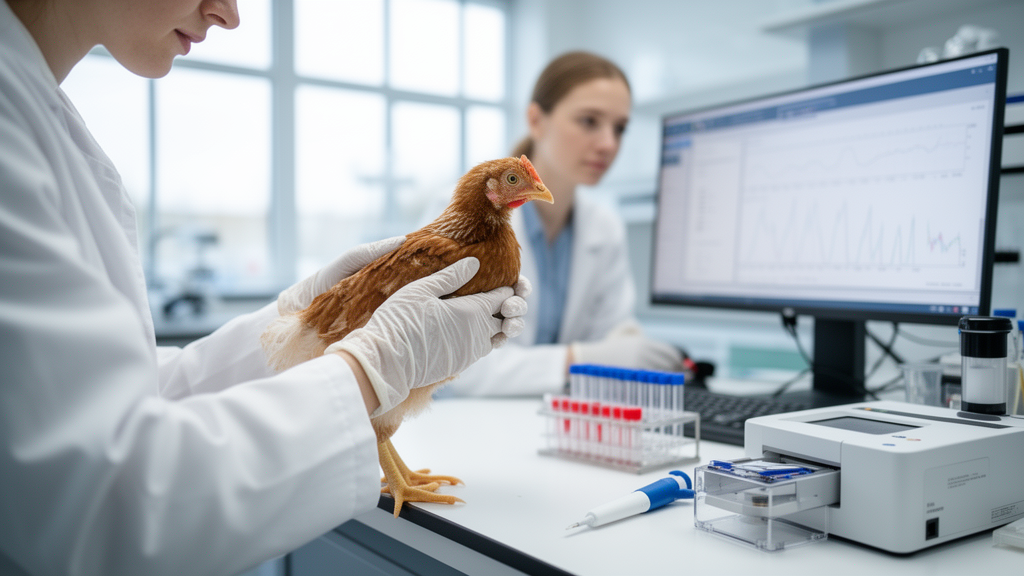
A systematic review of 38 studies has found that only a small handful of gene variants in chickens show consistent associations with growth, carcass and reproductive traits, despite more than a decade of research into four candidate genes. The review, published in BMC Veterinary Research, examined polymorphisms in the genes encoding growth hormone (GH), its receptor (GHR), prolactin (PRL) and insulin-like growth factor-1 (IGF-1), and concluded that just two locus–trait combinations were significant in more than one independent study.
The authors searched Scopus and Web of Science for studies published between January 2013 and August 2026, including any that reported associations between polymorphisms in the four genes and growth, carcass or reproductive traits in chickens. The 38 English-language studies that met the criteria came mostly from Asia, Africa and the Middle East, and more than half examined indigenous breeds. Polymerase chain reaction–restriction fragment length polymorphism genotyping was the most common laboratory method, used in 22 of the studies.
To map the structure of the literature, the team used a co-occurrence network analysis with the Louvain community-detection algorithm. This grouped the field into two distinct clusters: a growth-oriented community centred on GH, GHR and IGF-1, and a reproduction-oriented community centred on PRL, the gene whose protein product regulates incubation behaviour and egg laying.
The most frequently significant candidates were regulatory variants of PRL and IGF-1. The PRL promoter 24-bp insertion/deletion and the g.2402 C>T polymorphism were most often significant for reproductive traits. For growth, IGF-1 variants in the 5′ untranslated region were associated with growth in three of the four studies that tested them, while promoter variants showed less consistent results. Evidence for GH was spread across many loci and traits, and evidence for GHR was limited.
Consistency, however, remained scarce. Only two locus–trait combinations were significant in more than one independent study, a finding the review authors highlight as a central weakness of the candidate-gene approach as currently practised. The review distinguished replication within a study from replication across independent studies, and it was the stricter, cross-study form of validation that proved rare.
The review also assessed how completely studies reported the data needed for synthesis, using eight core data elements. Reporting completeness was high overall, but Hardy–Weinberg equilibrium testing, covariate adjustment and effect sizes were reported less consistently. The absence of effect sizes and baseline performance figures means that even where associations were statistically significant, their practical magnitude for breeding decisions often cannot be judged from the published record.
The authors conclude that few studies reported the effect sizes, baseline performance or independent validation needed to support marker-assisted selection. Without that information, significant associations cannot be translated into reliable genetic improvement tools, even for the variants that appear most promising.
Looking forward, the review suggests that once validated, these variants may be most useful as prior biological information in genomic selection models, particularly for indigenous breeds. In that role, known candidate polymorphisms would inform genomic predictions rather than serve as standalone markers, a use that may be better suited to the inconsistent single-study evidence that currently characterises much of the field.
Subject of Research: Systematic review of associations between GH, GHR, PRL and IGF-1 gene polymorphisms and growth, carcass and reproductive traits in chickens
Article Title: Polymorphisms in GH, GHR, PRL, and IGF-1 genes and their associations with growth, carcass, and reproductive traits in chickens: a systematic review
Article References: Yoniwo, S. N., Muluh, W. D., Katte, N. K. Y., Massawa, J., Hako, B. A. T., & Awah-Ndukum, J. (2026). Polymorphisms in GH, GHR, PRL, and IGF-1 genes and their associations with growth, carcass, and reproductive traits in chickens: a systematic review. BMC Veterinary Research. https://doi.org/10.1186/s12917-026-06051-0
Image Credits: AI Generated
DOI: 10.1186/s12917-026-06051-0
Keywords: chickens, systematic review, candidate genes, PRL, IGF-1, growth hormone, polymorphisms, indigenous breeds, marker-assisted selection, genomic selection, reproductive traits, growth traits
News Source: Juliet Wilcox. (October 29, 2026). PRL and IGF-1 Gene Variants Emerge as Leading Candidates in Chicken Genetics Review. Scienmag.