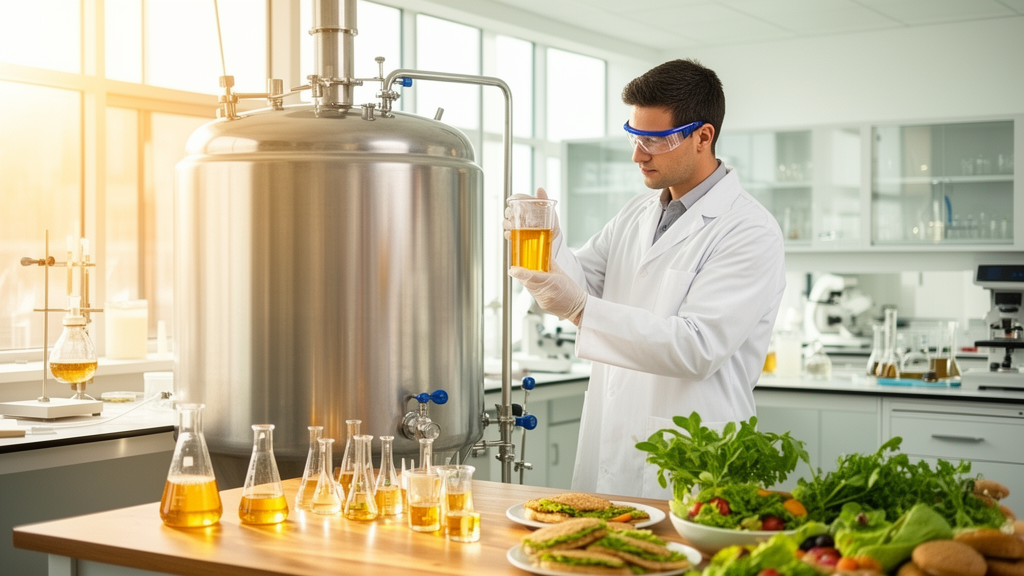
Lab-grown protein that mimics the color, taste, and texture of meat. Egg white substitutes for baked goods. Food colorants that replace beta-carotene extracted from carrots. These are some of the products now emerging from precision fermentation, a technology that develops tailored food ingredients in the laboratory and, if adapted to large-scale production, could contribute to reducing global food insecurity by creating affordable, sustainable products that supplement those delivered by traditional agriculture. That is the picture drawn by researchers at the University of Illinois Urbana-Champaign, who argue that the technology stands at a turning point between niche, high-value applications and a much broader role in the food system.
The challenge they are responding to is a formidable one: producing food for a growing world population amid climate change and supply chain constraints is a tall order, and the question of whether biotechnology can be part of the solution is increasingly urgent. Precision fermentation itself is not new. It has been around for decades, but until recently it was used primarily in the production of fuel and animal feed rather than food. Regular yeast used for corn ethanol fermentation, for example, cannot process non-edible grain sources such as corn stover, but with metabolic engineering it is possible to produce yeast strains that can ferment sugar from cellulosic biomass, unlocking energy from material that would otherwise go unused.
The distinction between traditional and precision fermentation lies in the biology of the production organisms. Precision fermentation, by contrast, uses genetically engineered microorganisms whose cellular metabolism is redirected to produce specific food ingredients. One prominent example is leghemoglobin, an alternative protein used to give plant-based burgers a red, blood-like color. More recently, the technology has been applied to food production more broadly, including alternative proteins, vitamins, and nutrients, expanding its reach from the fuel tank and the feed trough to the dinner plate.
Researchers at the University of Illinois Urbana-Champaign position themselves at the forefront of these developments, and several facilities on campus provide resources for precision fermentation technology and applications. Among them are the NSF iBioFoundry and the Integrated Bioprocessing Research Laboratory, known as IBRL. The IBRL is a research and development facility that helps companies bridge the gap from basic discovery to commercialization of bioproducts.
According to Beth Conerty, IBRL Associate Director of Business Development, precision fermentation is one of the facility’s core competencies and one of its busiest areas. “Currently, we’re seeing a lot of interest from the major consumer packaged goods companies on replacing traditionally petroleum-derived ingredients with natural alternatives, including food dyes, non-caloric sweeteners, and preservatives,” she said. That demand signals a shift in the food industry: companies that once relied on petrochemical routes to make ingredients that end up in everyday packaged foods are now looking to engineered microbes to deliver the same molecules from biological sources.
The university’s ambitions extend internationally. The U. of I. has co-established a research institute in Singapore, the Centre for Precision Fermentation and Sustainability, known as PreFerS. The center is funded by a $15 million grant from Singapore’s National Research Foundation and is administered through the Illinois Advanced Research Center at Singapore Ltd., a U. of I.-affiliated non-profit organization. Yong-Su Jin, professor in the Department of Food Science and Human Nutrition, is a program lead of PreFerS, and the collaboration reflects the particular pressures facing a nation with almost no agricultural land of its own.
“Singapore is a small country with no agriculture, so they are very interested in using precision fermentation for food production,” Jin said. “The center focuses on advancing technologies for microbial cell engineering to produce targeted nutritional molecules, including alternative proteins and vitamins.
In a recent publication, Jin outlined the steps necessary to bring specialized precision fermentation food products to market. He highlights the core concept of the minimum viable product, which indicates a product that provides value for the consumer and can be produced safely and economically. He also introduces the precision fermentation ingredient pyramid, a framework comprising three tiers based on production volume, market value, and functionality. The structure is deliberately practical: it maps where fermentation-derived ingredients can enter the food economy first, and where they must eventually go if the technology is to matter at scale.
At the pyramid’s top sit high-value food ingredients, traditionally obtained through plant extraction or chemical synthesis. An example is beta-carotene, used as a food colorant and antioxidant; extracting it from carrots is inefficient and expensive, whereas microbial production can provide an economical, sustainable approach. The mid-tier consists of functional ingredients, products that deliver specific properties in a concentrated way. Ovalbumin, the main protein in egg whites, is widely used for baked goods and other food products, and precision fermentation can be a desirable way to produce functional proteins that mimic the natural product without relying on animal-derived ingredients. The bottom tier holds commodity ingredients, typically inexpensive to produce with traditional methods. Even here, precision fermentation can improve microbial production systems, for example to develop single-cell proteins as edible biomass for food ingredients, and the technology is already used to produce amino acids such as lysine for animal feed and citric acid for canning.
“Most products are currently developed in the high-value category, which is a small market,” Jin said. “My vision is to fill the whole pyramid, including commodity ingredients, within the next 10 to 20 years to obtain greater environmental impact.” Reaching that goal, he argues, requires a change in how the field works. It is critical to consider consumer demand and economic potential when developing new products, he added. “Scientists typically study fundamental technology, while consumers in the marketplace are looking for mature products. But if we start with consumer input, we can ensure greater acceptance. We also need to conduct techno-economic analysis to evaluate market viability. This is a paradigm shift that is needed to advance the precision fermentation industry.” Jin is collaborating with campus facilities like IBRL and industry partners to research and develop consumer products, and he contends that a novel approach to precision fermentation research and application is crucial to turning the technology into a viable platform for sustainable food production. The article, “Minimum viable products in precision fermentation: defining translational milestones for food biotechnology,” is published in Current Opinion in Biotechnology.
Subject of Research: Precision fermentation using engineered microorganisms to produce food ingredients, alternative proteins and vitamins
Article Title: Does the future of food production start in the lab?
Article References: Does the future of food production start in the lab?. Original publication (Bibliographic details unavailable.)
Image Credits: AI Generated
DOI: Not provided
Keywords: precision fermentation, food biotechnology, alternative proteins, metabolic engineering, food security, sustainable food production, microbial cell engineering, ingredient pyramid, minimum viable product, University of Illinois, Singapore PreFerS, Current Opinion in Biotechnology
News Source: Denise Maddox. (October 27, 2026). Precision Fermentation Moves From Fuel and Feed to the Future of Food. Scienmag.