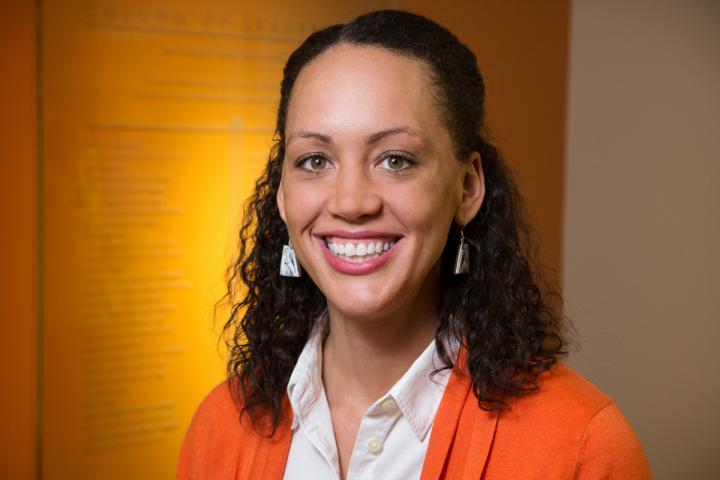
Credit: Photo by L. Brian Stauffer
CHAMPAIGN, Ill. — A new study of 736 low-income pregnant women in Illinois found that more than one-third of those who reported thoughts of self-harm did not have elevated levels of depression, according to a commonly used health questionnaire.
“One would think that having suicidal thoughts would be associated with depression, but for a large proportion of the women in our sample that wasn’t the case,” said University of Illinois social work professor Karen M. Tabb, the study’s lead author. “Not all women who report suicidal ideation are going to meet the threshold for depression.”
Women in the study were assessed for depressive symptoms using the Edinburgh Postnatal Depression Scale, a 10-item questionnaire. Under a state mandate enacted in 2008, the Postpartum Mood Disorders Prevention Act, primary care doctors, obstetricians, pediatricians and other front-line clinicians in Illinois use the Edinburgh scale to screen women for perinatal depression during pregnancy and after delivery.
Each of the women in the study completed at least one depression screening in English or in Spanish at clinics run by the Champaign-Urbana Public Health District, which serves about 2,300 pregnant and postpartum women each month.
All of the women in the study were enrolled in the Women, Infants and Children Special Supplemental Nutrition Program, which serves nearly half of all pregnant women in the U.S. To be eligible for WIC benefits, women must have incomes less than 185% of the federal poverty level and be pregnant or have children under age 5.
About 4.6% of women in the sample reported suicidal thoughts, according to the study, which will be published in the Journal of Affective Disorders.
The prevalence of suicidal thoughts among the Illinois women was higher than that reported by two prior studies, which found prenatal suicidal ideation rates of 2.7% and 3.8% in samples that included both low- and high-income women.
A possible reason for the higher incidence among the Illinois women could be related to the state mandate, which requires universal screening of all pregnant women as opposed to selective screening of only those women who are in distress, the researchers wrote.
For every 1-point increase in patients’ depression scores on the questionnaire, the Illinois women’s odds of reporting suicidal thoughts rose by 39%, Tabb and her co-authors found.
When the researchers adjusted for risk factors such as smoking status, age, education and income, patients’ odds of reporting suicidal ideation increased by 43% for every 1-point increase in their depression score.
However, 35% of the women with suicidal thoughts did not have scores on the depression questionnaire that warranted concern. This means that many women who are struggling with suicidal thoughts could be overlooked if they are not assessed for suicidal ideation as well as depressive symptoms, the researchers said.
Suicidal ideation is a significant risk factor and often a precursor for suicide attempts, recent studies showed, making it vital that thorough mental health evaluations be performed during routine clinic visits, the researchers wrote.
“Based on our findings, we suggest that practitioners should consider using instruments that screen for suicidal ideation as well as for depression to identify women who need mental health referrals and follow-up,” Tabb said.
Perinatal depression, which can begin during pregnancy or up to a year after childbirth, is believed to affect up to 20% of women worldwide, making it one of the most common complications of childbearing.
Although some recent studies suggested that suicidal ideation is more prevalent among low-income women, few population-level studies have been conducted thus far and more are needed to validate possible disparities and develop appropriate interventions, Tabb and her co-authors wrote.
Tabb’s team is developing a perinatal depression registry, a database that tracks women’s depression symptoms, adverse birth outcomes, health conditions and known risk factors such as obesity and smoking. The registry will enable the researchers to examine the incidence of perinatal depression and suicidality among low-income populations and measure the strength of various risk factors over time.
Management of patients with suicidal ideation is as important as detection, and the registry enables case managers and other clinicians at CUPHD to jointly monitor their patients, Tabb said.
“Our study adds to a growing body of evidence that calls for collaborative treatment models – patient-centered teams led by behavioral care case managers who work with consulting psychiatrists and use depression registries to track patients’ symptoms and care to ensure that no one fall through the cracks,” Tabb said.
###
Co-authors of the study were Amelia R. Gavin, University of Washington; Dr. Alexandre Faisal-Cury, University of Sao-Paulo; Tumani Malinga, University of Botswana; Brandon Meline, CUPHD; Dr. Hsiang Huang, Harvard Medical School; Nichole Nidey, University of Iowa Health Care; and Ya-Fen Chan, University of Washington.
Media Contact
Sharita Forrest
[email protected]
Original Source
https:/
Related Journal Article
http://dx.