• HOME
  • NEWS
  • EXPLORE
    • CAREER
      • Companies
      • Jobs
    • EVENTS
    • iGEM
      • News
      • Team
    • PHOTOS
    • VIDEO
    • WIKI
  • BLOG
  • COMMUNITY
    • FACEBOOK
    • INSTAGRAM
    • TWITTER
Thursday, July 2, 2026
BIOENGINEER.ORG
No Result
View All Result
  • Login
  • HOME
  • NEWS
  • EXPLORE
    • CAREER
      • Companies
      • Jobs
        • Lecturer
        • PhD Studentship
        • Postdoc
        • Research Assistant
    • EVENTS
    • iGEM
      • News
      • Team
    • PHOTOS
    • VIDEO
    • WIKI
  • BLOG
  • COMMUNITY
    • FACEBOOK
    • INSTAGRAM
    • TWITTER
  • HOME
  • NEWS
  • EXPLORE
    • CAREER
      • Companies
      • Jobs
        • Lecturer
        • PhD Studentship
        • Postdoc
        • Research Assistant
    • EVENTS
    • iGEM
      • News
      • Team
    • PHOTOS
    • VIDEO
    • WIKI
  • BLOG
  • COMMUNITY
    • FACEBOOK
    • INSTAGRAM
    • TWITTER
No Result
View All Result
Bioengineer.org
No Result
View All Result
Home NEWS Science News Chemistry

Performing optical logic operations by a diffractive neural network

Bioengineer by Bioengineer
May 26, 2020
in Chemistry
Reading Time: 2 mins read
0
IMAGE
Share on FacebookShare on TwitterShare on LinkedinShare on RedditShare on Telegram

IMAGE

Credit: by Chao Qian, Xiao Lin, Xiaobin Lin, Jian Xu, Yang Sun, Erping Li, Baile Zhang, and Hongsheng Chen

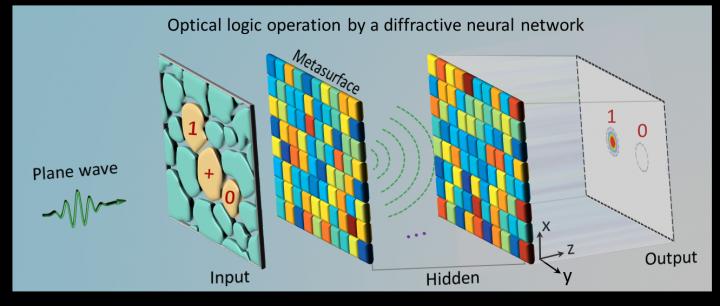
Optical logical operations have sparked major interest in the past decades since it can enable many applications, particularly those involving high-throughput and on-the-fly data processing such as secured wireless communication and autonomous driving. However, the reported optical logic gates rely heavily on the precise control of input light/pump light, including the phase, polarization, and amplitude. Due to the complexity and difficulty in these precise controls, the two output states may suffer from an inherent instability and a low contrast ratio of intensity. Moreover, the miniaturization of optical logic gates would become difficult, if the extra bulky apparatus for these controls are considered. As such, it is desirable, albeit challenging, to get rid of these complicated controls and to achieve full logic functionality in a compact photonic system.

In a new paper published in Light Science & Application, scientists from the Interdisciplinary Center for Quantum Information, Zhejiang University, China, and co-workers introduced a simple yet universal design strategy, namely diffractive neural network, to realize all seven basic optical logic operations in a same compact system, simply using a plane wave as input signal. The diffractive neural network is implemented by a compound Huygens’ metasurface, and it can partially mimic the functionality of artificial neural network. After training, the compound metasurface can directionally scatter or focus the input encoded light into one of the two designated small areas/points, one of which represents logic state ‘1’ and the other stands for ‘0’. As a conceptual demonstration, three basic logic gates, i.e., NOT, OR, and AND, are experimentally verified using a two-layered high-efficiency dielectric metasurface at microwave.

Compared with previous works, this design strategy features two distinct advantages. First, the realization of optical logic operations here gets rid of the complicated and precise control of the features of input light; such a scheme is thus totally different from previous works. Moreover, the design of the input layer is very general and powerful, and it can be flexibly modified into other user-favored and programmable forms. Second, the proposed strategy can enable complete logic functionalities in a single optical network, if the transmittance state of the input layer is simply tunable, e.g., electrically tunable if the optical mask is constructed by a spatial light modulator. Therefore, the revealed universal design strategy has the potential to facilitate a single miniaturized programmable photonic processor for arbitrary logic operations.

The scientists believe that the full-featured optical logical gates make a big step for further miniaturized, high computing density and ultrafast computing element, promised by nanophotonic circuits and meta-structures. Beyond that, the proposed approach will also lead to a broad scope of applications, such as real-time object recognition in surveillance system, and intelligent wave shaping inside biological tissue in microscope imaging.

###

Media Contact
Hongsheng Chen
[email protected]

Related Journal Article

http://dx.doi.org/10.1038/s41377-020-0303-2

Tags: Chemistry/Physics/Materials SciencesOptics
Share12Tweet8Share2ShareShareShare2

Related Posts

Graz University of Technology Deciphers the Structural Secrets of MOF Thin Films — Chemistry

Graz University of Technology Deciphers the Structural Secrets of MOF Thin Films

July 2, 2026
Breaking Thermodynamic Limits: Wavelength-Driven Catalysis Advances Ammonia Synthesis — Chemistry

Breaking Thermodynamic Limits: Wavelength-Driven Catalysis Advances Ammonia Synthesis

July 2, 2026

From Quantum Mechanics to AI-Powered Materials Discovery: MARVEL Marks 12 Years of Transforming Computational Science

July 2, 2026

Djire Recognized with National Award for Outstanding Contributions in Research and Teaching

July 2, 2026
Please login to join discussion

POPULAR NEWS

  • Detection of EDCs in Breast Milk and Infant Urine Up to Six Months Highlights Early Exposure Risks

    77 shares
    Share 31 Tweet 19
  • Saying Goodbye to PGY-6: Pediatric Fellowship Realities

    103 shares
    Share 41 Tweet 26
  • New Drug Candidate Developed at McMaster Shows Potential for Treating Brain Cancer

    58 shares
    Share 23 Tweet 15
  • KTU Researchers Explore Ultrasound’s Role in Enhancing Blood Flow Beyond Diagnostics

    53 shares
    Share 21 Tweet 13

About

BIOENGINEER.ORG

We bring you the latest biotechnology news from best research centers and universities around the world. Check our website.

Follow us

Recent News

Steatosis Drives Liver Metastasis Diversity in CRC

Unlocking the Mysteries of Alzheimer’s Disease

Pensoft Introduces New Peer-Reviewed Journal of Regeneration to Advance Restorative Biology Across Species

Subscribe to Blog via Email

Enter your email address to subscribe to this blog and receive notifications of new posts by email.

Join 83 other subscribers
  • Contact Us

Bioengineer.org © Copyright 2023 All Rights Reserved.

Welcome Back!

Login to your account below

Forgotten Password?

Retrieve your password

Please enter your username or email address to reset your password.

Log In
No Result
View All Result
  • Homepages
    • Home Page 1
    • Home Page 2
  • News
  • National
  • Business
  • Health
  • Lifestyle
  • Science

Bioengineer.org © Copyright 2023 All Rights Reserved.