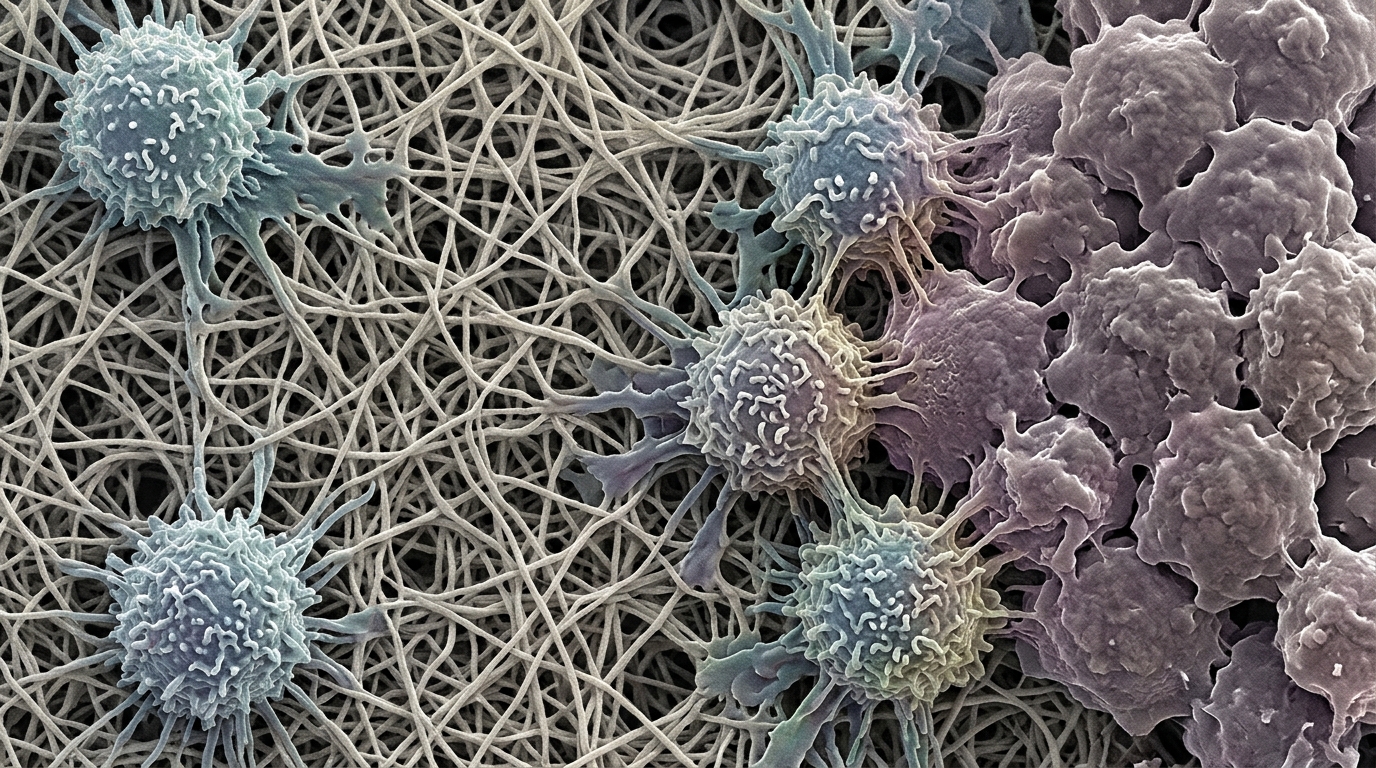
Chimeric antigen receptor natural killer (CAR-NK) cell therapy has emerged as a promising frontier in cancer immunotherapy, offering potent antitumor activity alongside the potential for allogeneic, off-the-shelf application. Yet its effectiveness against solid tumors remains constrained by a formidable set of obstacles: poor tumor trafficking and infiltration, insufficient persistence of the therapeutic cells, dense physical extracellular matrix barriers, metabolic stress, and a barrage of immunosuppressive signals within the tumor microenvironment (TME). A new review published in Discover Materials examines how peptide-functionalized biomaterials—in particular injectable hydrogels and engineered scaffolds—could serve as emerging platforms to overcome these barriers and unlock the full potential of CAR-NK cells in solid tumors.
The review, authored by Marzieh Shokoohi, Hoda Ansari, Ramona Pasandideh, Sara Mohammadnabi, Arastoo Farokhi, Asal Ghanad and Mobin Ghaderi, critically evaluates the design parameters that govern how peptide-functionalized biomaterials interact with therapeutic immune cells. Biomaterial-based delivery systems offer opportunities to improve the local retention, protection, and functional support of CAR-NK cells once they are deployed at or near the tumor site. Peptide functionalization introduces defined biological cues that can regulate cell–material interactions, tumor localization, matrix remodeling, and stimulus-responsive delivery—capabilities that conventional biomaterials alone cannot provide.
Among the key design considerations highlighted are peptide density and spatial presentation, which determine how strongly and in what orientation cells engage with the material surface. The authors compare several classes of peptides: extracellular matrix (ECM)-derived adhesive peptides that promote cell attachment and survival, tumor-targeting and tumor-penetrating peptides that guide cells toward malignant tissue, immune-synapse-oriented strategies that shape the interface between immune and tumor cells, and stimuli-responsive peptide systems that release their cargo only under specific environmental triggers such as altered pH or enzyme activity.
A particularly important contribution of the review is its careful distinction between direct evidence obtained in CAR-NK models and findings extrapolated from conventional NK cells, CAR-T cells, or other biomaterial and drug-delivery systems. Much of what is known about peptide-guided immune cell delivery comes from studies in these adjacent fields, and the authors caution that such findings cannot be assumed to translate automatically to CAR-NK platforms. This critical lens is essential for readers seeking to understand where genuine progress has been made and where optimism currently outpaces data.
The review evaluates the potential of these platforms across several functional dimensions: improving tumor localization, enhancing cell retention at the target site, promoting deeper infiltration into tumor tissue, providing metabolic support to sustain cell viability, and modulating interactions with the hostile tumor microenvironment. Each of these represents a distinct point of intervention where peptide-functionalized biomaterials could, in principle, tip the balance in favor of the therapeutic cells.
However, the authors are equally clear about the limitations and risks. Off-target effects remain a concern, as peptides designed to bind tumor-associated markers may also interact with healthy tissues expressing similar motifs. Tumor heterogeneity—the fact that different regions of a tumor, and different patients, may present different molecular targets—complicates any strategy that relies on a single peptide ligand. Manufacturing complexity is another barrier: incorporating peptides into biomaterials at defined densities and orientations adds layers of quality control and reproducibility challenges that must be solved before clinical deployment.
The translational picture is sobering. Current evidence remains predominantly preclinical, and direct demonstrations of therapeutic benefit from peptide-functionalized biomaterials in CAR-NK systems are still limited. The review does not report new experimental results; rather, it synthesizes existing literature to map out where the field stands and what must happen next. This is a critical distinction for readers evaluating the state of the science: the promise is real, but the proof is not yet in hand.
Looking forward, the authors identify several requirements for meaningful progress. CAR-NK-specific validation is essential—experiments must be performed in CAR-NK models rather than borrowed from CAR-T or conventional NK studies. Quantitative characterization of peptide presentation is needed so that researchers can compare materials across laboratories and optimize designs rationally. Appropriate non-functionalized controls must be included to isolate the true contribution of peptide functionalization from the effects of the biomaterial carrier itself. Finally, rational integration of peptide functionality with scalable biomaterial and cell-manufacturing strategies will be necessary to move these platforms from bench to bedside.
As CAR-NK cell therapy continues to advance toward clinical applications in solid tumors, peptide-functionalized biomaterials represent a sophisticated engineering approach to the persistent challenges of delivery, persistence, and microenvironmental resistance. This review provides a timely and rigorous framework for researchers navigating this emerging intersection of immunotherapy and biomaterials science, emphasizing both the opportunities and the substantial validation work that lies ahead.
Subject of Research: Peptide-functionalized biomaterials as platforms to enhance CAR-NK cell therapy in solid tumors
Article Title: Peptide-functionalized biomaterials as emerging platforms to enhance CAR-NK cell therapy in solid tumors
Article References: Shokoohi, M., Ansari, H., Pasandideh, R., Mohammadnabi, S., Farokhi, A., Ghanad, A., & Ghaderi, M. (2026). Peptide-functionalized biomaterials as emerging platforms to enhance CAR-NK cell therapy in solid tumors. Discover Materials. https://doi.org/10.1007/s43939-026-01053-z
Image Credits: AI Generated
DOI: 10.1007/s43939-026-01053-z
Keywords: CAR-NK cells, peptide-functionalized biomaterials, solid tumors, tumor microenvironment, injectable hydrogels, cancer immunotherapy, preclinical evidence, biomaterial scaffolds, tumor-targeting peptides, allogeneic therapy, Peptide-functionalized, biomaterials
News Source: Matthew Wilson. (November 7, 2026). Peptide-Functionalized Biomaterials Could Boost CAR-NK Cell Therapy Against Solid Tumors. Scienmag.