Researchers in Iran have developed a gelatin coating loaded with peppermint essential oil encapsulated in solid lipid nanoparticles and shown that it slows the growth of spoilage microorganisms on rainbow trout fillets during twelve days of refrigerated storage. The study, published in Food Science & Nutrition, combined a detailed physicochemical characterization of the nanoparticle formulation with a microbiological evaluation of coated fish fillets, and found that the encapsulated oil outperformed both plain gelatin and gelatin containing free peppermint oil across most of the microbial indicators measured.
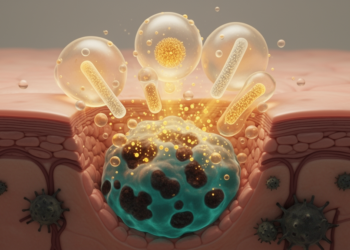
Glycerol monostearate served as the solid lipid, melted at 70 degrees Celsius before 0.5 percent peppermint essential oil was added, and Tween 80 acted as the surfactant at 0.2 percent. The emulsion was sonicated in three fifteen-minute cycles at 70 degrees Celsius and then cooled to room temperature, allowing the lipid matrix to solidify around the oil droplets and form spherical colloidal particles in the nanometer range.
Characterization of the optimized formulation, validated across three independent preparations, yielded a particle size of 124.18 nanometers, a polydispersity index of 0.20, and a zeta potential of −21.84 millivolts. Encapsulation efficiency was reported as approximately 56 percent, with the authors noting that the optimized formulation had been selected in a prior optimization study in which efficiency values ranged from 42.9 to 55.5 percent. All formulations tested showed negative surface charges between −17 and −22 millivolts, which the researchers attributed to glycerol monostearate and Tween 80 at the particle surface, and all polydispersity indices remained below 0.5, indicating a reasonably narrow size distribution.
Gas chromatography-mass spectrometry of the peppermint oil identified iso-menthol as the dominant constituent at 24.69 percent, followed by carvone at 16.98 percent, menthone at 12.35 percent, and limonene at 10.88 percent, with total identified compounds accounting for 88.66 percent of the oil. The authors noted that this profile differs from studies reporting much higher menthol and menthone content, and attributed such variation to geographical origin, climate, plant developmental stage, harvest timing, and extraction and analytical procedures. In young plants menthone typically predominates, and it is progressively converted to menthol as the plant matures toward flowering.
X-ray diffraction and Fourier transform infrared spectroscopy were used to probe how the oil integrates into the lipid matrix. The XRD patterns showed that the pure materials were more crystalline and organized than the resulting nanocarriers, which the researchers interpreted as evidence that the essential oil was thoroughly incorporated into the lipid matrix. The FTIR spectra of the loaded nanoparticles showed no discernible peak shifts, changes in shape, or changes in intensity compared with the individual components, suggesting that no chemical interaction or modification occurs between the oil and the lipid carrier during encapsulation.
Antimicrobial testing by the microdilution method covered four strains of Pseudomonas aeruginosa, four strains of Listeria monocytogenes, and one strain of Escherichia coli O157:H7. The encapsulated oil showed lower minimum inhibitory and bactericidal concentrations than free oil against all tested strains of P. aeruginosa and L. monocytogenes, with MIC values of 0.5 and 0.25 milligrams per milliliter respectively for the encapsulated form, compared with 1 and 0.5 for the free oil. Against E. coli O157:H7, both formulations showed identical MIC and MBC values of 1 milligram per milliliter. Gram-positive bacteria proved more susceptible than Gram-negative ones, a pattern the authors linked to the outer membrane of Gram-negative cells restricting penetration of hydrophobic antimicrobial compounds.
An in vitro release study in phosphate buffer at 37 degrees Celsius over 144 hours revealed a biphasic release profile. A burst release occurred within the first six hours, attributed to diffusion of oil located near the particle surface, followed by a slow, sustained release that reached 38.8 percent of the loaded oil by the end of the observation period. The authors attributed the prolonged second phase to release of oil from within the solid lipid matrix, and cited comparable biphasic behavior in studies of essential oils encapsulated in chitosan nanoparticles and of carvacrol in solid lipid nanoparticles.
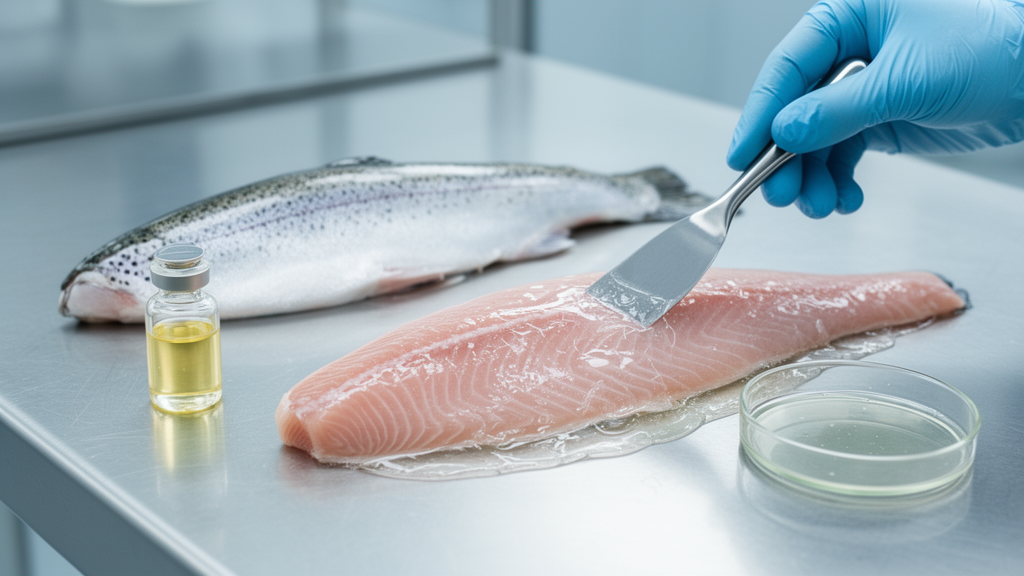
To test the practical application, rainbow trout fillets cut into ten-gram pieces were assigned to four treatments: an uncoated control, a 5 percent fish gelatin coating, gelatin containing 0.2 percent free peppermint oil, and gelatin containing 0.2 percent of the oil-loaded nanoparticles. Fillets were immersed in their respective coating solutions for two minutes, drained, packaged, and stored at 4 degrees Celsius for twelve days, with microbial sampling on days 0, 1, 2, 4, 6, 8, and 12. The initial total viable count after coating was 3.33 log colony-forming units per gram, and counts rose in all groups during storage, with the control reaching 7.76 and the plain gelatin coating 7.46 log CFU/g by day twelve, both above the recommended maximum of 7 log CFU/g for raw fish.
The nanoparticle coating delivered the largest reductions across the board. Relative to the control, the gelatin-plus-nanoparticle treatment reduced total viable bacteria by 1.20 log CFU/g, psychrotrophic bacteria by 1.04, Pseudomonas species by 0.74, Shewanella putrefaciens by 0.73, Enterobacteriaceae by 0.93, and yeasts and molds by 0.91 log CFU/g. Free oil in gelatin produced smaller but significant reductions for most indicators. The advantage of the encapsulated oil over the free oil was statistically significant for four of the six microbial groups evaluated, but not for Shewanella putrefaciens and Enterobacteriaceae. The authors suggested that encapsulation limits evaporation and oxidative loss of the volatile oil constituents and enables sustained release, while the nanoscale particle size may reduce mass transfer barriers and improve contact between hydrophobic antimicrobial compounds and microbial cell membranes.
The researchers concluded that the optimized peppermint oil-loaded solid lipid nanoparticles, incorporated into a fish gelatin coating, improved the microbiological quality of trout fillets during refrigerated storage, and they noted that further studies incorporating physicochemical and sensory measurements are needed to establish how much the treatment actually extends shelf life. The findings position lipid nanocarriers as a delivery system for natural preservatives in perishable seafood, though the results are limited to the specific strains, coating concentrations, and twelve-day storage window tested in the laboratory.
Subject of Research: Encapsulation of peppermint essential oil in solid lipid nanoparticles within gelatin coatings to control spoilage microorganisms on refrigerated rainbow trout fillets
Article Title: Encapsulation of Peppermint Essential Oil (Mentha piperita L.) in Gelatin‐Coated Solid Lipid Nanocarriers (PEO‐SLNs): Characterization and Its Effect on Microbial Quality of Trout Fillet (Oncorhynchus mykiss)
Article References: Safaeian Laein, S., Khanzadi, S., Hashemi, M., Gheybi, F., Azizzadeh, M., Laein, M. S., Oz, E., Zeng, M., Oz, F., & Sarabandi, K. (2026). Encapsulation of Peppermint Essential Oil ( Mentha piperita L.) in Gelatin‐Coated Solid Lipid Nanocarriers ( PEO ‐ SLNs ): Characterization and Its Effect on Microbial Quality of Trout Fillet ( Oncorhynchus mykiss ). Food Science & Nutrition, 14(10), Article e72496. https://doi.org/10.1002/fsn3.72496
Image Credits: AI Generated
DOI: 10.1002/fsn3.72496
Keywords: peppermint essential oil, solid lipid nanoparticles, gelatin coating, rainbow trout, food preservation, antimicrobial packaging, microbial quality, encapsulation efficiency, refrigerated storage, spoilage bacteria, nanocarrier, food science
News Source: Morgan Morrow. (October 28, 2026). Peppermint Oil Nanocarriers in Gelatin Coatings Slow Microbial Spoilage of Trout Fillets. Scienmag.