


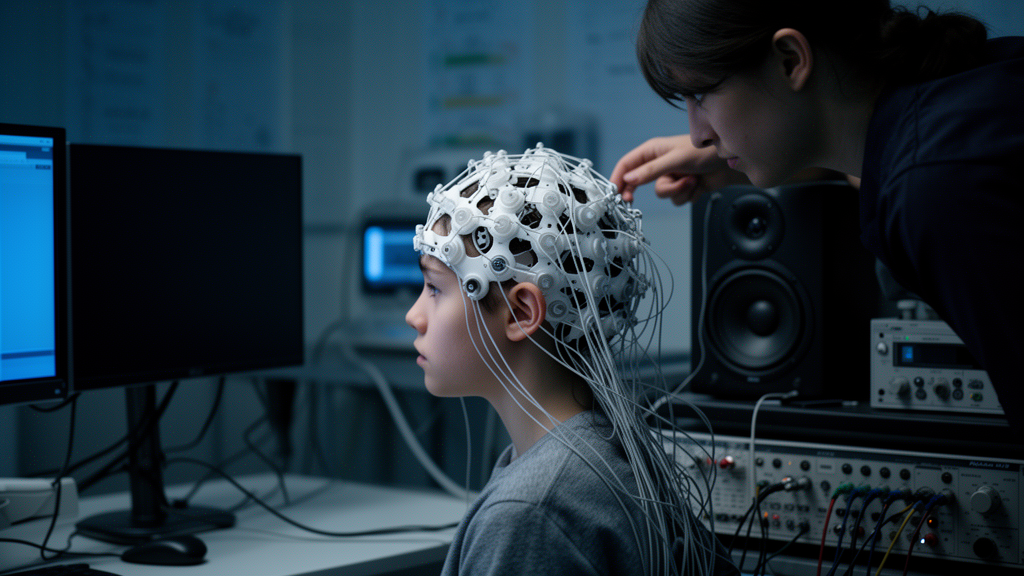
A single flash of light accompanied by two quick beeps can convince the brain that two flashes occurred, even though only one ever appeared. This phenomenon, known as the sound-induced flash illusion (SIFI), has long served as a testing ground for understanding how the brain combines information from different senses. A new study published in Behavioral and Brain Functions takes the investigation a step further, using trial-by-trial EEG recordings and hierarchical Bayesian modeling to ask why the illusion strikes on some moments and not others, and what the brain’s electrical activity reveals about the decisions that follow.
The research team, led by Haoping Yang, Dong Ding, and Haibo Qin with colleagues at Beijing Sport University and collaborating institutions, recruited thirty healthy adults to perform a beep–flash task while their brain activity was recorded with electroencephalography. Each participant completed 400 trials across six conditions: two visual-only baselines with one or two flashes, two audiovisually congruent pairings where the number of beeps matched the number of flashes, and two incongruent pairings. The most notorious of these was the fission configuration, in which one flash was paired with two beeps, and the fusion configuration, in which two flashes were paired with a single beep. Participants simply judged whether they saw one or two flashes while trying to ignore the sounds.
Behaviorally, the results followed the classic pattern of the illusion. Visual-only and congruent conditions produced faster and more accurate responses, whereas the incongruent configurations degraded performance. The two-beep, one-flash condition stood out: it produced elevated illusion rates and markedly prolonged reaction times, with the greatest slowing of any condition in the experiment. The fusion configuration, meanwhile, yielded the lowest accuracy overall. A repeated-measures analysis of variance confirmed that condition had a significant effect on both accuracy and response speed, with large effect sizes. The authors interpret this pattern through the lens of Bayesian causal inference: when auditory and visual signals are congruent, the brain infers a common cause and integrates them smoothly, but when they conflict, the system must adjudicate between competing explanations, and that adjudication carries a measurable cost in time and accuracy.
To move beyond condition averages, the researchers extracted several neural measures on every single trial. They quantified prestimulus alpha-band power over occipital electrodes in the second before each stimulus, measured the amplitude of the auditory and visual N1 event-related potentials as indices of early sensory encoding, and computed the slope of the centro-parietal positivity, or CPP, a well-established marker of evidence accumulation that builds toward a decision bound before a response is made. They also examined scalp topographies, finding that correct trials showed stronger N1 and CPP components and a contralateral occipital positivity compatible with the auditory-evoked contralateral occipital positivity, a signature of cross-modal orienting in which sounds reflexively capture visual-cortical resources.
The methodological core of the study was a hierarchical Bayesian regression framework that jointly modeled accuracy and reaction time at the trial level. Accuracy was modeled with a Bernoulli likelihood and a logit link, with effects expressed as odds ratios, while reaction time was modeled on the log scale with a heavy-tailed Student-t likelihood, chosen deliberately because reaction-time distributions are skewed and prone to outliers. Crucially, the researchers decomposed each EEG predictor into within-subject and between-subject components, a technique that prevents the conflation of trial-to-trial fluctuations within a person with stable differences between people, a common pitfall in this literature. Model generalizability was assessed with Pareto-smoothed importance sampling leave-one-out cross-validation, and the team compared a condition-only baseline model against models that added EEG covariates and, in the most complex version, an interaction between auditory N1 and sound presence.
The single most robust neural finding concerned prestimulus alpha power. Higher alpha before the stimulus was reliably associated with reduced odds of a correct response, with an odds ratio of about 0.88 per standard deviation increase. This fits a substantial body of prior work suggesting that elevated alpha reflects lower cortical excitability and a more conservative reporting criterion, biasing perception without necessarily improving discrimination. In the context of the illusion, the authors propose that heightened alpha may weaken the brain’s tendency toward common-cause integration under cross-modal conflict, tilting trials toward illusory or erroneous reports. Notably, this alpha effect remained stable across all model specifications, making it the clearest neural correlate of single-trial performance in the dataset.
Auditory N1 amplitude told a different story. Larger auditory N1 responses predicted faster reaction times, consistent with the idea that stronger early encoding of the beeps shortens decision latency, and the tertile-based classical analyses showed that auditory N1 contributed additional variance to response speed and interacted with congruency. In the Bayesian models, however, the auditory N1 effect on accuracy was only borderline negative, and its effect on reaction time was small, with a confidence interval that crossed the null. The CPP, for its part, tracked reaction time closely in descriptive and correlational analyses, with steeper build-up associated with shorter latencies, replicating its established role as an accumulation-to-bound signal, but its trial-level regression coefficient did not reach a robust association in the hierarchical models.
Perhaps the most sobering result came from the model comparison itself. Although the most complex model scored nominally best for accuracy, its advantage over the condition-only baseline was not statistically robust, and the reaction-time models were practically indistinguishable from one another. In other words, once the experimental conditions were accounted for, the EEG covariates added limited and non-robust incremental out-of-sample predictive value under the linear additive specification the researchers employed. The authors are candid about this: task conditions accounted for most of the behavioral variance, and the neural measures, while theoretically informative, did not materially improve single-trial prediction. They suggest that future work may need nonlinear, latency-sensitive, or state-by-condition model formulations to capture neurobehavioral coupling more fully.
The study also has limitations the authors acknowledge. Sensory energy and salience were not fully equated across modalities, which could entangle weight reallocation with causal inference. The CPP’s sensor-level profile may overlap with late attentional or motor-preparatory processes, so amplitude and slope alone cannot definitively isolate accumulation. The sample of twenty-five included participants, all young adults recruited at a single university, constrains generalizability, and the symmetric bilateral flashes with fixed-intensity beeps, while internally valid, reduce ecological validity relative to real-world multisensory environments.
Even so, the study delivers a reusable pipeline for integrating trial-level neurophysiology with behavior in multisensory research, and it sharpens a conceptual distinction that matters well beyond the flash illusion. Stimulus configuration, the authors argue, sets the dominant decision context, while momentary neural states such as prestimulus excitability and early sensory gain act as modulators that tune how strongly that context is expressed on any given trial. Neural markers can remain mechanistically meaningful even when their incremental predictive contribution is small, and recognizing that gap between theoretical relevance and predictive leverage may be one of the study’s most lasting contributions to cognitive neuroscience.
Subject of Research: Trial-level EEG and hierarchical Bayesian modeling of perceptual decisions in the sound-induced flash illusion
Article Title: Perceptual decision-making in the sound-induced flash illusion: a trial-level hierarchical Bayesian integration of EEG and behavior
Article References: Yang, H., Ding, D., Qin, H., Miao, H., Wang, C., Zang, Y., Chi, L., & Wu, B. (2026). Perceptual decision-making in the sound-induced flash illusion: a trial-level hierarchical Bayesian integration of EEG and behavior. Behavioral and Brain Functions, 22(1), Article 48. https://doi.org/10.1186/s12993-026-00344-y
Image Credits: AI Generated
DOI: 10.1186/s12993-026-00344-y
Keywords: sound-induced flash illusion, multisensory integration, EEG, hierarchical Bayesian modeling, prestimulus alpha, centro-parietal positivity, auditory N1, perceptual decision-making, causal inference, reaction time, evidence accumulation, audiovisual processing
News Source: Cassandra Pierce. (October 30, 2026). When Two Beeps Trick the Eye: EEG and Bayesian Models Decode a Classic Illusion. Scienmag.



