Environmental DNA (eDNA) methods for monitoring coral reefs in Hawaiʻi have been evaluated in two complementary studies conducted with local stewardship organizations on Oʻahu, according to a peer-reviewed, accepted research article published in BMC Zoology. The work compared coral-specific genetic markers for tracking benthic community dynamics through time and tested passive eDNA samplers (PEDS) as a low-effort alternative to active filtration, aiming to assess how eDNA sampling could complement existing reef-monitoring activities and provide information relevant to conservation planning.
The researchers note that while eDNA has transformed biodiversity monitoring, its application to long-term ecological assessment has been limited by uncertainty in the temporal stability and consistency of eDNA signals, as well as by workflows that require specialized equipment and analytical support. Broader use of eDNA in community-based monitoring, they argue, depends on approaches that are both logistically practical and scientifically reliable.
In the first study, the team compared five broad taxonomic markers — 16S, 18S, 23S, COI and MFU — and detected diverse reef assemblages spanning 17 phyla. Community composition differed consistently between the two Oʻahu study regions, Keʻehi and Maunalua Bay, which lie roughly 12 kilometers apart, including clear differentiation in algal assemblages.
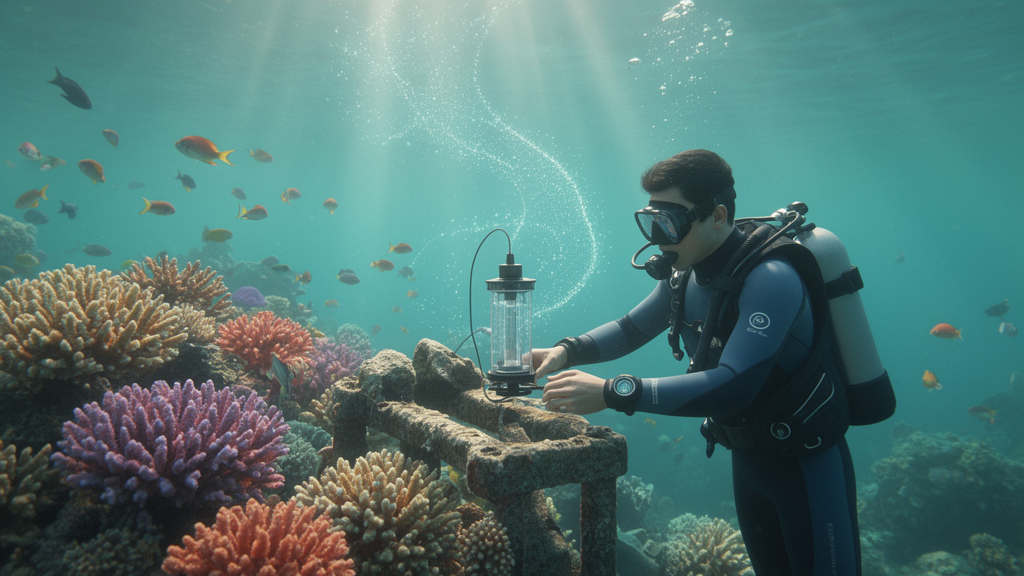
The comparison of sampling methods showed that passive samplers recovered taxonomic richness comparable to active filtration when sampling effort was standardized. However, passive samplers showed greater variability among replicates, whereas active methods more consistently detected rare and transient taxa. Despite this variability, passive samplers captured similar broad-scale ecological patterns with reduced logistical effort, suggesting they could offer a relatively simple option for expanding spatial and temporal biomonitoring while active filtration remains important for detecting rare taxa.
For coral monitoring specifically, all three tested markers — 12S, 16S and ITS2 — showed strong correlations with visually assessed coral cover and detected more genera than visual surveys, with 23 site-genera detections compared with 17, an increase of 35 percent. Among the three markers, 16S showed the strongest and most consistent performance across temporal replicates, while ITS2 showed greater temporal variability.
The authors conclude that eDNA approaches can generate ecologically meaningful data for reef monitoring when matched to specific objectives. A multi-marker approach enabled detection of native, endemic and nuisance taxa, offering an ecosystem-level perspective for management. Given the relatively slow pace of change in coral assemblages, the study suggests that periodic eDNA surveys may provide a useful and practical longer-term complement to rapid visual assessments of coral cover.
The researchers emphasize that integrating these tools with local stewardship efforts may increase monitoring capacity, provided that requirements for laboratory processing, bioinformatic analysis, taxonomic validation and interpretation are adequately supported. The article is being shared early to provide faster access to peer-reviewed, accepted research; it is citable and carries a permanent DOI, and this version is subject to further edits before the final Version of Record replaces it.
Subject of Research: Environmental DNA methods for coral reef biomonitoring in Hawaiʻi
Article Title: Integrating active and passive environmental DNA sampling into coral reef assessments: implications for community-based biomonitoring in Hawaiʻi
Article References: Vimond, C. M., Hill, Z., Walsh, C. A. J., Weiant, P., Kupihea, K., Marko, P. B., & Nichols, P. K. (2026). Integrating active and passive environmental DNA sampling into coral reef assessments: implications for community-based biomonitoring in Hawaiʻi. BMC Zoology. https://doi.org/10.1186/s40850-026-00293-z
Image Credits: AI Generated
DOI: 10.1186/s40850-026-00293-z
Keywords: environmental DNA, coral reefs, biomonitoring, Hawaiʻi, passive samplers, metabarcoding, coral markers, community-based monitoring, Oʻahu, biodiversity, Integrating, active
News Source: Juliet Wilcox. (October 28, 2026). Passive eDNA samplers and coral genetic markers tested for reef monitoring in Hawaiʻi. Scienmag.