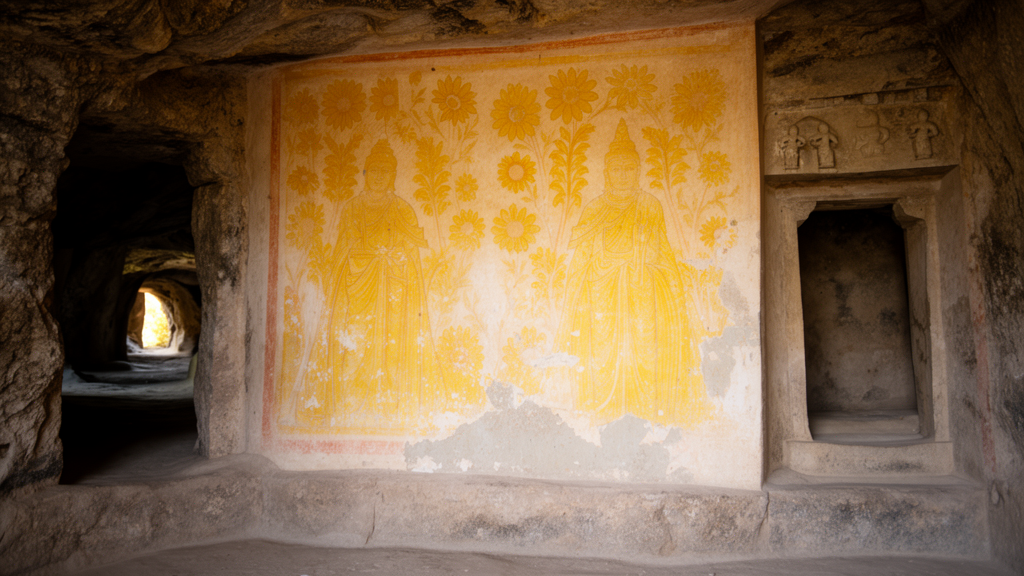
The vivid yellow of some of China’s most treasured Buddhist murals is quietly being destroyed by an invisible attacker: ground-level ozone. A new analytical study reports that the natural organic pigment safflower yellow, detected in mural samples from the Tiantishan Grottoes, the Potala Palace, and the Maijishan Grottoes, survives in the murals not as the intact pigment but as a mixture of the original molecule and its ozone-oxidation degradation products.
Safflower yellow is a water-soluble dye extracted from the petals of the safflower plant, an ancient cash crop that contains both a red and a yellow pigment. Alongside other plant-derived pigments such as indigo and gamboge, it was widely used by painters of Chinese grotto temples. As early as the Northern Dynasties to the Tang Dynasty, painters had learned to combine these organic plant pigments with mineral pigments to enrich the color of murals. But organic pigments are chemically fragile, and surviving empirical evidence of them in ancient murals is extremely scarce, which makes their detection and study particularly challenging for conservation scientists.
The samples were provided by the Dunhuang Research Academy. Using high-performance liquid chromatography, the researchers compared the chromatographic profiles of the mural extracts with that of a safflower yellow standard, confirming the pigment’s presence in all three samples.
Quantification revealed striking differences between the sites. Under the optimized chromatographic conditions, the mass contents of safflower yellow were 470 micrograms per gram in TTS-0624, 95 micrograms per gram in BDLG, and 315 micrograms per gram in MJS-156. Notably, an initial analysis under a different chromatographic method had suggested much higher contents in the Tiantishan and Potala samples, but closer inspection showed that the detected peak was not pure safflower yellow. The retention time of the pigment peak in the mural sample closely matched that of safflower yellow that had been deliberately oxidized with ozone in the laboratory, indicating that the murals contain the pigment together with a range of its oxidation products formed over different time periods.
To pin down the chemistry, the team ran a controlled laboratory simulation. Two glass fiber membranes, each coated with 1 milligram of safflower yellow, were treated in darkness: one was exposed to ordinary air at a flow rate of 100 liters per minute for one hour, and the other to ozone under identical conditions. Air had almost no effect; the solution color barely changed and no new chromatographic peaks appeared. Ozone, by contrast, caused the solution to fade almost to colorless within the hour, and new chromatographic peaks emerged. This stark contrast demonstrates that the oxidative damage observed in the murals is attributable to ozone rather than to oxygen or other ordinary components of air.
Spectroscopic analysis explained why the color disappears. Ultraviolet spectra of intact safflower yellow showed a strong absorption band between 200 and 250 nanometers, corresponding to conjugated double bonds and aromatic rings, plus a characteristic peak near 405 nanometers that underlies the pigment’s yellow appearance. After ozone exposure, only a strong absorption at 215 nanometers remained, while the 405-nanometer peak was dramatically weakened and flattened. The researchers interpret this as evidence that ozone destroys the conjugated chromophore system, breaking the carbon-carbon double bonds responsible for absorbing visible light, and leaves behind small saturated molecules such as carboxylic acids and alcohols that absorb only in the far ultraviolet.
Fourier transform infrared spectroscopy told a complementary story. Peaks associated with the benzene ring skeleton at 1629.9 and 1509.7 inverse centimeters changed in shape and intensity after oxidation, consistent with ozone attacking the carbon-carbon double bonds. The intensity of a peak at 1036.6 inverse centimeters increased markedly, indicating the formation of additional oxygen-containing functional groups such as carbon-oxygen bonds. Meanwhile, peaks for saturated alkyl carbon-hydrogen stretches showed no obvious shift, suggesting those structures survived. The fingerprint region of the spectrum, between roughly 1022 and 578 inverse centimeters, changed almost entirely after oxidation, with new peaks appearing at 924.9, 775.4, 702.7, and 475.1 inverse centimeters, a clear sign that the overall molecular architecture had been substantially reorganized.
Building on these observations, the authors proposed a stepwise oxidation pathway. Ozone is known to preferentially attack the most reactive carbon-carbon double bonds in conjugated systems, forming unstable five-membered ring ozonide intermediates that cleave to yield a carbonyl compound and a Criegee radical. In the proposed scheme, ozone first attacks a central double bond of safflower yellow, then a second double bond adjacent to the benzene ring, and finally the two remaining double bonds on the ring of a second intermediate, ultimately producing a small final product with a glycosyl dicarboxylic acid-like structure. Mass spectrometry of the laboratory-oxidized samples supported this sequence: molecular ion peaks appeared at mass-to-charge ratios corresponding to intact safflower yellow at 911, an intermediate product with the formula C22H22O12 at 479, a second intermediate C15H16O12 at 389, and the final product C9H14O10 at 283, all detected as protonated molecules.
The authors emphasize that the pathway is a proposed mechanism, inferred from theoretical analysis and corroborated by the mass spectrometric agreement between predicted and observed molecular weights, rather than a directly observed reaction sequence. The study also notes that the Tiantishan murals face multiple environmental stresses, including high humidity, water seepage, and salinization, and the team attributes the chromatographic changes primarily to ozone oxidation rather than photodegradation after weighing the mural preservation conditions and the regional atmospheric environment, an area where nitrogen oxides and volatile organic compounds from various sources drive elevated ozone formation. The laboratory experiments were conducted in darkness, which helps isolate the ozone effect from light exposure.
For conservators, the implications are sobering. Near-surface ozone pollution has worsened over recent decades, driven by industrial emissions and other human activities, and rising atmospheric ozone concentrations intensify the oxidation of fragile organic pigments in murals. The authors argue that understanding the specific degradation pathways and products of safflower yellow provides a theoretical and technical basis for targeted protection strategies, and a reference for studying the gas-phase evolution of natural organic pigments as atmospheric ozone pollution continues to intensify. For the four Buddhas of Tiantishan, the painters of the Potala, and the apsaras of Maijishan Cave 156, the chemistry of the modern atmosphere has become as much a part of their story as the pigments themselves.
Subject of Research: Ozone-induced oxidative degradation of the organic pigment safflower yellow in ancient Chinese grotto temple murals
Article Title: A study of the ozone oxidation mechanism of the organic pigment safflower yellow in grotto temple murals
Article References: Cheng, G., Jia, S., Li, J., Wang, T., Yang, Y., Kang, Z., Liang, S., Li, X., Shi, G., & Wang, G. (2026). A study of the ozone oxidation mechanism of the organic pigment safflower yellow in grotto temple murals. Discover Surfaces, 1(1), Article 5. https://doi.org/10.1007/s44507-026-00006-6
Image Credits: AI Generated
DOI: 10.1007/s44507-026-00006-6
Keywords: safflower yellow, ozone oxidation, grotto temple murals, Tiantishan Grottoes, Potala Palace, Maijishan Grottoes, organic pigments, HPLC, HPLC-MS, pigment fading, cultural heritage conservation, atmospheric ozone pollution
News Source: Bethany Barker. (October 28, 2026). Ozone Pollution Is Fading Ancient Safflower Yellow in Grotto Temple Murals. Scienmag.