A new computational study has mapped out how some of Earth’s most abundant layered minerals behave optically, and the results reveal a striking difference that comes down to a single structural detail: what holds the layers together. Using density functional theory, researchers compared talc with three kaolinite-group minerals—kaolinite, dickite, and nacrite—and found that the type of bonding between atomic layers directly shapes each material’s dielectric response, optical anisotropy, and ultraviolet absorption. The work, published in Applied Physics B, positions these naturally occurring phyllosilicates as candidates for photonic and optoelectronic uses, including ultraviolet-transparent insulating layers and dielectric spacers in van der Waals heterostructures.
Phyllosilicates occupy an unusual niche among two-dimensional materials. Unlike graphene or transition-metal dichalcogenides, which are typically synthesized in the laboratory, minerals such as talc and kaolinite occur naturally as layered crystals that can, in principle, be exfoliated down to atomically thin sheets. They are abundant in nature, chemically stable under ambient conditions, and available in large quantities at low cost. The study’s authors note that while the structural and mechanical properties of these minerals are well documented, systematic comparative first-principles investigations of their frequency-dependent dielectric response across different phyllosilicate families have remained limited, with most existing work focused on infrared vibrational spectroscopy rather than broadband electronic and optical behavior.
The team, led by Lenka Filipović, with co-authors including Ayan Khasiyeva, Andrijana Šolajić, and Jelena Pešić Ninković, performed all calculations within the PBE generalized gradient approximation of density functional theory, using the Quantum ESPRESSO package with ultrasoft pseudopotentials and a Grimme-D2 correction to capture long-range dispersion interactions. Structural relaxations adjusted only the internal atomic coordinates while lattice parameters were held at literature-based crystallographic values, and the resulting geometries agreed well with both experimental data and previous first-principles studies. Brillouin-zone integrations used Monkhorst-Pack meshes tailored to each mineral, and optical properties were computed with the epsilon.x module within the random phase approximation.
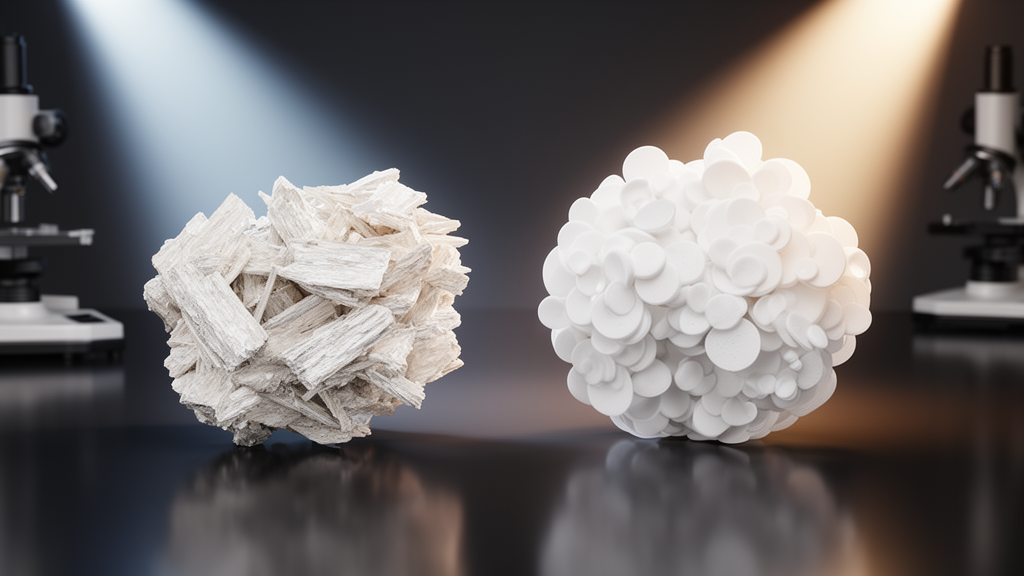
The structural contrast at the heart of the study is straightforward but consequential. Talc is built from stacked T-O-T layers—two tetrahedral sheets of SiO4 units sandwiching a central trioctahedral sheet of Mg-centered octahedra—producing electrically neutral layers with strong in-plane bonding and only weak van der Waals forces between them. The kaolinite-group minerals, by contrast, consist of single T-O layers in which hydroxyl groups interact with oxygen atoms of the adjacent layer, creating interlayer hydrogen bonds. The calculations confirmed that talc’s interlayer distance is significantly larger than in kaolinite, dickite, or nacrite, reflecting those weaker interactions, while the kaolinite-type minerals show smaller separations due to hydrogen bonding that strengthens interlayer coupling.
Electronic structure calculations placed all four minerals firmly in the wide-band-gap insulator category. Talc exhibited a direct band gap of approximately 5.26 electron volts, with both the valence band maximum and conduction band minimum near the Gamma point. Kaolinite showed a slightly smaller indirect gap of 5.04 electron volts, with its valence band maximum at the V point and conduction band minimum at Gamma. The projected density of states revealed that oxygen p states dominate the upper valence bands in both materials, while talc’s conduction-band edge is composed primarily of magnesium-derived states with contributions from oxygen and hydrogen, and kaolinite’s conduction band draws its most pronounced contributions from aluminum- and silicon-centered states.
The authors are careful to contextualize these gap values. Standard PBE calculations are known to underestimate true band gaps, and more advanced theoretical treatments reported in the literature predict substantially larger values for talc—direct gaps of approximately 7.27 electron volts at the Gamma point, rising to about 7.63 electron volts when electronic excitation effects are included. The study did not apply higher-level corrections, so the reported gaps should be read as comparative benchmarks within a consistent computational framework rather than definitive material constants. The relative ordering, with talc wider-gapped than kaolinite, is consistent with previously reported density functional theory trends for phyllosilicates.
The optical results form the core of the paper. For light polarized within the layers, talc’s imaginary dielectric function shows two prominent ultraviolet absorption features, while the perpendicular component displays a smoother, more continuous profile reflecting fewer allowed optical transitions along that direction. The real part of the dielectric function within the layers shows stronger dispersion and reaches more negative values at higher energies, characteristic of intense interband transitions. Kaolinite follows similar qualitative trends but with noticeably reduced anisotropy: its absorption spans a broader energy range, and the perpendicular response becomes comparable to, and slightly stronger than, the in-plane response at higher photon energies—a signature of enhanced optical activity along the direction normal to the layers, which the authors attribute to hydrogen-bond-mediated interlayer coupling.
Dickite and nacrite, which share kaolinite’s composition but differ in stacking sequence, behaved much like kaolinite, with two pronounced ultraviolet absorption features for in-plane polarization and smoother spectra perpendicular to the layers. Their absorption spectra proved broader than talc’s but narrower than kaolinite’s, an apparent paradox the authors resolve by noting that optical absorption depends not only on the density of available electronic states but also on momentum-resolved interband transition energies and dipole selection rules. The more ordered stacking and uniform hydrogen-bond network of dickite and nacrite narrow the distribution of allowed transition energies, while kaolinite’s lower symmetry and greater structural heterogeneity activate a broader range of transitions across the Brillouin zone.
Overall, the study demonstrates a direct link between interlayer coupling and optical anisotropy. Talc’s weak van der Waals bonding confines electronic states within its layers, producing pronounced anisotropy, a sharp absorption onset deep in the ultraviolet, and a narrower absorption range. Kaolinite’s hydrogen bonding enhances dielectric screening and polarization perpendicular to the layers, yielding a more balanced dielectric response and a broader ultraviolet absorption profile. All four minerals show negligible absorption in the visible range, consistent with their wide-band-gap insulating character, and supplementary reflectivity analysis placed peak reflectivity values within the ultraviolet region.
On the application side, the authors suggest complementary roles. Talc’s wide gap, low absorption, and strong anisotropy make it a promising candidate for ultraviolet-transparent insulating layers and dielectric spacers in van der Waals heterostructures, where minimal optical losses and weak substrate interactions are desirable. The kaolinite-type minerals, with their enhanced dielectric response and broader ultraviolet absorption, may suit substrates for optical measurements or natural insulating coatings requiring increased dielectric screening and ultraviolet shielding. The authors also emphasize that these are computational predictions: because PBE-GGA underestimates band gaps, absolute positions of optical transitions should be interpreted with caution, and the analysis focuses on comparative trends in spectral shape and anisotropy. Excitonic and local-field effects were neglected in the independent-particle treatment. Even so, the combination of natural abundance, insulating behavior, and ultraviolet transparency suggests these everyday minerals could offer a low-cost, scalable alternative to synthetic two-dimensional dielectrics—an intriguing prospect, given that the raw materials can be quarried rather than grown in a laboratory.
Subject of Research: First-principles calculations of the electronic and optical properties of layered phyllosilicate minerals
Article Title: First-principles investigation of the optical properties of layered phyllosilicates
Article References: Filipović, L., Khasiyeva, A., Šolajić, A., & Pešić Ninković, J. (2026). First-principles investigation of the optical properties of layered phyllosilicates. Applied Physics B, 132(11), Article 110. https://doi.org/10.1007/s00340-026-08721-1
Image Credits: AI Generated
DOI: 10.1007/s00340-026-08721-1
Keywords: phyllosilicates, talc, kaolinite, density functional theory, optical anisotropy, dielectric function, band gap, two-dimensional materials, van der Waals, hydrogen bonding, ultraviolet absorption, Applied Physics B
News Source: Katie Riggs. (October 28, 2026). Common Minerals Talc and Kaolinite Show Distinct Optical Behavior in New Simulations. Scienmag.