Zoological Museum in Kiel plays a leading role in reconstructing the death of the European oyster
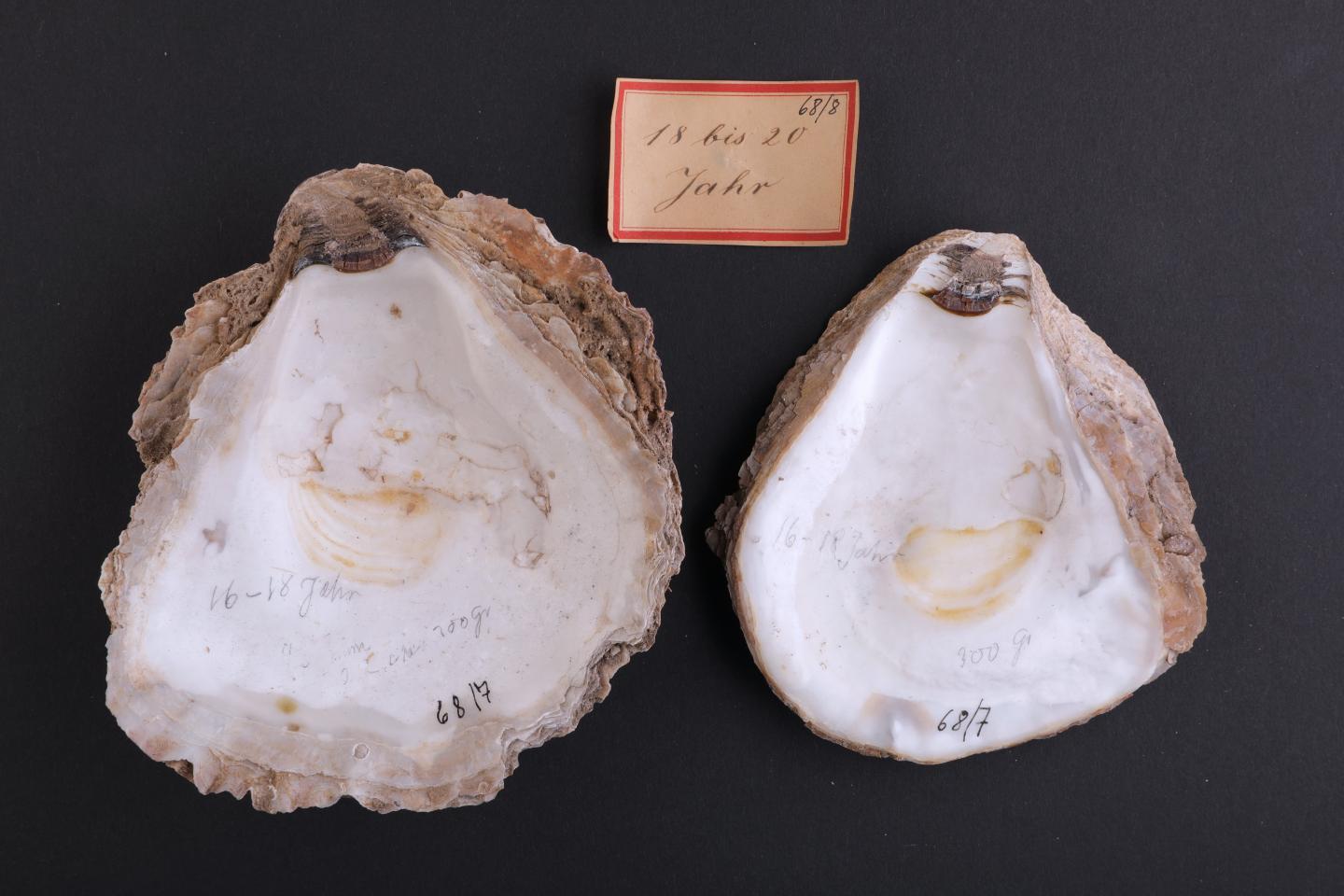
Credit: © Jutta Drabek-Hasselmann, Zoological Museum, Kiel University
Natural history collections are unique archives of biodiversity. They document how living things transform over time and what effects aspects like climate change or other man-made environmental changes have on their distribution. A good example is the decline in numbers of the European oyster (Ostrea edulis) in the North Sea, which has been continuing for over 100 years. Researchers from Kiel University (CAU), in cooperation with the NORe museum association for the North and Baltic Sea region and the Senckenberg Research Institute and Natural History Museum in Frankfurt, have now managed to shine some light on this phenomenon. They have concluded that the occurrence of the invasive American slipper limpet (Crepidula fornicata) is not one of the main causes for the European oyster dying out – unlike previously assumed. The researchers published their study in the renowned journal PLOS ONE in October.
The informative value of natural historical collections
Historical collections of the European oyster and its surrounding fauna form the basis for the new findings. The researchers investigated a total of 1,750 oysters and more than 700 slipper limpets which all found their way into the joint project’s museums and the museums in Leiden and London between 1820 and 2018. “Our unique collection by Karl August Möbius was of key importance here. This collection documented the presence of the oyster throughout Europe around 1870,” reported Dr Dirk Brandis, head of the Zoological Museum in Kiel and private lecturer at the CAU. Möbius conducted research in Kiel during the second half of the 19th century as a zoologist and ecologist. Based on his investigations of oyster presence in domestic waters, with the concept of biocoenosis he also discovered the mutual dependence of different life forms within a community. “We used the various historical archives to prove that the slipper limpet, which was introduced, had nothing to do with the European oyster dying out, although that has been assumed for a long time,” Brandis continued.
Chronological sequence of the spread of the limpet doesn’t match oyster decline
The researchers drew this conclusion from the temporal sequences, which they were now able to trace back. “Around 200 years ago, oyster fishing in the North Sea was a flourishing business,” explained Dr Dieter Fiege from the Senckenberg Research Institute and Natural History Museum in Frankfurt. He continued: “In the years afterwards, however, the Ostrea edulis numbers declined continuously. It was assumed that the appearance of the invasive slipper limpet, Crepidula fornicata, was the reason behind the dramatic decrease in oysters, along with overfishing, cold winters or diseases.”
In actual fact, the slipper limpet – which is native to the coastlines of North America – was introduced to Europe around 1870 but its presence could only be verified after 1934. “According to our findings, the decline in numbers of the European oyster population already began in the late 19th century, so well before the invasive spread of the slipper limpet. We were able to reconstruct this decline in detail,” emphasized CAU doctoral researcher, Sarah Hayer, who is conducting research at the Zoological Museum in Kiel and who accounted for the study as the lead author. “This makes it clear that the competition by an immigrant species did not cause the European oyster to die out,” added Dr Christine Ewers-Saucedo, who was chiefly responsible for collecting and analysing the data in the study at the Zoological Museum in Kiel. The real reason why the European oyster population dramatically declined in its native habitat remains unanswered.
###
Original publication:
Hayer S, Bick A, Brandt A, Ewers-Saucedo C, Fiege D, Füting S, et al. (2019) Coming and going – Historical distributions of the European oyster Ostrea edulis Linnaeus, 1758 and the introduced slipper limpet Crepidula fornicata Linnaeus, 1758 in the North Sea. PLOS ONE 14(10): e0224249.
https:/
Photos are available for download at:
http://www.
http://www.
http://www.
Historical oyster shells from the collections of Karl August Möbius, Zoological Museum Kiel
© Jutta Drabek-Hasselmann, Zoological Museum, Kiel University
Kiel University
Press, Communication and Marketing, Dr Boris Pawlowski, Text/editing: Claudia Eulitz
Postal address: D-24098 Kiel, Germany, Telephone: +49 431 880-2104, Fax: +49 431 880-1355
E-mail: [email protected], Internet: http://www.
Facebook: http://www.
Media Contact
Dr. Dirk Brandis
[email protected]
49-431-880-5176
Original Source
https:/
Related Journal Article
http://dx.