Children with Cerebral Palsy have more energy to play and be physically active for longer thanks to specially designed orthotics.
Credit: Staffordshire University
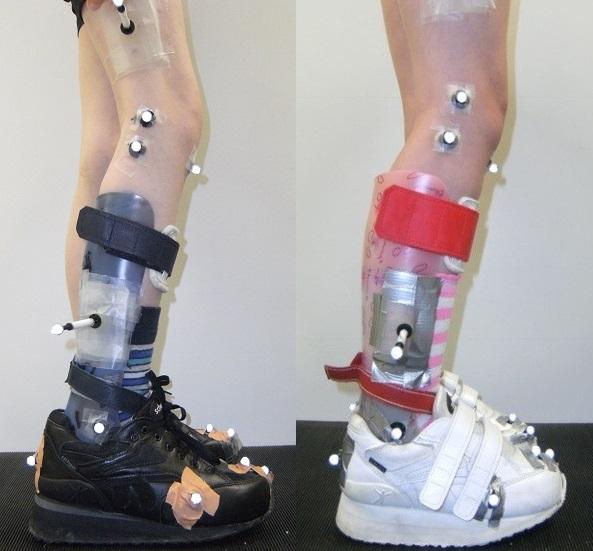
Researchers have confirmed that adapting splints in combination with the footwear used by disabled children to help them walk can decrease the energy they use by as much as 33%.
The Clinical Biomechanics team at Staffordshire University and the orthotics specialists from The Royal Wolverhampton NHS Trust examined the effectiveness of tuning the splint – footwear combination, using clinical trials with families in the West Midlands.
Nachi Chockalingam, Professor of Clinical Biomechanics, explained: “Helping children with disabilities to play longer and do the things that other children can do is important for all families. The more children with disabilities can play with their friends and do activities they enjoy, the more included they feel.
“We know that children with cerebral palsy use more energy to walk and our team have found fine-tuning splints to suit the individual needs of a child can make huge difference to their overall mobility.”
Dr Nicola Eddison, Clinical lead for Orthotics Service at The Royal Wolverhampton NHS Trust and a Senior Research Fellow, Centre for Biomechanics and Rehabilitation Technologies, Staffordshire University, said: “Our research shows that the appropriate design and tailoring of splints can reduce the energy used by children with CP while increasing their speed and distance, compared with a splint which is not fine-tuned. This is something which could have a significant impact on their quality of life.”
During the study, the researchers analysed the walking pattern of children with cerebral palsy at Staffordshire University’s specialist gait laboratory and participants were assessed while barefoot and with both non-tuned and tuned splints.
Children wearing the fine-tuned splints showed improvements in several areas including hip and pelvic function and knee extension, while a non-tuned splint potentially showed a decrease in hip function.
Mrs Susan Hayfield, from Wolverhampton, is mother of 15-year-old Robert who suffers with Cerebral Palsy. She said: “Dr Eddison and her team have helped Robert from the age of three with his mobility.
“After having his footwear and splint adapted, my son’s walking improved. This treatment has enabled him to be active for longer and he has felt less fatigued, which have all helped to give him a better quality of life”
Robert added: “Wearing the splint helps me stay off my toes and to help me walk heel to toe instead of toe to heel. The splint keeps my foot at a 90-degree angle which supports my walking. When I first remember wearing a splint, I felt different to other people, but now I just feel like it’s normal for me.”
The researchers recommend fine-tuning splints for all children with cerebral palsy who wear them and hope that their findings will be used to inform future clinical practice. Both Dr Eddison and Professor Chockalingam are calling for standardisation of terminologies used within splints, which are also known as Ankle Foot Orthoses (AFO), to help future research and clinical practice.
Professor Chockalingam added: “There still remains a lack of research on the longer-term effects of using a fine-tuned splints but our studies provide a stepping stone to improving quality of life for many children.”
The full research findings, which were published in the June edition of The Foot Journal, are available below:
- Does user perception affect adherence when wearing biomechanically optimised ankle foot orthosis – footwear combinations: A pilot study
- The effect of tuning ankle foot orthoses-footwear combinations on gait kinematics of children with cerebral palsy: A case series
- Ankle Foot Orthoses: Standardisation of Terminology
Media Contact
Amy Platts
[email protected]
Original Source
https:/
Related Journal Article
http://dx.