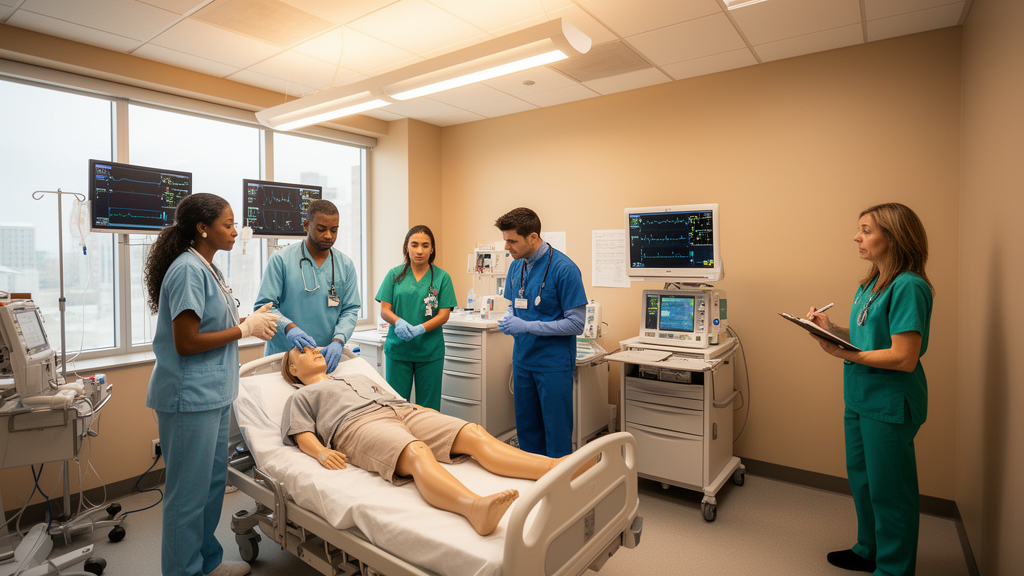
Healthcare simulation is increasingly delivered not only in universities and training organisations but also on the clinical front line, in hospitals and other care sites. A new qualitative study from the Republic of Ireland has examined what helps and what hinders simulation delivery in both settings, and its central conclusion is striking: the factors that matter most for keeping simulation programmes alive are organisational rather than individual. Protected time, adequate staffing, facilities, funding and leadership support emerged as the dominant influences across both educational and clinical contexts.
The research, published open access in the journal Advances in Simulation, was led by Roisin O’Malley and colleagues including Paul O’Connor. The team conducted an exploratory qualitative study combining semi-structured interviews with open-ended survey responses. Thirty simulationists took part in interviews, fifteen drawn from education and training organisations and fifteen from clinical sites, while a further 120 survey respondents contributed qualitative data on the barriers and facilitators they encounter in delivering simulation.
To analyse the material, the researchers used directed content analysis informed by two established frameworks: the Capability, Opportunity, Motivation-Behaviour model, known as COM-B, and the Theoretical Domains Framework, or TDF. These tools allowed the team to categorise the determinants of simulation delivery across fourteen behavioural domains, and to compare how those determinants were experienced and prioritised in the two different contexts.
The findings showed that determinants of simulation delivery spanned all COM-B dimensions. Capability-related factors included simulation knowledge, pedagogic understanding, technical expertise and facilitation skills, although the specific capabilities emphasised differed between educational and clinical settings. Across both datasets, however, opportunity-related determinants, particularly environmental context and resources, were the dominant influences on whether simulation actually got delivered. Motivation-related factors reflected a strong commitment to simulation among practitioners, but participants also described challenges relating to burnout, recognition and sustaining programmes over time.
While many determinants were shared across contexts, the study found important differences in how these factors were experienced and prioritised, which is precisely the gap the authors set out to address. Previous research had identified barriers and facilitators to simulation implementation, but little was known about how these factors differ between education and training organisations and clinical sites, the two settings where simulation is now routinely delivered.
The authors’ conclusion carries a practical message for health systems and educators. While simulation delivery requires skilled and motivated faculty, they write that the principal determinants of sustainability are organisational rather than individual. Efforts to expand healthcare simulation should therefore move beyond faculty development alone and prioritise the organisational investment and implementation strategies needed to embed simulation as a routine and sustainable component of healthcare education and improvement.
As an exploratory qualitative study based on self-reported interviews and survey responses from Irish simulationists, the research describes perceived determinants rather than measuring the effects of any intervention, and its findings are specific to the Republic of Ireland. Nevertheless, the pattern it identifies, in which resources and organisational support outweigh individual skill and enthusiasm as the decisive factors for sustainability, offers a clear evidence-based signal for anyone planning to grow simulation programmes in either educational or clinical settings.
Subject of Research: Barriers and facilitators to healthcare simulation delivery in educational and clinical settings in the Republic of Ireland
Article Title: Comparing barriers and facilitators to healthcare simulation across educational and clinical contexts
Article References: O’Malley, R., Ryng, S., McLoughlin, J., Byrne, D., & O’Connor, P. (2026). Comparing barriers and facilitators to healthcare simulation across educational and clinical contexts. Advances in Simulation. https://doi.org/10.1186/s41077-026-00489-w
Image Credits: AI Generated
DOI: 10.1186/s41077-026-00489-w
Keywords: healthcare simulation, simulation delivery, COM-B model, Theoretical Domains Framework, qualitative study, Republic of Ireland, organisational determinants, faculty development, clinical education, sustainability, barriers and facilitators, Advances in Simulation
News Source: Courtney Benton. (October 28, 2026). Organisational factors dominate what makes healthcare simulation sustainable, study finds. Scienmag.