Frozen and freeze-dried raw pet foods have become one of the fastest-growing segments of the pet food industry, but they carry a persistent microbiological problem: because they are never cooked, they can harbor Salmonella and Listeria monocytogenes, two pathogens that threaten both the animals eating the food and the humans handling it. A new study from researchers at Texas A&M University’s National Center for Electron Beam Research, working with the Carnivore Meat Company, reports that electron beam (eBeam) irradiation can eliminate these pathogens from raw pet food matrices at doses already used commercially, while leaving the overwhelming majority of the nutritional profile intact. The work was published in Frontiers in Veterinary Science.
The research team tested eight commercially available raw pet food products spanning diverse protein sources and formats: a frozen pork patty formula, freeze-dried cubed beef liver, salmon skin, chicken hearts, whole minnows, a duck small nib formula, a ground chicken formula, and a freeze-dried pork patty formula. Each product was inoculated in the laboratory with high-titer multi-serovar cocktails of the two pathogens. The Salmonella cocktail contained four serovars of Salmonella enterica (Dublin, Enteritidis, Newport, and Typhimurium), while the Listeria cocktail contained three strains of L. monocytogenes. Inoculated samples received approximately 10^9 colony-forming units per 25 grams, and were held for 24 hours under their typical storage conditions to allow the bacteria to adsorb to the meat matrix, simulating natural contamination as closely as possible.
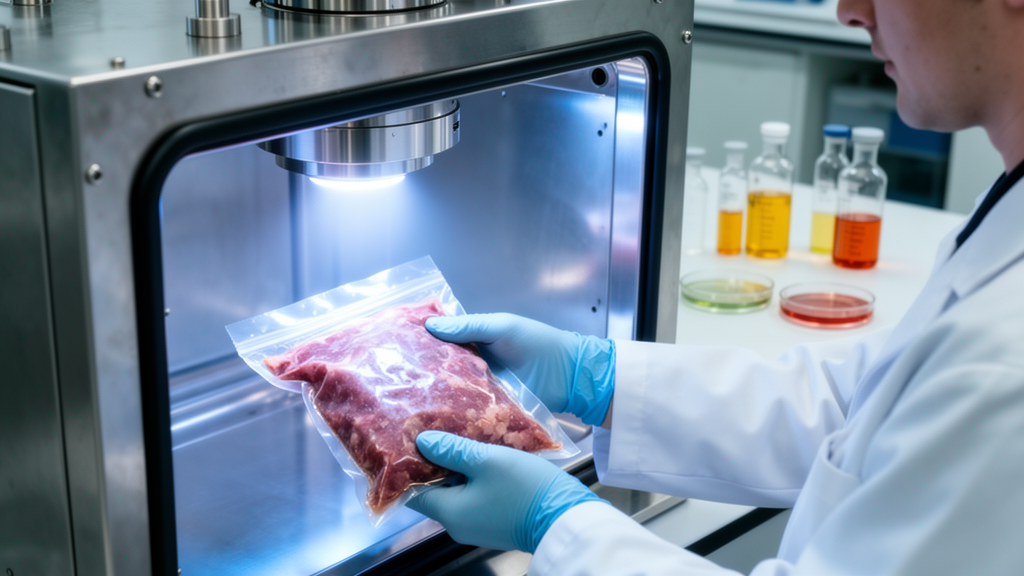
The treated samples then passed through a 10 MeV, 15 kW S-band linear accelerator at Texas A&M, configured with dual beams so that packages were irradiated simultaneously from top and bottom. This arrangement maximized dose uniformity, verified through dose mapping with a dose uniformity ratio close to 1.0. Absorbed doses were measured with calibrated alanine dosimeters traceable to National Institute of Standards and Technology standards. Samples received incremental target doses of 0, 2.5, 4, 7, 12.5, and 25 kilograys (kGy), allowing the researchers to construct log-linear survival curves and calculate the D10 value for each pathogen-product combination.
The D10 value, the dose required to reduce a microbial population by 90 percent (one log), is the key metric of radiation susceptibility. For the Listeria cocktail, D10 values ranged narrowly from 0.65 ± 0.01 kGy in the freeze-dried ground chicken formula to 1.15 ± 0.04 kGy in the freeze-dried duck nibs. Salmonella proved more matrix-dependent: its D10 values ranged from 0.55 ± 0.02 kGy in the frozen pork patty to 1.93 ± 0.10 kGy in the freeze-dried ground chicken formula. One-way analysis of variance showed that Salmonella D10 values varied significantly across product matrices, with freeze-dried beef liver, ground chicken, and pork patty showing notably higher resistance, whereas Listeria values remained relatively consistent. Within any single product, the two pathogens did not differ significantly from each other.
Moisture clearly mattered for Salmonella. The bacterium was roughly twice as sensitive in the frozen pork patty (D10 of 0.55 ± 0.02 kGy) as in its freeze-dried counterpart (1.13 ± 0.05 kGy), although this pattern did not hold for Listeria, and the differences were not statistically significant. From these D10 values, the team estimated the minimum doses needed for a validated 5-log pathogen reduction, a benchmark relevant to the U.S. Food and Drug Administration’s zero-tolerance policy for Salmonella in pet food. Those estimates ranged from 3.25 to 5.75 kGy for Listeria and from 2.75 to 9.65 kGy for Salmonella, depending on the matrix. Doses between 5 and 9.5 kGy could effectively achieve the greater-than-5-log reductions in the study, meaning the commercially relevant doses of 9.5 to 12.7 kGy applied in the nutritional phase of the work were comfortably sufficient for substantial microbial inactivation.
That nutritional phase was deliberately separate from the microbiological challenge. Seven of the eight products (freeze-dried salmon skin was excluded because its high fat content complicated sample preparation) were collected uninoculated, split into untreated controls and eBeam-treated groups of three samples each, and processed at a commercial facility, Next Beam in North Sioux City, South Dakota, at doses of 9.5 to 12.7 kGy. All samples were then shipped to an accredited third-party laboratory, Midwest Laboratories in Omaha, Nebraska, for a full panel of AAFCO-relevant analyses: proximate composition, amino acids, fatty acids, minerals, and vitamins, performed according to standard AOAC International methods. Comparisons used multiple unpaired t-tests with false discovery rate correction to control the Type I error rate across the many simultaneous comparisons.
The proximate results were unambiguous. Moisture, crude protein, crude fat, crude fiber, and ash showed no statistically significant differences between control and treated groups in any of the seven product formats (q > 0.05). Crude protein ranged from 48.30 ± 0.66 percent in the treated frozen pork patty to 76.10 ± 0.68 percent in the control freeze-dried chicken hearts, and fat ranged from about 10 percent in freeze-dried beef liver to over 46 percent in the treated frozen pork patty, reflecting formulation differences rather than treatment effects. Taurine and lysine, chosen as key nutritional markers for companion animals, were likewise unchanged, with taurine ranging from 0.12 to 1.06 percent and lysine from 3.52 to 5.99 percent across products. The omega-3 fatty acids DHA and EPA also remained statistically unchanged, although the fish-based whole minnow product showed numerical reductions of roughly 17.4 percent in DHA and 14.3 percent in EPA that did not reach significance after correction.
Vitamins emerged as the most sensitive nutrient class. Vitamin A showed statistically significant reductions in two products, the freeze-dried duck nibs (about 25.6 percent) and the frozen pork patty formula (about 28.4 percent). Vitamin E dropped significantly in the freeze-dried whole minnows by about 66.4 percent. Vitamin D3 remained largely stable, with only modest, non-significant declines in the minnows (about 7.6 percent) and duck nibs (about 12.1 percent), and the water-soluble B vitamins thiamine and riboflavin were well preserved across all formats. The authors note that commercial raw pet foods are typically formulated to exceed minimum AAFCO nutrient requirements, providing a buffer that can accommodate moderate processing-related losses, and that radiation-induced vitamin degradation is generally dose-dependent, so losses at the minimum effective doses of roughly 3.25 to 9.65 kGy would likely be proportionally smaller.
The study’s authors frame eBeam processing as a complement and alternative to existing interventions. Thermal methods such as retort processing at 121 to 140 °C and extrusion at 80 to 200 °C effectively sterilize pet food but fundamentally alter the native proteins, color, and heat-sensitive nutrients that define raw products. High pressure processing, currently the most widely adopted non-thermal technology in the raw pet food industry, works well in high-moisture formats but performs poorly in low-moisture, freeze-dried systems because pressure transfer requires sufficient water activity. Machine-based eBeam technology, which accelerates electrons from commercial electricity to near light speed using linear accelerators, requires no radioactive material, can be switched on and off as needed, operates at high dose rates, and can be applied to products after packaging, positioning it as a terminal decontamination step. Ionizing radiation for animal and pet food is permitted under U.S. regulation 21 CFR 579 for pathogen control and shelf-life extension.
The researchers also acknowledge limitations. The study evaluated only bacterial pathogens, so its results cannot be directly extrapolated to viruses such as highly pathogenic avian influenza, although prior work from the same laboratory and collaborators suggests eBeam doses in this range could contribute to viral load reduction, a question requiring direct experimental validation. Nutritional impact was assessed only at the commercial dose range rather than at minimum effective doses, and long-term nutrient stability, shelf life, lipid oxidation markers such as TBARS and peroxide values, instrumental color measurements, and sensory or palatability evaluations were beyond the scope of this initial investigation, with follow-up studies planned. Within those boundaries, the findings indicate that eBeam processing can serve as an effective non-thermal kill step for frozen and freeze-dried raw pet food, achieving substantial reductions of Salmonella and L. monocytogenes if present, while preserving proximate composition, amino acids, fatty acids, minerals, and most vitamins at doses the industry already employs.
Subject of Research: Electron beam processing to eliminate Salmonella and Listeria monocytogenes in frozen and freeze-dried raw pet food while assessing nutritional impact.
Article Title: Electron beam processing of freeze-dried and frozen raw pet food to eliminate Salmonella and Listeria monocytogenes: efficacy and nutritional impact
Article References: Wavare, N. S., Lara-Ramos, T. S., Ali, M., Jakeman, S. A., Pillai, S. D., & Praveen, C. (2026). Electron beam processing of freeze-dried and frozen raw pet food to eliminate Salmonella and Listeria monocytogenes: efficacy and nutritional impact. Frontiers in Veterinary Science, 13, Article 1904850. https://doi.org/10.3389/fvets.2026.1904850
Image Credits: AI Generated
DOI: 10.3389/fvets.2026.1904850
Keywords: electron beam, raw pet food, Salmonella, Listeria monocytogenes, food safety, non-thermal processing, irradiation, pet nutrition, freeze-dried, D10 value, pathogen inactivation, Electron
News Source: Daisy Hatcher. (October 29, 2026). Electron Beam Irradiation Kills Salmonella and Listeria in Raw Pet Food, Preserving Nutrients. Scienmag.