• HOME
  • NEWS
  • EXPLORE
    • CAREER
      • Companies
      • Jobs
    • EVENTS
    • iGEM
      • News
      • Team
    • PHOTOS
    • VIDEO
    • WIKI
  • BLOG
  • COMMUNITY
    • FACEBOOK
    • INSTAGRAM
    • TWITTER
Thursday, October 29, 2026
BIOENGINEER.ORG
No Result
View All Result
  • Login
  • HOME
  • NEWS
  • EXPLORE
    • CAREER
      • Companies
      • Jobs
        • Lecturer
        • PhD Studentship
        • Postdoc
        • Research Assistant
    • EVENTS
    • iGEM
      • News
      • Team
    • PHOTOS
    • VIDEO
    • WIKI
  • BLOG
  • COMMUNITY
    • FACEBOOK
    • INSTAGRAM
    • TWITTER
No Result
View All Result
Bioengineer.org
No Result
View All Result
Home NEWS Science News Biology

Optimized root-pulling force protocol speeds wheat root screening in sandy field

by
October 28, 2026
in Biology
Reading Time: 2 mins read
0
Optimized root-pulling force protocol speeds wheat root screening in sandy field

Optimized root-pulling force protocol speeds wheat root screening in sandy field

Share on FacebookShare on TwitterShare on LinkedinShare on RedditShare on Telegram

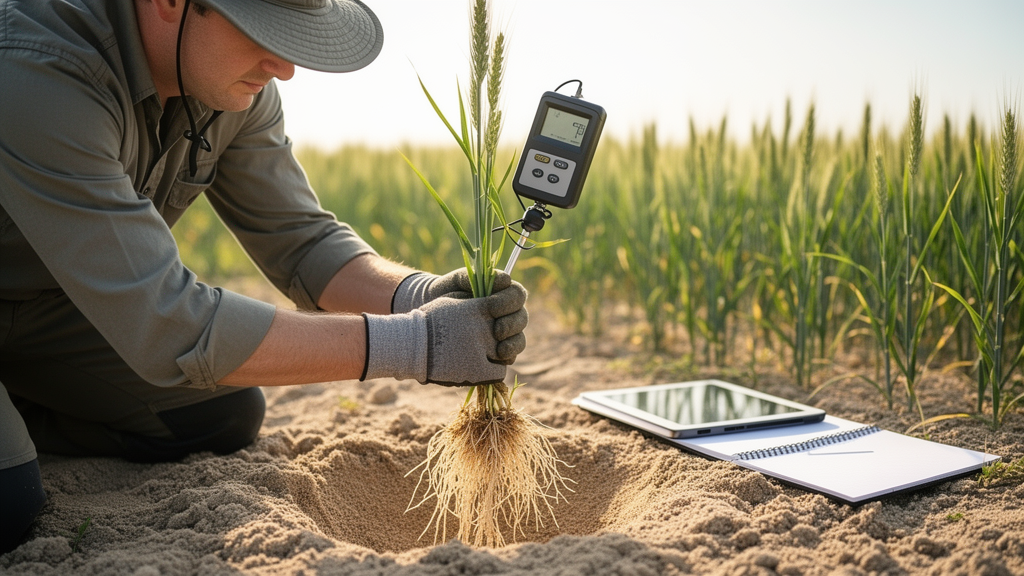
Researchers have established a simple vertical root-pulling force (RPF) protocol for characterizing wheat cybrids under the sandy field conditions of Tottori, Japan, offering a rapid field-based approach to assessing root system architecture (RSA). The work, published as an open-access research article in Plant Methods on 25 October 2026, addresses the need for practical phenotyping methods that can handle large numbers of plants directly in the field.

In mature plants, measured RPF ranged from 1.47 to 20.61 kg, while immature plants showed values from 0.58 to 6.79 kg. The optimized protocol allowed measurements at approximately 5 seconds per plant, with four concurrent operators able to process more than 1000 plants within 24 working hours. Importantly, the procedure allowed recovery of most of the visible root system with little visible breakage, meaning that plants could be assessed without destroying the majority of their root material.

The wheat cybrids examined displayed substantial variation in RSA-related traits, providing the genetic diversity needed to test how well RPF reflects underlying root characteristics. At maturity, RPF proved most reliable, achieving a repeatability of 0.83 and showing significant associations with root area, root biomass, and root-adhering soil mass.

In immature plants, however, the method performed considerably less well. Repeatability dropped to 0.13, and the line effect was not statistically significant (p = 0.052), indicating that RPF measurements in young plants should be treated with caution. The authors therefore position the protocol as an initial screening tool for mature wheat under the uniform sandy field conditions evaluated, rather than a universal solution for all growth stages or soil types.

The researchers are explicit about the method’s limits. RPF does not directly measure complete root system architecture, and root breakage or incomplete recovery cannot be excluded. Consequently, projected two-dimensional root area and other measurements taken from extracted roots should be interpreted as characteristics of the recovered root fraction rather than of the entire root system. Lines selected through RPF screening can subsequently be examined using more detailed root-phenotyping methods when additional architectural information is required.

Subject of Research: A rapid root-pulling force protocol for field phenotyping of wheat cybrid root systems in sandy soil

Article Title: Fast and efficient root phenotyping of wheat cybrids using an optimized root-pulling force protocol under Tottori sandy field conditions

Article References: Sugiura, R., Ikpa-Agodo, K. I., Okamoto, T., Ubi, B. E., & Ishii, T. (2026). Fast and efficient root phenotyping of wheat cybrids using an optimized root-pulling force protocol under Tottori sandy field conditions. Plant Methods. https://doi.org/10.1186/s13007-026-01605-7

Image Credits: AI Generated

DOI: 10.1186/s13007-026-01605-7

Keywords: wheat, root phenotyping, root-pulling force, root system architecture, cybrids, Tottori sandy field, field screening, plant methods, root biomass, repeatability, Fast, efficient

News Source: Alan Morgan. (October 28, 2026). Optimized root-pulling force protocol speeds wheat root screening in sandy field. Scienmag.


Tags: cybridsefficientfastfield screeningPlant Methodsrepeatabilityroot biomassroot phenotypingroot system architectureroot-pulling forceTottori sandy fieldwheat
Share12Tweet7Share2ShareShareShare1

Related Posts

TBHQ Shows Protective Effects Against Cisplatin-Induced Neurotoxicity in Rats

TBHQ Shows Protective Effects Against Cisplatin-Induced Neurotoxicity in Rats

October 29, 2026
Genomes of Tibetan Horpa Sheep Reveal Signatures of High-Altitude Selection

Genomes of Tibetan Horpa Sheep Reveal Signatures of High-Altitude Selection

October 29, 2026

12 Weeks of Elastic Band Training Linked to Better Balance and Gait in Older Adults with Sarcopenia

October 29, 2026

Essential Oils Show No Clear Methane-Cutting Effect in Dairy Cows, Meta-Analysis Finds

October 29, 2026

POPULAR NEWS

  • One Transformer Reads Three Brain-Signal Types at Once, Hitting 71% Accuracy

    One Transformer Reads Three Brain-Signal Types at Once, Hitting 71% Accuracy

    29 shares
    Share 12 Tweet 7
  • Research report: Case Report: Probable paroxysmal sympathetic hyperactivity during vascular and postoperative critical illness with bilateral white matter abnormalities

    29 shares
    Share 12 Tweet 7
  • Propionate, Not Extra Protein, Drives Reproductive Gains in Young Range Cows

    29 shares
    Share 12 Tweet 7
  • Deep Learning Model Predicts Adhesive Hydrogel Strength Under Distribution Shift

    29 shares
    Share 12 Tweet 7

About

We bring you the latest biotechnology news from best research centers and universities around the world. Check our website.

Follow us

Recent News

Stakeholder-led nutrition interventions fall short in Eastern Ethiopia, survey finds

Scientists Decode the Chemistry Behind Baijiu’s Aged Aroma Across Seven Brewing Rounds

Over Half of Rural Households in South Wollo, Ethiopia Face Severe Food Insecurity, Survey Finds

Subscribe to Blog via Email

Enter your email address to subscribe to this blog and receive notifications of new posts by email.

Join 85 other subscribers
  • Contact Us

Bioengineer.org © Copyright 2023 All Rights Reserved.

Welcome Back!

Login to your account below

Forgotten Password?

Retrieve your password

Please enter your username or email address to reset your password.

Log In
No Result
View All Result
  • Homepages
    • Home Page 1
    • Home Page 2
  • News
  • National
  • Business
  • Health
  • Lifestyle
  • Science

Bioengineer.org © Copyright 2023 All Rights Reserved.