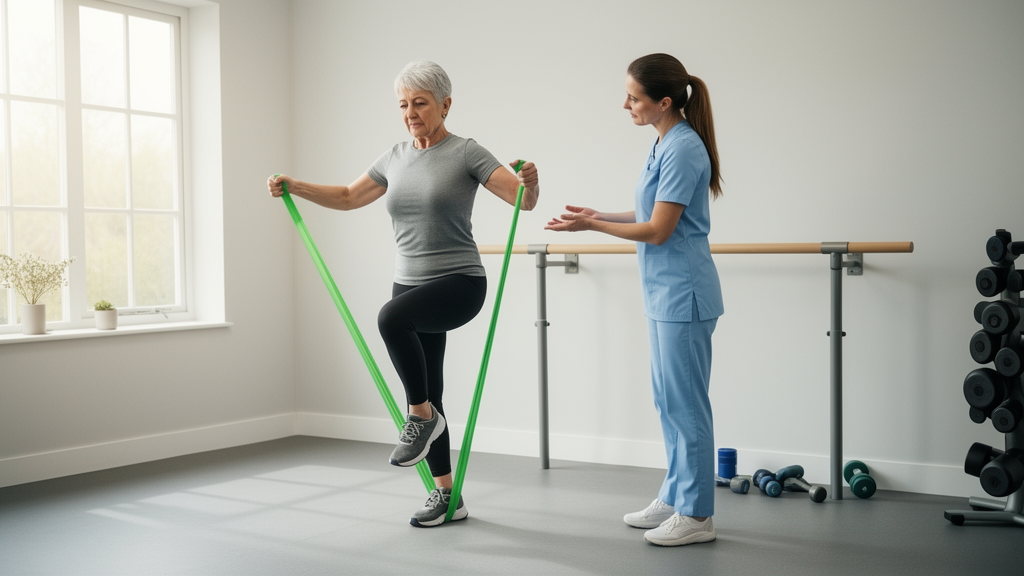
Older adults with sarcopenia who completed a 12-week elastic band resistance training program showed measurable improvements in functional performance, balance scores, and gait symmetry, according to a single-arm pre–post study conducted by researchers at Jilin Sport University in Changchun, China. The study, published in Frontiers in Physiology, recruited 120 community-dwelling older adults with sarcopenia, of whom 102 participants aged 61.5 to 73.1 years completed the full intervention and the post-intervention assessments.
Sarcopenia is characterized by progressive declines in skeletal muscle mass and physical function, resulting in impaired mobility, balance deficits, and gait abnormalities in older adults. Although elastic band resistance training has previously been reported to improve muscle strength and functional performance, its associations with sit-to-stand performance, task-related lower-limb electromyographic activity, balance function, and gait symmetry in this population had remained insufficiently understood. The new study was designed to evaluate pre–post changes across these outcomes over the 12-week program.
The primary outcome reported was the change in Five Times Sit-to-Stand Test (FTSST) completion time from baseline to 12 weeks. Secondary functional outcomes included the Timed Up and Go Test (TUGT) and sit-to-stand transfer time. In addition, the researchers assessed lower-limb surface electromyography, using task-normalized root mean square (RMS) and integrated electromyography (IEMG), along with the Berg Balance Scale (BBS) and gait symmetry indices covering step length, stance phase, swing phase, and contact time. All measures were taken before and after the intervention, and pre–post differences were analyzed using paired statistical tests with Holm adjustment within specified families of secondary outcomes.
At the post-intervention assessment, lower-limb functional performance was better, as reflected by reduced completion times on the FTSST, the TUGT, and the sit-to-stand transfer task. Faster times on these tests indicate that participants could rise from a chair repeatedly and complete timed mobility tasks more quickly after the training period than they had at baseline.
The electromyographic findings showed a distinct pattern. RMS values were lower in all examined muscles after the program, whereas IEMG values were higher only in the bilateral rectus femoris and tibialis anterior muscles after Holm adjustment for multiple comparisons. The authors note that limitations of between-session EMG comparisons further constrain interpretation of these changes.
Balance performance also improved.
All gait symmetry indices were lower at the post-intervention assessment, indicating reduced inter-limb asymmetry during walking. Reduced asymmetry is relevant in sarcopenia, where gait abnormalities are among the characteristic functional consequences of declining muscle mass and function.
The study’s conclusion is deliberately cautious. Among the 102 participants who completed both baseline and post-intervention assessments, functional performance, balance scores, and gait symmetry measures improved over the 12-week exercise program.
Attrition also constrains the findings. Of the 120 participants originally recruited, 18 did not complete the 12-week intervention and post-intervention assessments, and the authors state that this attrition, together with the EMG comparison limitations, further restricts interpretation. The researchers call for controlled studies to investigate training effects and the persistence of the observed changes, noting that whether the improvements last beyond the immediate post-intervention assessment remains an open question.
The study was received by the journal on 17 August 2026 and accepted on 6 October 2026, with the final formatted version to be published subsequently. The work was led by Zhengbin Li, with Fei Gao, Yang Liu, and corresponding author Na Liu, all affiliated with Jilin Sport University. As a single-arm pre–post study without a control group, the findings should be read as an association observed over a training period in a defined group of older adults with sarcopenia, rather than as proof that the elastic band program caused the improvements. Controlled trials will be needed to establish the program’s specific effects and their durability.
Subject of Research: The effects of a 12-week elastic band resistance training program on functional performance, muscle activation, balance, and gait symmetry in older adults with sarcopenia.
Article Title: Changes in functional performance, lower-limb muscle activation, balance, and gait symmetry after a 12-week elastic band resistance training program in older adults with sarcopenia: a single-arm pre–post study
Article References: Li, Z., Gao, F., Liu, Y., & Liu, N. (2026). Changes in functional performance, lower-limb muscle activation, balance, and gait symmetry after a 12-week elastic band resistance training program in older adults with sarcopenia: a single-arm pre–post study. Frontiers in Physiology, 17, Article 1970041. https://doi.org/10.3389/fphys.2026.1970041
Image Credits: AI Generated
DOI: 10.3389/fphys.2026.1970041
Keywords: sarcopenia, elastic band resistance training, older adults, balance, gait symmetry, sit-to-stand, electromyography, Berg Balance Scale, physical function, single-arm study, resistance exercise, Changes
News Source: Drew Townsend. (October 29, 2026). 12 Weeks of Elastic Band Training Linked to Better Balance and Gait in Older Adults with Sarcopenia. Scienmag.