


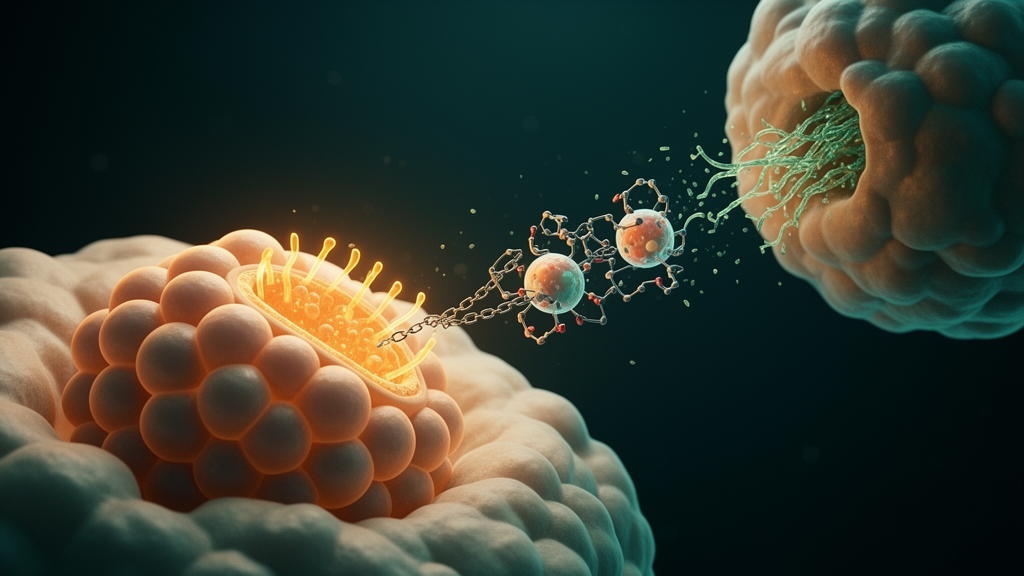
In the developing ovary of the fruit fly, a single developmental switch decides which cells will nurture stem cells and which will shepherd their daughters toward differentiation. A new study published in EMBO Reports shows that this decision hinges on an unexpected molecular arrangement: a Notch-driven E2-E3-E3 ubiquitin ligase module that destroys the Hedgehog pathway’s transcriptional effector and thereby silences Hedgehog signaling precisely where the stem cell niche must form.
The research, led by Hwei-Jan Hsu and colleagues, focuses on the Drosophila ovary, a system prized by developmental biologists because its germline stem cells and their supporting microenvironments are spatially well defined and genetically tractable. At the anterior tip of each egg-producing unit sits a cluster of cap cells that constitute the germline stem cell maintenance niche, secreting short-range BMP/Dpp signals that keep two to three adjacent germ cells in a self-renewing state. Just behind them, escort cells extend long protrusions that wrap developing germ cell cysts, insulating them from niche-derived self-renewal signals and creating the differentiation zone. Both cell types descend from a common pool of intermingled cells, yet how sibling cells from the same origin acquire such different identities has remained unresolved.
Using a ptc-lacZ reporter that reads out Hedgehog pathway activity, the team traced signaling across development. In late-third instar larval ovaries, the reporter was active in apical cells, intermingled cells, and cap cell precursors. By the mid-pupal stage and into the adult germarium, however, the signal persisted in escort cells and sheath cells but was extinguished in mature cap cells. This dynamic pattern suggested that Hedgehog signaling, which maintains intermingled cell identity, must be actively shut down in the subset of cells that become cap cells, while remaining on in those destined for the escort cell lineage.
To test whether Hedgehog activity itself dictates the choice, the researchers manipulated Cubitus interruptus, or Ci, the transcriptional effector of the pathway. When they depleted Ci in intermingled cells from the mid-late larval stage through adulthood, cells in the escort cell region began to resemble cap cells: they turned on LamC, a cap cell nuclear envelope marker, lost ptc-lacZ expression, and acquired cap-cell-associated markers including Bab2 and E-cadherin. These CpC-like cells appeared in roughly 70 to 90 percent of examined germaria, typically two to five per germarium, and some were positioned next to ectopic germline stem cells showing BMP-dependent signaling revealed by pMad staining. Clonal analysis using a flip-out system reinforced the point: among Ci-depleted germaria, the proportion containing only escort cell clones dropped by about 30 percent, while the proportion containing only cap cell clones rose roughly ninefold, indicating that losing Ci pushes intermingled cells toward a cap-cell fate in a cell-autonomous manner.
The converse experiment produced the mirror-image outcome. When the team stabilized Ci using a degradation-resistant mutant called Cim1-6, over half of the manipulated germaria developed escort-like cells within or near the cap cell region, marked by reduced LamC, elevated ptc-lacZ, cytoplasmic punctate Ci, and extended protrusions labeled by the fz3-RFP escort cell reporter. These cells could contact germline stem cells, but E-cadherin at the junctions was reduced compared with normal cap cell-stem cell contacts, indicating weaker anchorage. Notably, simply knocking down Ptc or expressing a partial-degradation-resistant Ci mutant failed to activate the pathway in cap cells, whereas depleting HIB or Cul3, components of the machinery that fully degrades Ci, reproduced the Cim1-6 phenotype. Full degradation of Ci, the authors conclude, is what normally extinguishes Hedgehog output and permits proper cap cell formation.
The next question was what triggers this degradation at the right place and time. Because Notch signaling is a known driver of cap cell specification, the team generated Notch mutant clones in larval intermingled cells by mitotic recombination. Mutant cap cells showed markedly elevated ptc-lacZ, reduced E-cadherin at stem cell junctions, and escort-like features, and mosaic ovaries shifted toward escort cell fates. Apoptosis controls ruled out cell death as the cause of missing cap cell clones, and Ci protein levels rose in Notch-depleted ovaries. Strikingly, co-expressing stabilized Ci with the activated Notch intracellular domain suppressed the ectopic cap cells that NICD alone induces, placing Hedgehog suppression downstream of Notch in the specification cascade.
The search for the molecular link between the two pathways led to an E2 ubiquitin-conjugating enzyme called Ubc10. An in silico survey of 58 candidate genes identified a putative Suppressor of Hairless binding motif in the Ubc10 promoter with a score comparable to known Notch target genes. In S2 cell luciferase assays, activated Notch increased activity of a 1.7-kilobase Ubc10 promoter reporter by about 1.7-fold, and in situ hybridization showed Ubc10 transcripts rising in the niche region upon NICD overexpression and falling when Notch was depleted. Functionally, Ubc10 knockdown phenocopied Notch loss and Ci stabilization, producing escort-like cells and reducing cap cell and germline stem cell numbers, and Western blotting showed Ci accumulation upon Ubc10 depletion. Most tellingly, overexpressing Ubc10 almost fully rescued the reduced ovary size and lost mature egg production caused by Notch knockdown, and partially restored cap cells and germline stem cells, while Ubc10 depletion partially suppressed NICD-induced ectopic cap cells. Ubc10, the authors conclude, is necessary but not sufficient for cap cell specification downstream of Notch.
The surprise came when the team asked which E3 ligases Ubc10 serves. Ubc10 is known to partner with Ariadne-1, a RING-between-RING type E3 ligase, and both were expressed in cap cells according to GAL4 reporter lines. Depleting Ari-1 in intermingled cells reduced cap cells and germline stem cells and generated escort-like cells, mirroring the effects of losing Notch, Ubc10, or Cul3. Proximity ligation assays, which detect proteins within roughly 40 nanometers of each other in intact tissue, revealed close association between Ari-1 and Cul3, between Ubc10 and Cul3, and between Ari-1 and Ubc10 in germaria. When the proteasome inhibitor MG132 was used to stabilize Ci, all three components showed proximity signals with Ci. Immunoprecipitation from ovaries co-expressing tagged versions confirmed that Ari-1 pulled down Ci, Cul3, and Ubc10 together, supporting the existence of an integrated E2-E3-E3 ubiquitination module assembled around the Hedgehog effector.
The architecture echoes an emerging theme in ubiquitin biology, in which multiple E3 ligases cooperate to tag a substrate, a strategy previously demonstrated biochemically in human cells where neddylated Cullin-RING ligases recruit and activate ARIH1, and in vivo in C. elegans pharyngeal development. Here, the authors propose that neddylated Cul3, guided by the substrate adapter HIB, recruits the Ubc10-Ari-1 pair, allowing ubiquitin transfer onto Ci and its destruction. Notably, the developmental cue in this case acts at the level of the E2 enzyme rather than the E3, a paradigm the authors suggest may operate broadly in cell-fate decisions, since E2 enzymes, though far fewer in number than E3 ligases, largely determine ubiquitin chain type and length.
There are signs the mechanism is conserved. In human HEK293T cells, the human orthologs ARIH1, CUL3, and GLI2 co-precipitated in immunoprecipitation assays, suggesting that a comparable E3-E3 team-tagging module may regulate Hedgehog signaling in mammals, where Notch is also known to restrain GLI2 activity in skin. The authors caution that the small number of cap cells per ovary makes direct biochemical reconstitution of the full reaction impossible for now, and future work with purified components will be needed to demonstrate sequential ubiquitin transfer and map the chain architecture on endogenous Ci. They also note that other inputs, including insulin and TOR signaling, contribute to niche formation, so Notch is unlikely to be the sole instructive signal. Even with those caveats, the study delivers a concrete answer to a long-standing question: the stem cell niche and the differentiation zone are carved apart because Notch, acting through a three-enzyme ubiquitin assembly, switches off Hedgehog in exactly the cells that must become niche.
Subject of Research: How Notch-directed E2-E3-E3 ubiquitin ligase assembly silences Hedgehog signaling to pattern the Drosophila germline stem cell niche
Article Title: Notch-hedgehog antagonism regulates stem cell niche formation through an E2-E3-E3 ubiquitin module
Article References: Wang, Y.-T., Lai, C.-M., Chen, T.-A., Chu, W.-C., Kao, C.-H., Lin, C.-H., Amartuvshin, O., Lin, K.-Y., Huang, W.-C., Chen, R.-H., & Hsu, H.-J. (2026). Notch-hedgehog antagonism regulates stem cell niche formation through an E2-E3-E3 ubiquitin module. EMBO Reports. https://doi.org/10.1038/s44319-026-00939-6
Image Credits: AI Generated
DOI: 10.1038/s44319-026-00939-6
Keywords: Notch signaling, Hedgehog signaling, ubiquitin ligase, stem cell niche, Drosophila ovary, cap cells, Ci degradation, Ubc10, Ari-1, Cul3, E2-E3-E3 module, cell fate specification
News Source: Drew Townsend. (October 29, 2026). Notch Turns Off Hedgehog Through a Three-Enzyme Ubiquitin Module to Build the Stem Cell Niche. Scienmag.



