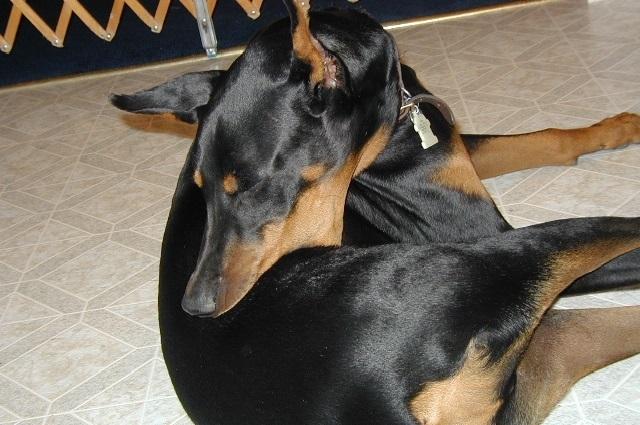
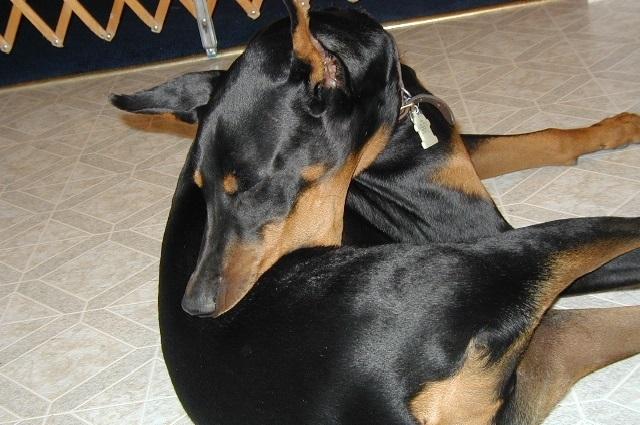
Research led by investigators in veterinary and human medicine has identified genetic pathways that exacerbate severity of canine compulsive disorder in Doberman pinschers, a discovery that could lead to better therapies for obsessive compulsive disorder in people. The discovery appears online in advance of print on Feb. 29, 2016 in the International Journal of Applied Research in Veterinary Medicine.
"Dogs naturally suffer complex diseases, including mental disorders that are similar to those in humans. Among those is canine compulsive disorder (CCD), the counterpart to human obsessive compulsive disorder (OCD)," says the study's first and corresponding author Nicholas Dodman, BVMS, DACVA, DACVB, professor in clinical sciences and section head and program director of animal behavior at Cummings School of Veterinary Medicine at Tufts University.
OCD is one of the world's most common neuropsychiatric disorders, affecting an estimated 1 to 3 percent of people and listed by the World Health Organization as among the 20 most disabling diseases. OCD is often characterized by distressing thoughts and time-consuming, repetitive behaviors, while canine compulsions may include repetitive tail chasing, excessive grooming and flank and blanket sucking. Current OCD therapies are not as effective as they could be; medicinal treatment benefits only about half of all human patients. No previously recorded study in humans or dogs has addressed the factors that drive severity in OCD and CCD.
"Genomic research on human neuropsychiatric disorders can be challenging due to the genetic heterogeneity of disease in humans," says neurologist Edward Ginns, MD, PhD, professor of psychiatry, neurology, pediatrics and clinical pathology, and director, program in medical genetics at the University of Massachusetts Medical School and a co-author on the new study. "Canine compulsive disorder shares behavioral hallmarks, pharmacological responsiveness, and brain structural homology with human OCD, and thus is expected to be an important animal model."
The research team compared whole genome sequencing of 70 Doberman pinschers to search for inherited factors that exacerbate CCD. Researchers identified two loci on chromosomes that were strongly correlated with severe CCD, as well as a third locus that showed evidence of association.
The locus most strongly associated with severe CCD was found on chromosome 34 — a region containing three serotonin receptor genes.
"This is particularly significant because drugs that work on the serotonin system are the mainstay treatment for OCD in humans, which demonstrates further correlation between the human and animal models," says Dodman.
The second locus significantly correlated with severe CCD was on chromosome 11, the same chromosome that contains a gene thought to increase the risk of schizophrenia in humans. This discovery, along with suggestive evidence found on chromosome 16 linking CCD to stress tolerance, may also be relevant to the pathophysiology of OCD, according to the study authors. "Comparative genomics is a particularly attractive approach to reveal the molecular underpinnings of disease in inbred animals with the hope of gaining new insights into these diseases in dogs and humans," says Ginns.
The study builds on more than a decade of research from Cummings School of Veterinary Medicine and the University of Massachusetts Medical School that in 2010 initially found the neural cadherin (CDH2) gene on canine chromosome 7 appeared to coincide with an increased risk of OCD. Additionally, 2013 MRI research from Cummings School of Veterinary Medicine at Tufts University and McLean Imaging Center at McLean Hospital showed that the structural brain abnormalities of Doberman pinschers afflicted with canine compulsive disorder (CCD) were similar to those of humans with OCD.
"If the canine construct is fully accepted by other OCD researchers, this spontaneously-occurring model of the condition in humans, right down to the biological pathways involved, could help point the way to novel and more effective treatments for such a debilitating condition," Dodman says.
###
Additional study authors are Louis Shuster, professor emeritus at Tufts University Medical School; Alice A. Moon-Fanelli, formerly of Cummings School of Veterinary Medicine at Tufts University; Marzena Galdzicka, University of Massachusetts Medical School; Jiashun Zheng, University of California, San Francisco; Alison L. Ruhe, ProjectDog, and Mark W. Neff, formerly with the Van Andel Institute.
Support for the new study came from Tufts University Cummings School of Veterinary Medicine, the University of Massachusetts Medical School and the Van Andel Research Institute.
Dodman NH, Ginns EI, Shuster L, Moon-Fanelli AA, Galdzicka M, Zheng J, Ruhe AL, Neff MA, "Genomic risk for severe canine compulsive disorder, a dog model of human OCD," International Journal of Applied Research in Veterinary Medicine 2016 Vol. 14, No.1
Contacts:
Taraneh Pettinato
508-839-7910
[email protected]
Kim Thurler
617-627-3175
[email protected]
About Cummings School of Veterinary Medicine at Tufts University
Founded in 1978 in North Grafton, Mass., Cummings School of Veterinary Medicine at Tufts University is internationally esteemed for academic programs that impact society and the practice of veterinary medicine; three hospitals and two clinics that combined log more than 80,000 animal cases each year; and groundbreaking research that benefits animal, public, and environmental health.
Media Contact
Kim Thurler
[email protected]
617-627-3175
@TuftsUniversity
http://www.tufts.edu