• HOME
  • NEWS
  • EXPLORE
    • CAREER
      • Companies
      • Jobs
    • EVENTS
    • iGEM
      • News
      • Team
    • PHOTOS
    • VIDEO
    • WIKI
  • BLOG
  • COMMUNITY
    • FACEBOOK
    • INSTAGRAM
    • TWITTER
Sunday, August 23, 2026
BIOENGINEER.ORG
No Result
View All Result
  • Login
  • HOME
  • NEWS
  • EXPLORE
    • CAREER
      • Companies
      • Jobs
        • Lecturer
        • PhD Studentship
        • Postdoc
        • Research Assistant
    • EVENTS
    • iGEM
      • News
      • Team
    • PHOTOS
    • VIDEO
    • WIKI
  • BLOG
  • COMMUNITY
    • FACEBOOK
    • INSTAGRAM
    • TWITTER
  • HOME
  • NEWS
  • EXPLORE
    • CAREER
      • Companies
      • Jobs
        • Lecturer
        • PhD Studentship
        • Postdoc
        • Research Assistant
    • EVENTS
    • iGEM
      • News
      • Team
    • PHOTOS
    • VIDEO
    • WIKI
  • BLOG
  • COMMUNITY
    • FACEBOOK
    • INSTAGRAM
    • TWITTER
No Result
View All Result
Bioengineer.org
No Result
View All Result
Home NEWS Science News Chemistry

New unprinting method can help recycle paper and curb environmental costs

Bioengineer by Bioengineer
June 26, 2019
in Chemistry
Reading Time: 2 mins read
0
IMAGE
Share on FacebookShare on TwitterShare on LinkedinShare on RedditShare on Telegram

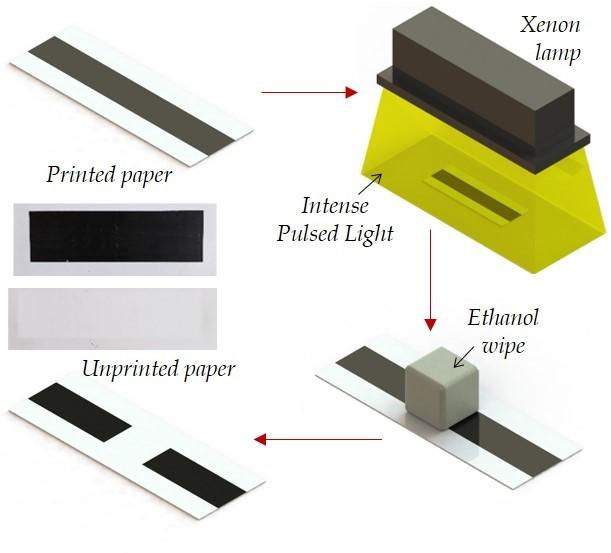
Rutgers-led study shows the benefits of removing toner with pulses of intense xenon light
IMAGE

Credit: Rajiv Malhotra/Rutgers University-New Brunswick

Imagine if your printer had an “unprint” button that used pulses of light to remove toner – and thereby quintupled the lifespan of recycled paper.

A Rutgers-led team has created a new way to unprint paper that, unlike laser-based methods, can work with the standard, coated paper used in home and office printers. The new method uses pulses of light from a xenon lamp, and can erase black, blue, red and green toners without damaging the paper, according to a study in the Journal of Cleaner Production.

“Our method makes it possible to unprint and then reprint on the same paper at least five times, which is typically as many times paper can be reused with conventional recycling. By eliminating the steps involved in conventional recycling, our unprinting method could reduce energy costs, pollution and greenhouse gas emissions,” said study coauthor Rajiv Malhotra, an assistant professor in the Department of Mechanical and Aerospace Engineering in the School of Engineering at Rutgers University-New Brunswick.

Conventional recycling of coated paper is a major contributor to climate change emissions, chemical pollution and energy use, according to the study. Extending the life of paper while avoiding these recycling steps would yield significant environmental benefits.

The engineers’ next steps are to further refine the method by testing additional toner colors on a wider range of paper types. Unprinting can be done with simple equipment and a wipe with a very small amount of benign alcohol, and the engineers are working to integrate unprinting with typical office and home printers.

###

The study’s lead author is Michael Dexter, a former Rutgers engineering doctoral student. Former undergraduate engineering student Keri Rickman contributed to the study, along with researchers at Oregon State University.

Media Contact
Todd Bates
[email protected]

Original Source

https://news.rutgers.edu/new-unprinting-method-can-help-recycle-paper-and-curb-environmental-costs/20190625#.XRIurrxKi70

Related Journal Article

http://dx.doi.org/10.1016/j.jclepro.2019.05.387

Tags: Climate ChangeEcology/EnvironmentEnvironmental HealthMaterialsMechanical EngineeringPollution/RemediationPublic HealthResearch/DevelopmentTechnology/Engineering/Computer Science
Share12Tweet8Share2ShareShareShare2

Related Posts

Scientists uncover design rules for high-performance thermoelectric materials

Scientists uncover design rules for high-performance thermoelectric materials

August 22, 2026
Bringing Optical Fibre Materials to Photonic Chips

Bringing Optical Fibre Materials to Photonic Chips

August 22, 2026

Nanoscience and Liquid Crystals Unite in Functional Hybrids With Transformative Applications

August 22, 2026

Designing Better Biomedical Hydrogels Through Molecular Building Blocks and Hierarchical Structures

August 22, 2026
Please login to join discussion

POPULAR NEWS

  • KAIST Surface Defects Boost Droplet Formation, Removal, and Heat Transfer by 5.5-Fold

    29 shares
    Share 12 Tweet 7
  • Dual-oxygen pancreatic cancer organoids mirror basal-classical diversity, spatial transcriptomics confirms

    29 shares
    Share 12 Tweet 7
  • Tirzepatide Versus GLP-1 Agonists for Stroke Risk in Atrial Fibrillation and Diabetes

    29 shares
    Share 12 Tweet 7
  • Real-world study examines psychotic complications of subcutaneous foslevodopa/foscarbidopa infusions in 198 patients

    29 shares
    Share 12 Tweet 7

About

We bring you the latest biotechnology news from best research centers and universities around the world. Check our website.

Follow us

Recent News

KAIST Surface Defects Boost Droplet Formation, Removal, and Heat Transfer by 5.5-Fold

Dual-oxygen pancreatic cancer organoids mirror basal-classical diversity, spatial transcriptomics confirms

Tirzepatide Versus GLP-1 Agonists for Stroke Risk in Atrial Fibrillation and Diabetes

Subscribe to Blog via Email

Enter your email address to subscribe to this blog and receive notifications of new posts by email.

Join 85 other subscribers
  • Contact Us

Bioengineer.org © Copyright 2023 All Rights Reserved.

Welcome Back!

Login to your account below

Forgotten Password?

Retrieve your password

Please enter your username or email address to reset your password.

Log In
No Result
View All Result
  • Homepages
    • Home Page 1
    • Home Page 2
  • News
  • National
  • Business
  • Health
  • Lifestyle
  • Science

Bioengineer.org © Copyright 2023 All Rights Reserved.