Recycling is just as essential in cells as in our more familiar macroscopic world. Cells continuously generate waste products and accumulate damaged components while performing regular functions. Various recycling mechanisms have evolved to ensure efficient use of these resources and help maintain homeostasis, with autophagy being one of the most well-preserved among countless animal, plant, and fungal lineages.
Credit: Tokyo Tech
Recycling is just as essential in cells as in our more familiar macroscopic world. Cells continuously generate waste products and accumulate damaged components while performing regular functions. Various recycling mechanisms have evolved to ensure efficient use of these resources and help maintain homeostasis, with autophagy being one of the most well-preserved among countless animal, plant, and fungal lineages.
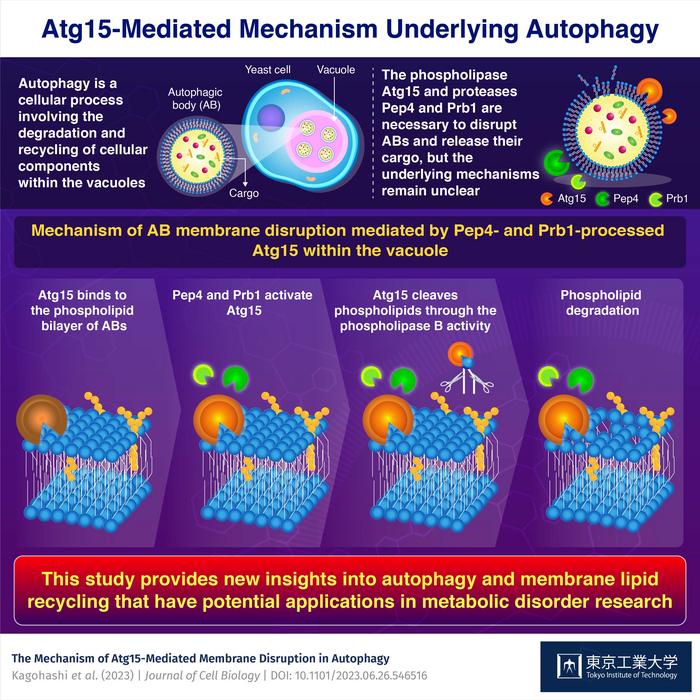
In the main form of autophagy, materials floating in the cell are transported to specialized organelles, such as lysosomes or vacuoles, within small capsule-like structures called autophagosomes. Once these autophagosomes reach inside the lysosomes or vacuoles, they are called autophagic bodies (ABs). To degrade the cargo contained in ABs—a process called autophagy—the proteins within the lysosome or vacuole begin by breaking down the phospholipid bilayers enveloping the ABs. Previous research identified a few key players in this process, namely the proteins Atg15, Pep4, and Prb1. However, the interrelation between these proteins and underlying mechanisms is still unclear.
Recently, a research team from Tokyo Institute of Technology, Japan, has made substantial progress toward solving this puzzle. In a recent study published in the Journal of Cell Biology and led by 2016 Nobel laureate Professor Yoshinori Ohsumi and Assistant Professor Kawamata, they used yeast as a model organism to shed light on some of the intricacies of autophagy. “The relative simplicity of yeast vacuolar enzymes was particularly advantageous for our study as it allowed us to clarify the relationship between protein- and lipid-breaking activity in the vacuole,” explains first author Kagohashi.
By applying in vitro assays involving lipid-degradation, the researchers demonstrated that Pep4 and Prb1 transform Atg15 into an ‘activated’ form. This step is necessary to enable Atg15 to break the phospholipid bilayer of ABs. The team confirmed these findings by testing various Atg15 mutants and yeast strains lacking the genes coding for Pep4 and Prb1. By tagging Atg15 with a probe, they also pinpointed the modifications that Pep4 and Prb1 make to Atg15 within the vacuole.
The team delved deeper into how Atg15 breaks down the phospholipid bilayer through further experiments using isolated ABs. These analyses revealed, for the first time, that Atg15 has phospholipase B activity—this allows Atg15 to cleave phospholipid molecules at two specific locations, thus efficiently disrupting the phospholipid membrane.
In summary, this work deepens our understanding of crucial cellular processes, as Dr. Kawamata remarks: “Characterization of lipid-breaking activity in the vacuole/lysosome is essential to understand how lipids are recycled. This study provides insights into the recycling of membrane lipids and informs work on a range of metabolic disorders.” As she notes, autophagy is implicated in many diseases and can also be an attractive drug target for new therapies.
Journal
Journal of Cell Biology
DOI
10.1083/jcb.202306120
Method of Research
Experimental study
Subject of Research
Not applicable
Article Title
The mechanism of Atg15-mediated membrane disruption in autophagy
Article Publication Date
2-Nov-2023