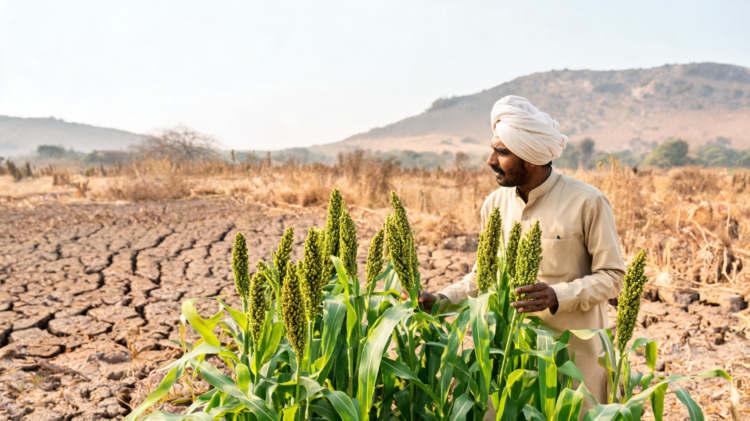
A new pearl millet hybrid named RHB 273 has been reported for drought-prone agricultural conditions in India, drawing attention to a crop widely associated with farming under heat, limited rainfall and difficult soils. The hybrid is presented in the Indian Journal of Genetics and Plant Breeding as a three-way hybrid developed for drought-prone ecology. Its release comes at a time when crop breeders are under pressure to maintain food production while rainfall becomes less predictable and water supplies remain constrained. The published record identifies RHB 273 as a varietal notification and germplasm registration, placing the work within India’s formal crop-improvement and variety-release system. The article does not provide a detailed dataset in the accessible record, so its significance rests primarily on the breeding objective and the formal documentation of the hybrid rather than on a set of publicly reported yield figures or stress-performance measurements.
Pearl millet, scientifically known as Pennisetum glaucum, is a cereal adapted to environments where many other staple crops face serious limitations. Its value in dryland agriculture comes from a combination of biological characteristics, including a capacity to complete its life cycle under relatively low water availability and to produce grain in hot regions. Those characteristics do not eliminate the risks posed by drought, however. The timing, severity and duration of water shortage can affect plant establishment, flowering, grain formation and final harvests. Breeding programs therefore seek combinations of traits that help plants remain productive across variable seasons. A hybrid such as RHB 273 is part of that broader strategy: rather than relying on a single parental line, breeders combine genetic material to create a crop intended for a defined production environment. The source article identifies the target ecology, but the available publication page does not disclose the specific parentage or the individual traits selected in the hybrid.
The phrase “three-way hybrid” describes a particular breeding structure. In a conventional single-cross hybrid, two parental lines are crossed to produce seed for cultivation. A three-way hybrid generally involves first producing a single-cross, then crossing that product with a third parental line. This arrangement can bring together genetic contributions from three sources and may be used to balance agronomic characteristics, seed-production requirements and field performance. In crops such as pearl millet, hybrid development also depends on reproductive biology and on systems that allow breeders to control which plants contribute pollen and which receive it. The precise crossing scheme used for RHB 273 is not described in the accessible source material, so it would be inappropriate to assign particular parental lines or mechanisms to this hybrid. What is documented is that the cultivar is classified as a three-way hybrid and was developed for drought-prone Indian ecology.
That breeding goal matters because drought is not a single problem experienced in the same way by every crop or every field. A shortage of water early in the season can reduce germination and stand establishment, while stress around flowering can interfere with pollination and grain set. Late-season drought can restrict grain filling, reducing the weight and quality of the harvest. Breeders may evaluate plants under managed stress, naturally dry locations or multiple environments to determine whether a promising line remains stable as conditions change. Such evaluations can involve measurements of flowering time, plant height, panicle characteristics, grain yield and response to water limitation, although none of those results are reported in the article record supplied here. RHB 273’s designation signals that adaptation to drought-prone conditions was central to its development, but the published information available for this report does not establish how it compares quantitatively with existing hybrids or varieties.
The researchers named on the article include S. K. Jain, Kuldeep Kandarkar, L. D. Sharma, S. K. Sharma, Vaibhav Sharma, B. L. Dhaka and Shashi Kumar Gupta, with an ellipsis in the online author display indicating that the full author list may extend beyond the names shown in the accessible preview. Their affiliations connect regional agricultural research with international crop science. Jain, L. D. Sharma, S. K. Sharma, Vaibhav Sharma and Dhaka are associated with the Rajasthan Agricultural Research Institute at Sri Karan Narendra Agriculture University in Durgapura, Jaipur, Rajasthan. Kandarkar and Gupta are affiliated with the International Crops Research Institute for the Semi-Arid Tropics in Hyderabad. The article records that all authors were involved in testing and release of the hybrid. This institutional combination reflects the practical nature of varietal development, which requires both breeding expertise and evaluation under the conditions where farmers may eventually grow the crop.
Formal notification and germplasm registration are important because a breeding result becomes useful to agriculture only when it can be identified, maintained and moved through recognized channels. A named hybrid provides a reference point for seed multiplication, evaluation and future comparison. Registration also helps distinguish the new material from other pearl millet germplasm and creates an official record of its development. Yet notification alone does not guarantee that a variety will perform identically across all drought-prone landscapes. Indian dryland regions differ in soil type, seasonal rainfall, temperature, sowing practices and disease pressure. Farmers and agricultural agencies typically need location-specific evidence before recommending a new hybrid widely. The accessible record for RHB 273 does not state its recommended maturity period, yield potential, disease resistance, seed rate, release zone or commercial availability. Those details will be essential for assessing how the hybrid fits into real farming systems.
The article’s data statement says that no datasets were generated or analysed during the current study. That declaration helps define the scope of the publication. It suggests that the report is focused on the notification, registration and release of the hybrid rather than on presenting a new, openly analysed experimental dataset. The source also states that the authors have no relevant financial or non-financial interests to disclose and that they declare no competing interests. The work was published by Springer in the Indian Journal of Genetics and Plant Breeding, with the record listing acceptance on 19 August 2026 and publication on 28 August 2026. Because the article is shown as a preview of subscription content, the accessible page offers only limited technical detail. A full evaluation of RHB 273 would require the complete paper or accompanying official release documents, including information on parental material, trial design, environments, statistical comparisons and the performance standards used for notification.
Even with those limitations, RHB 273 illustrates why pearl millet remains important in conversations about climate-resilient agriculture. Breeding for dry environments is not simply a search for plants that survive without water; it is an effort to produce reliable harvests while matching a crop to the realities of a region. A three-way hybrid can provide breeders with a structured way to combine genetic resources, but its value ultimately depends on testing, seed quality, farmer access and performance across the environments for which it was intended. The new record therefore represents a documented step in India’s continuing effort to improve pearl millet for water-limited agriculture, not a complete answer to drought risk. Further publicly available evidence will determine whether RHB 273 offers measurable advantages over existing materials. For now, the hybrid’s formal release places a new name into the country’s dryland breeding pipeline and highlights the technical work behind adapting staple crops to increasingly uncertain growing conditions.
The strongest conclusion supported by the available record is that RHB 273 has advanced through a formal recognition process, not that its agronomic superiority has been demonstrated in the published preview. “Varietal notification and germplasm registration” identifies the article’s administrative and breeding significance, while the absence of reported datasets limits what can be concluded about productivity, stability or stress tolerance. This distinction is important in crop science: a release designation records the status of a breeding product, whereas comparative evidence is needed to establish how consistently that product performs against established cultivars.
The timing of the publication also shows how quickly the report moved through the journal’s editorial stages. The manuscript was received on 25 July 2026, revised on 16 August, accepted on 19 August and published on 28 August. Those dates document the publication history of the report, but they do not provide information about the duration of the hybrid’s field testing before submission. Consequently, the accessible record cannot be used to infer how many seasons, locations or drought scenarios were represented during development. That missing context matters because drought response can vary substantially with the onset and duration of water shortage.
RHB 273’s identification as a three-way hybrid also has implications for how future seed and performance information should be interpreted. The hybrid name refers to a defined breeding product, but the source does not disclose the parental combinations, maintenance procedures or any distinguishing descriptors beyond its target ecology. Without those details, researchers and seed-production organizations cannot assess the genetic basis of its adaptation from the preview alone. The registration record nevertheless creates a stable identity around which subsequent agronomic testing, seed characterization and independent comparisons can be organized.
The article’s institutional affiliations provide a useful indication of the collaboration behind the release. The Rajasthan Agricultural Research Institute at Sri Karan Narendra Agriculture University and the International Crops Research Institute for the Semi-Arid Tropics are both represented among the authors, linking a Rajasthan-based agricultural research setting with an international organization focused on crops of the semi-arid tropics. The source states that all authors participated in testing and release. That statement supports viewing the report as a coordinated varietal-development contribution, while the absence of disclosed funding and competing interests removes no stated conflict from the record. More detailed assessment will depend on information not included in the accessible preview, particularly trial locations, comparison standards and the criteria used for notification.
Subject of Research: A three-way pearl millet hybrid developed for drought-prone ecology in India
Article Title: RHB 273: Three-Way Hybrid of Pearl Millet for Drought Prone Ecology of India
Article References: Jain, S. K., Kandarkar, K., Sharma, L. D., Sharma, S. K., Sharma, V., Dhaka, B. L., & Gupta, S. K. (2026). RHB 273: Three-Way Hybrid of Pearl Millet for Drought Prone Ecology of India. Indian Journal of Genetics and Plant Breeding. https://doi.org/10.1007/s44489-026-00047-8
Image Credits: AI Generated
DOI: 10.1007/s44489-026-00047-8
Keywords: pearl millet, RHB 273, three-way hybrid, drought resilience, crop breeding, dryland agriculture, India, germplasm registration, Three-Way, Hybrid, Pearl, Millet
Cite Scienmag News
APA MLA Chicago
Scienmag. (August 28, 2026). India’s New Pearl Millet Hybrid Targets Drought-Prone Farming Regions. https://scienmag.com/indias-new-pearl-millet-hybrid-targets-drought-prone-farming-regions/
Scienmag. “India’s New Pearl Millet Hybrid Targets Drought-Prone Farming Regions.” Scienmag, 28 August 2026, https://scienmag.com/indias-new-pearl-millet-hybrid-targets-drought-prone-farming-regions/. Accessed 28 August 2026.
Scienmag. “India’s New Pearl Millet Hybrid Targets Drought-Prone Farming Regions.” Scienmag. August 28, 2026. https://scienmag.com/indias-new-pearl-millet-hybrid-targets-drought-prone-farming-regions/
Copy citation Download RIS
Tags: climate-resilient agriculture in Indiacrop breedingdrought resiliencedrought-prone farming region crop solutionsdrought-resistant crop breeding Indiadrought-tolerant pearl millet hybrid developmentdryland agriculturedryland agriculture crop innovationsfood security and climate change Indiagermplasm registrationHybridhybrid crop variety registration IndiaIndiaMilletPearlpearl milletpearl millet cultivation under heat stresspearl millet genetic improvementpearl millet hybrid RHB 273 for drought-prone regionsPennisetum glaucum drought adaptationRHB 273Three-Waythree-way hybridwater-efficient cereal crops