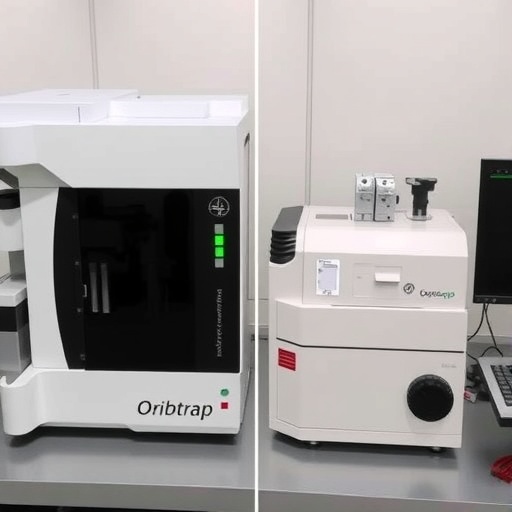
A New Mass-Spectrometry Showdown Reveals That “Seeing” Water’s Hidden Chemistry Depends on the Instrument
Dissolved organic matter, the invisible mixture of carbon-rich molecules flowing through oceans, rivers, soils and underground aquifers, has just delivered a warning to scientists: two of the most powerful tools used to study it do not necessarily see the same chemical world. In a comparison of Orbitrap and Fourier transform ion cyclotron resonance mass spectrometry, researchers found that both technologies could measure molecular masses with extraordinary precision, yet each instrument emphasized a different portion of the chemical landscape. The result is not a failure of either method, but evidence that environmental samples may require complementary analytical perspectives before their molecular diversity can be fully understood.
The finding matters because dissolved organic matter, or DOM, is far more than a passive form of carbon dissolved in water. It helps regulate the movement of carbon through ecosystems and the climate system, influences how pollutants travel, and affects the behavior of metals, nanoparticles and colloids. It also provides energy and nutrients for microorganisms. Yet DOM is composed of thousands of molecules, many of which are present at extremely low concentrations and have overlapping chemical properties. Researchers therefore rely on high-resolution mass spectrometry to create molecular “fingerprints” of samples. These fingerprints can reveal patterns linked to biological activity, soil processes, water movement and carbon persistence, but only if results from different laboratories and instruments can be interpreted consistently.
Charlotte Brun, Thomas Flahou, Mourad Harir, Christos Panagiotopoulos, Philippe Schmitt-Kopplin, Sébastien Schramm and Maxime C. Bridoux compared three platforms: two Fourier transform ion cyclotron resonance mass spectrometers operating at magnetic field strengths of 7 and 12 tesla, and an ultrahigh-resolution Orbitrap system. The team tested the instruments on marine, riverine, groundwater and terrestrial DOM. They also used two ionization approaches, electrospray ionization and atmospheric pressure photoionization, because molecules do not all respond to energy in the same way. Ionization converts molecules into charged particles, allowing the mass spectrometer to separate and detect them according to their mass-to-charge ratio, or m/z.
At first glance, the platforms appeared remarkably well matched. After internal recalibration, every instrument achieved mass accuracies below 0.2 parts per million. In practical terms, that means the measured mass of an ion differed from its expected value by less than two ten-millionths of the mass itself. The instruments also resolved mass differences smaller than 3.4 millidaltons, or 0.0034 unified atomic mass units. Such resolution is essential in DOM research because chemically different molecules can have nearly identical nominal masses. For example, replacing combinations of carbon, hydrogen, oxygen or nitrogen atoms can produce distinct molecular formulas separated by only a few thousandths of a mass unit. The close agreement in accuracy showed that calibration quality was not the main reason the instruments produced different molecular profiles.
Instead, the differences arose from what the instruments were able to detect. With electrospray ionization, the FT-ICR systems generally extended farther toward higher masses than the Orbitrap. The 12-tesla instrument produced a distribution centered near m/z 470, while the 7-tesla system displayed an additional high-mass mode around m/z 765. The Orbitrap generated a narrower distribution centered near m/z 400. These patterns suggest that the instruments were sampling different molecular windows rather than simply measuring the same mixture with different levels of precision. Larger or more chemically complex ions may be preferentially represented in one platform, while other species may be suppressed, fragmented or ionized less efficiently.
The pattern reversed in atmospheric pressure photoionization, where the Orbitrap reached particularly far into the low-mass range. Its advantage was most apparent between m/z 100 and 250, a region containing relatively small molecules that can be difficult to capture under other ionization conditions. Electrospray ionization is especially effective for polar and readily charged compounds, whereas photoionization relies on photons to generate ions and can favor compounds with different chemical characteristics. The choice of ionization method therefore acts as a chemical filter before the mass analyzer even begins separating ions. Two instruments can be perfectly calibrated and still produce contrasting pictures because the sample preparation, ionization physics, transmission efficiency and detection behavior differ.
Despite these biases, the study found a substantial common core. More than 3,000 compounds were reproducibly detected across most samples and instruments, and 51 percent of the assigned molecular formulas were shared by all three platforms. A molecular formula does not uniquely identify a molecule; many structural isomers can contain the same numbers of carbon, hydrogen, oxygen and nitrogen atoms. Even so, shared formulas provide a robust basis for comparing broad chemical patterns. The overlap indicates that the platforms can agree on a large fraction of DOM’s measurable composition, while the unmatched portion contains information that might be missed if researchers rely on a single technology.
The researchers tested whether the instrument-specific differences undermined environmental interpretation by applying two common approaches: Van Krevelen analysis and principal component analysis. A Van Krevelen diagram places molecular formulas according to their hydrogen-to-carbon and oxygen-to-carbon ratios, helping researchers distinguish broad classes of compounds such as lipid-like, protein-like, aromatic or highly oxidized material. Principal component analysis reduces complex datasets into statistical axes that capture the strongest patterns of variation among samples. Both methods consistently separated the samples according to their environmental origins. Groundwater and peatland fulvic acid emerged as distinct compositional endmembers, showing that source-related chemical signals remained visible even when the instruments detected different molecular subsets.
That result offers reassurance, but also a practical challenge for environmental chemists. A groundwater sample can carry a molecular signature shaped by minerals, microbial processing and long residence times below ground, while peatland-derived material reflects the breakdown and transformation of vegetation in carbon-rich soils. Marine and riverine DOM likewise represent mixtures influenced by biological production, terrestrial runoff and chemical degradation. If different instruments emphasize different mass ranges or ionization classes, comparisons between studies may exaggerate or obscure real environmental differences. The authors’ findings support a strategy in which Orbitrap and FT-ICR mass spectrometry are treated as complementary rather than interchangeable. Combining their results could broaden molecular coverage and reduce the risk that conclusions are driven by the blind spots of a particular platform.
The study also highlights a broader issue confronting modern environmental science: technological precision is not the same as chemical completeness. A mass spectrometer may distinguish ions with astonishing accuracy while still failing to detect molecules that ionize poorly, fall outside its optimal mass range or are lost during extraction and transfer. The researchers acknowledge that observed discrepancies were not primarily caused by measurement error, but by instrument-specific detection biases. For scientists tracking carbon cycling, pollutant transport or ecosystem change, that distinction is crucial. Reliable environmental fingerprints will require not only high-resolution instruments, but also shared protocols, transparent reporting of ionization conditions and awareness of which molecular windows each platform favors. The hidden chemistry of water is becoming visible—but, as this comparison shows, no single instrument can yet see all of it.
Subject of Research: Molecular analysis of dissolved organic matter using Orbitrap and Fourier transform ion cyclotron resonance mass spectrometry
Subject of Research: Chemistry
Article Title: Comparison of Orbitrap and Fourier transform ion cyclotron resonance mass spectrometry for the analysis of dissolved organic matter
Article References: Brun, C., Flahou, T., Harir, M., Panagiotopoulos, C., Schmitt-Kopplin, P., Schramm, S., & Bridoux, M. C. (2026). Comparison of Orbitrap and Fourier transform ion cyclotron resonance mass spectrometry for the analysis of dissolved organic matter. Environmental Chemistry Letters. https://doi.org/10.1007/s10311-026-01922-2
Image Credits: AI Generated
DOI: 10.1007/s10311-026-01922-2
Keywords: dissolved organic matter, Orbitrap mass spectrometry, FT-ICR mass spectrometry, environmental chemistry, molecular fingerprints, high-resolution mass spectrometry, carbon cycling, ionization techniques
Cite Scienmag News
APA MLA Chicago
Felix Penrose. (August 28, 2026). Orbitrap and FT-ICR Mass Spectrometry Compared for Analyzing Dissolved Organic Matter. Scienmag. https://scienmag.com/orbitrap-and-ft-icr-mass-spectrometry-compared-for-analyzing-dissolved-organic-matter/
Felix Penrose. “Orbitrap and FT-ICR Mass Spectrometry Compared for Analyzing Dissolved Organic Matter.” Scienmag, 28 August 2026, https://scienmag.com/orbitrap-and-ft-icr-mass-spectrometry-compared-for-analyzing-dissolved-organic-matter/. Accessed 28 August 2026.
Felix Penrose. “Orbitrap and FT-ICR Mass Spectrometry Compared for Analyzing Dissolved Organic Matter.” Scienmag. August 28, 2026. https://scienmag.com/orbitrap-and-ft-icr-mass-spectrometry-compared-for-analyzing-dissolved-organic-matter/
Copy citation Download RIS
Tags: advanced techniquescarbon cycling in ecosystemscomplementary analytical tools for water chemistrydetecting low-concentration organic molecules in waterdetection of low-concentration organic moleculesdissolved organic matter analysisenvironmental molecular characterizationenvironmental sample analysisFT-ICR mass spectrometry comparisonFT-ICR mass spectrometry for environmental sampleshigh-resolution mass spectrometry in water chemistryhigh-resolution mass spectrometry techniquesimpact of analytical techniques on water chemistry studiesimportance of complementary mass spectrometry methodsinfluence of mass spectrometry on pollutant trackinglimitations of mass spectrometry methodsmolecular diversity in aquatic systemsmolecular diversity of aquatic dissolved organic matterOrbitrap mass spectrometryOrbitrap mass spectrometry comparisonrole of mass spectrometry in climate-related organic matter researchunderstanding carbon cycling through mass spectrometrywater chemistry analysis