• HOME
  • NEWS
  • EXPLORE
    • CAREER
      • Companies
      • Jobs
    • EVENTS
    • iGEM
      • News
      • Team
    • PHOTOS
    • VIDEO
    • WIKI
  • BLOG
  • COMMUNITY
    • FACEBOOK
    • INSTAGRAM
    • TWITTER
Monday, May 11, 2026
BIOENGINEER.ORG
No Result
View All Result
  • Login
  • HOME
  • NEWS
  • EXPLORE
    • CAREER
      • Companies
      • Jobs
        • Lecturer
        • PhD Studentship
        • Postdoc
        • Research Assistant
    • EVENTS
    • iGEM
      • News
      • Team
    • PHOTOS
    • VIDEO
    • WIKI
  • BLOG
  • COMMUNITY
    • FACEBOOK
    • INSTAGRAM
    • TWITTER
  • HOME
  • NEWS
  • EXPLORE
    • CAREER
      • Companies
      • Jobs
        • Lecturer
        • PhD Studentship
        • Postdoc
        • Research Assistant
    • EVENTS
    • iGEM
      • News
      • Team
    • PHOTOS
    • VIDEO
    • WIKI
  • BLOG
  • COMMUNITY
    • FACEBOOK
    • INSTAGRAM
    • TWITTER
No Result
View All Result
Bioengineer.org
No Result
View All Result
Home NEWS Science News Chemistry

New study presents transformative metasurface based on zerogap embedded template

Bioengineer by Bioengineer
July 6, 2021
in Chemistry
Reading Time: 2 mins read
0
IMAGE
Share on FacebookShare on TwitterShare on LinkedinShare on RedditShare on Telegram

IMAGE

Credit: UNIST

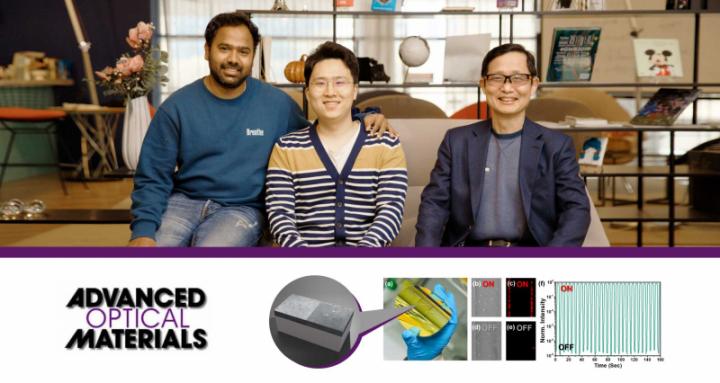
A research team, led by Professor Dai-Sik Kim in the Department of Physics at UNIST has developed a new technique of predefining the crack pattern on a flexible substrate by a sequential deposition of metallic layers which leads to a formation of a “zero-nanometer gap, or a “zerogap,” between the adjacent lateral patterns.

These gaps, according to the research team, readily open and recover with gentle bending and relaxing of the flexible substrate, precisely along the rims of the pre-patterns of centimeter lengths. Furthermore, in a prototypical pattern of densely packed slit arrays, these gaps serve as antennas achieving transparency for polarizations perpendicular to the length of the gap when opened and shut off all the incident lights when closed. These gaps are also fully tunable and healable from widths of zero nanometers to all the way up to several hundreds of nanometers, leading to a very high modulation depth throughout many times of repeated modulations, noted the research team.

Unlike most reconfigurable metasurfaces, which suffer from fatigue and gradual decline in performances after repeated operations, ZET is effectively fatigue-free and can readily be used in industrial applications where durability of the sample is crucial. Indeed, when the research team investigated the durability of their ZET samples, they exhibited an improved performance over time even after 10,000 repeated stretching/bending cycles.

“While we used an array of slits as a test system in this study, the method can readily be extended to any type of pattern with closed loops such as coaxial apertures, ring resonators, or grooves,” noted the research team. “Thus, our zerogap technology bears the potential to significantly improve all kinds of active optical components and therefore finds numerous applications in electromagnetic wave shielding, polarization conversion, and active filters as well as in quantum transport studies resulting from deep sub-nanometer-wide gaps.”

###

This study has been carried out jointly by Seoul National University and Kangwon National University with the support of the National Research Foundation of Korea (NRF). It was made available in March 2021, ahead of final publication in the June 2021 issue of Advanced Optical Materials.

Media Contact
JooHyeon Heo
[email protected]

Original Source

https://news.unist.ac.kr/new-study-presents-transformative-metasurface-based-on-zerogap-embedded-template/

Tags: Chemistry/Physics/Materials SciencesElectromagneticsIndustrial Engineering/ChemistryMaterials
Share12Tweet8Share2ShareShareShare2

Related Posts

Announcing the 2026 Carbon Future Young Investigator Award Winners — Chemistry

Announcing the 2026 Carbon Future Young Investigator Award Winners

May 11, 2026
Innovative Photocatalytic Approach Distinguishes Reactant Activation from Product Release — Chemistry

Innovative Photocatalytic Approach Distinguishes Reactant Activation from Product Release

May 11, 2026

Enhancing Surgical Safety with Laser-Induced Acoustic Imaging #ASA190

May 11, 2026

Miniature Sensor Uses Light to Detect Touch

May 8, 2026
Please login to join discussion

POPULAR NEWS

  • Research Indicates Potential Connection Between Prenatal Medication Exposure and Elevated Autism Risk

    841 shares
    Share 336 Tweet 210
  • New Study Reveals Plants Can Detect the Sound of Rain

    728 shares
    Share 290 Tweet 182
  • Salmonella Haem Blocks Macrophages, Boosts Infection

    62 shares
    Share 25 Tweet 16
  • Breastmilk Balances E. coli and Beneficial Bacteria in Infant Gut Microbiomes

    57 shares
    Share 23 Tweet 14

About

We bring you the latest biotechnology news from best research centers and universities around the world. Check our website.

Follow us

Recent News

Announcing the 2026 Carbon Future Young Investigator Award Winners

Brain-Controlled Hearing System Demonstrates Success in Initial Human Trials

Telemedicine Does Not Drive Higher Medical Utilization or Health Care Costs, Study Finds

Subscribe to Blog via Email

Enter your email address to subscribe to this blog and receive notifications of new posts by email.

Join 82 other subscribers
  • Contact Us

Bioengineer.org © Copyright 2023 All Rights Reserved.

Welcome Back!

Login to your account below

Forgotten Password?

Retrieve your password

Please enter your username or email address to reset your password.

Log In
No Result
View All Result
  • Homepages
    • Home Page 1
    • Home Page 2
  • News
  • National
  • Business
  • Health
  • Lifestyle
  • Science

Bioengineer.org © Copyright 2023 All Rights Reserved.