UMass Amherst, co-authors urge more research attention to fish, mammal, bird seasonal events
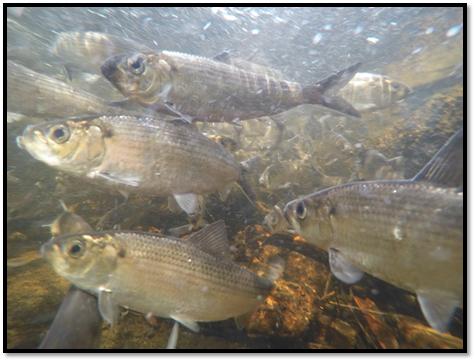
Credit: UMass Amherst/Matt Devine
AMHERST, Mass. – Many researchers and amateur naturalists keep track of dates for the first robin of spring, the first peepers or ice-out on ponds, and such records can offer decades of data on the timing of plant and animal life cycle events known as phenology.
While such observations are common in terrestrial systems, a new report by first author Michelle Staudinger and others at the University of Massachusetts Amherst shows there is limited understanding of similar events in the oceans. They urge more researchers to increase observations and use more phenological datasets to understand how marine species are responding to climate change through phenological shifts in the Gulf of Maine and other coastal regions.
Staudinger says, “We only found 20 studies documenting shifts in phenology in the Gulf of Maine. This topic appears to have received less attention in the region compared to other responses to climate change. We provide a summary of the existing evidence, and offer examples of the implications, remaining research questions and available long-term datasets appropriate for assessing shifts in the region. These data come from a range of federal, state, academic and citizen science monitoring programs.”
The report, by Staudinger, her colleague Adrian Jordaan, graduate student Keenan Yakola, and 23 other co-authors from 17 organizations, appears in the journal Fisheries Oceanography. It synthesizes presentations from the 2015 annual meeting of the Regional Association for Research on the Gulf of Maine plus expert input from a 2016 workshop at the Gulf of Maine Research Institute and a includes a comprehensive literature review.
Staudinger is science coordinator at the Northeast Climate Adaptation Science Center (NE CASC) at UMass Amherst and an ecologist for the U.S. Geological Survey. Jordaan is an associate professor of fish population ecology and conservation at UMass Amherst and director of the campus’s Gloucester Marine Station at Hodgkins Cove. Yakola is a graduate student in environmental conservation and a fellow at NE CASC.
Staudinger says, “We’re trying to increase awareness of the importance of understanding phenological shifts, the usefulness of existing data, and the possibility of applying them to marine ecosystems. There are a lot of really great resources out there. They may not have been collected with phenology in mind, and may need to be reworked to achieve desired goals, but it’s doable. We also need to continue to invest, and in some cases, expand regional monitoring programs to better capture shifts in phenology and other responses to climate change in the Gulf of Maine.”
Yakola points out, “The Gulf of Maine is a hotspot of warming. Warming is occurring in all seasons but is fastest in the summer when many fish and animals use it as a seasonal destination for critical life events. Seabirds, for example, are believed to be at high risk for mismatches with their prey during the nesting season when they must hunt in waters close to the islands where they raise their young. However, we only found one example of an actual documented shift in seabird phenology in Atlantic puffins, and it was restricted to a single colony out of many potential locations in the Gulf of Maine.”
Jordaan adds, “There are many concerns and anecdotes on how marine fish and animal species are shifting their timing, but we aren’t seeing overwhelming evidence. We believe this is due to the difficulty in observing fish and animals in the marine environment – it’s easy to say something was here, but much harder to say when it arrived or left the area when these events happen under water.”
He also points out that observing and understanding phenology is much easier in terrestrial environments. “You can look out your window right now and see migratory songbirds like phoebes arriving and building their nests, and spring daffodils popping up from the ground and flowering.”
New England already has an exceptional heritage and network of “river herring wardens” and other groups who have counted these and other fishes that spend parts of their life cycle in both salt and fresh water. Staudinger and colleagues hope such data will be incorporated into climate studies, and that similar efforts are launched for other marine life from puffins to whales, lobsters and coastal fishes from Newfoundland to Cape Cod.
The report outlines research priorities and opportunities. “We can build off of what we already know and address what we don’t know to increase the evidence base,” Staudinger says. It discusses potential implications of phenological changes for human activities such as commercial fisheries and recreational pursuits such as ice fishing. It was funded by a variety of institutions including the NE CASC, NASA, the National Science Foundation, and the Regional Association for Research on the Gulf of Maine.
###
In addition to UMass Amherst, the NE CASC and the Gulf of Maine Research Institute, others in the working group represent the Bigelow Laboratory for Ocean Sciences, Maine; the Center for Coastal Studies, Provincetown; the University of New Brunswick; NOAA’s National Marine Fisheries Service Northeast Fisheries Science Center; the University of Maine; Stony Brook University, Woods Hole Oceanographic Institution, Mass.; USGS New England Water Science Center; Fisheries and Oceans Canada; the Virginia Institute of Marine Science; the University of South Florida; the U.S. EPA New England; the Anderson Cabot Center for Ocean Life at the New England Aquarium, Boston, and the Connecticut Ornithological Association.
Media Contact
Janet Lathrop
@umassscience
413-545-2989
Related Journal Article
http://dx.