Credit: Derrick Hasterok
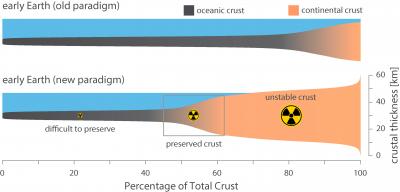
A new radioactivity model of Earth’s ancient rocks calls into question current models for the formation of Earth’s continental crust, suggesting continents may have risen out of the sea much earlier than previously thought but were destroyed, leaving little trace.
Scientists at the University of Adelaide have published two studies on a model of rock radioactivity over billions of years which found that the Earth’s continental crust may have been thicker, much earlier than current models suggest, with continents possibly present as far back as four billion years.
“We use this model to understand the evolving processes from early Earth to the present, and suggest that the survival of the early crust was dependent on the amount of radioactivity in the rocks – not random chance,” says Dr Derrick Hasterok, from the University of Adelaide’s Department of Earth Sciences and Mawson Centre for Geoscience.
“If our model proves to be correct, it may require revision to many aspects of our understanding of the Earth’s chemical and physical evolution, including the rate of growth of the continents and possibly even the onset of plate tectonics.”
Dr Hasterok and his PhD student Matthew Gard compiled 75,800 geochemical samples of igneous rocks (such as granite) with estimated ages of formation from around the continents. They estimated radioactivity in these rocks today and constructed a model of average radioactivity from four billion years ago to the present.
“All rocks contain natural radioactivity that produces heat and raises temperatures in the crust when it decays – the more radioactive a rock the more heat it produces,” says Dr Hasterok. “Rocks typically associated with the continental crust have higher radioactivity than oceanic rocks. A rock four billion years old would have about four times as much radioactivity when it was created compared with today.”
But the researchers found an unexpected deficit in the level of radioactivity in rocks older than about two billion years. When they corrected for higher heat production, because of the higher radioactivity that would have been present, the deficit disappeared.
“We think there would have been more granite-like – or continental-type – rocks around but because of the higher radioactivity, and therefore higher heat, they either melted or were easily destroyed by tectonic movement. That’s why these continental crusts don’t show in the geological record.
“Our prevailing models suggest that continents eventually grew out of the oceans as the crust thickened. But we think there may have been significant amount of, albeit very unstable, continental crust much earlier.”
Co-author Professor Martin Hand, also from the University of Adelaide, says the new model could have important implications for monitoring the effects of global warming.
“What this new model allows us to do is help predict rock radioactivity in places where we have few or no samples, like Antarctica, where we cannot access samples, which could be very important in assessing the stability of ice sheets and the threshold of temperature changes needed for global warming to impact glacial melting,” says Martin Hand, Professor of Earth Sciences.
The researchers say the new radioactivity model also may help in the search for hot rocks with geothermal potential and can be used to produce more accurate models of oil maturation in sedimentary basins.
###
The studies are published in the journals Precambrian Research and Lithos.
This research aligns with the University’s industry engagement priority in energy, mining and resources and in tackling the grand challenges of sustainable energy and environmental sustainability.
Media Contact:
Dr Derrick Hasterok, School of Physical Sciences, University of Adelaide. Mobile: +61 (0) 432 247 975, [email protected]
Robyn Mills, Media Officer, University of Adelaide. Phone: +61 (0)8 8313 6341, Mobile: +61 (0)410 689 084, [email protected]
Media Contact
Dr Derrick Hasterok
[email protected]
Related Journal Article
http://dx.