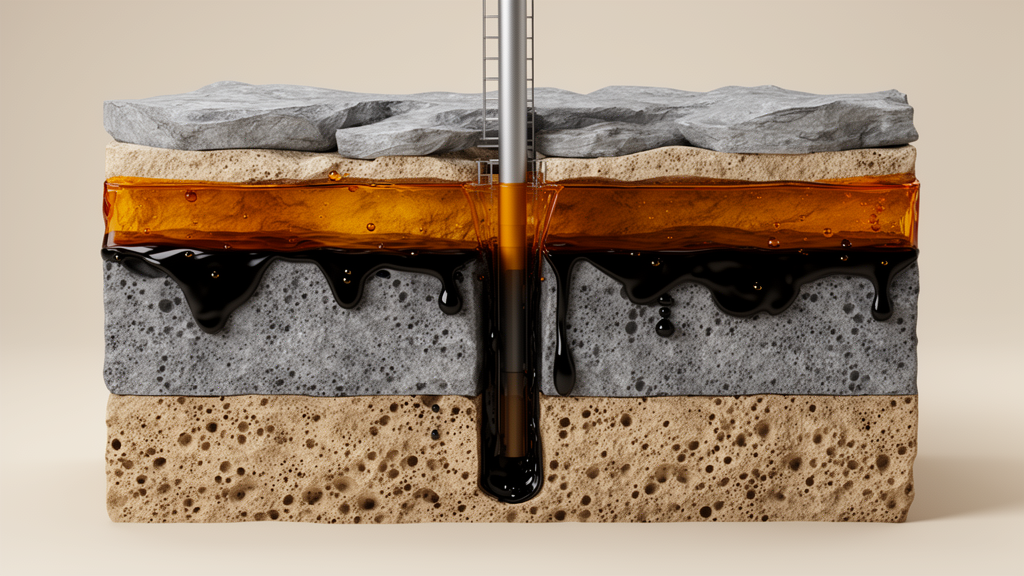
When oil is pumped out of a reservoir, the pressure inside the rock falls, and the rock itself responds. The solid skeleton of many petroleum reservoirs is compressible, so pressure changes during production can deform the porous medium, altering its porosity and permeability. Those changes feed back into how oil and water flow through the formation, how pressure redistributes, and ultimately how much hydrocarbon can be recovered. A new open-access study published in Discover Mechanical Engineering presents a mathematical model of non-stationary two-phase filtration in a compressible porous medium, built specifically to capture this coupling.
The work, carried out by Zokhidjon Kaytarov, Vladimir Burnashev, Kamola Suvanova, Arofatkhan Ismanova and K. K. Viswanathan, develops a quasi-one-dimensional model of oil and water flowing through a deformable reservoir opened by rows of production wells. Its distinguishing feature, according to the authors, is the numerical implementation of a two-phase flow model using the large-particle method, incorporating pressure-dependent porosity together with pressure-dependent oil and water densities. The model also treats the effect of wells directly, adding production and injection rates into the phase-mass conservation equations as source and sink terms, which allows the interaction between multiple wells to be described within a single formulation.
The physical picture behind the model is straightforward. When fluid flows through a porous medium, the pressure gradient can be sufficient to deform the medium; conversely, compressing the medium displaces the fluid it contains. Compression reduces pore size and increases resistance to flow, creating a complex relationship between skeleton deformation and filtration. Earlier foundations for describing this coupling were laid in classical poroelasticity theory, later generalized to anisotropic media and to multiphase systems, but the authors note that previous treatments did not simultaneously address two-phase oil–water filtration in a deformable reservoir, pressure-driven changes in porosity and permeability, and the compressibility of both liquid phases.
In the new formulation, the governing equations come from mass conservation and Darcy’s law, which the authors stress are not themselves novel. The novelty lies in applying them to a deformable, compressible reservoir system by simultaneously incorporating pressure-dependent porosity, pressure-dependent oil and water densities, and well production rate terms into the phase mass-balance equations. Porosity is assumed to depend linearly on reservoir pressure, so that when pressure falls below its initial equilibrium value, porosity decreases. Absolute permeability then follows a power-law relationship with porosity, chosen because permeability is sensitive even to small porosity changes and a power law captures this nonlinear sensitivity with a single parameter. Phase densities are likewise expressed as linear functions of pressure over the limited pressure range considered.
Several simplifying assumptions shape the model. The reservoir is treated as homogeneous, with spatially uniform initial properties, which isolates the effect of compressibility from the influence of natural heterogeneity. The flow is quasi-one-dimensional: because the wells are arranged in regular parallel rows, pressure, saturation and phase velocities are determined along a single spatial coordinate, while the radial flow near an individual well is accounted for through a radial filtration relationship when calculating the well’s production rate. Capillary pressure is neglected on the grounds that well-driven pressure gradients dominate, and the viscosities of oil and water are held constant under isothermal conditions, with liquid compressibility handled separately through the pressure-dependent densities.
The numerical solution uses the large-particle method, a Lagrange–Euler approach in which the computation proceeds through sequential, physically meaningful stages and the exchange of mass, momentum and energy between cells is calculated in conservative form. In the algorithm used here, the pressure field is determined first, phase filtration velocities are computed from the resulting pressure gradients, and phase and medium properties are updated for the next time step. The authors modified an existing algorithm to account for well rows, incorporating fluid production rates into the phase mass balance equations through local sink terms.
Before applying the model to a two-phase problem, the team verified the numerical algorithm against an analytical benchmark. The model was reduced to a single-phase filtration problem and compared with an analytical perturbation solution for a one-dimensional, stress-sensitive porous medium. The relative L2 error was 0.84 percent for pressure, 0.17 percent for porosity and 0.16 percent for absolute permeability, with corresponding maximum local errors of 2.12, 0.46 and 0.38 percent. Grid independence tests on spatial steps of 2 metres, 1 metre and 0.5 metres showed that solutions on the two finer grids almost coincide, and time-step sensitivity runs at 0.002, 0.001 and 0.0005 years produced nearly identical profiles, indicating that the nonlinear permeability–pressure dependence does not destabilize the algorithm within the tested parameter range.
The computational experiments used parameter values characteristic of real oil reservoirs, including an initial porosity of 0.23, an initial absolute permeability of 10 to the power of minus 15 square metres, initial oil and water saturations of 0.6 and 0.4, and initial oil and water densities of 860 and 1002 kilograms per cubic metre. Two rows of production wells were located at 90 and 270 metres along the formation, and the calculations tracked pressure, filtration velocity, porosity, permeability, oil saturation and well productivity over one year. The results showed that when the medium’s compressibility coefficient is large, for example 5 times 10 to the power of minus 8 per pascal, the pressure drop becomes more localized near the wells, whereas at lower compressibility the pressure disturbance propagates more rapidly across the formation and the hydrodynamic interaction between well rows intensifies.
The deformation response follows directly from the constitutive relationships. As pressure decreases, porosity falls, with the greatest change near the wells, and at high compressibility the same pressure change produces a much larger porosity reduction. Because permeability is nonlinearly tied to porosity, even a modest porosity change leads to a much larger permeability decline, and the calculations show a sharp drop in permeability around the wellbore at high compressibility values. Restricted mobility of the oil phase reduces the oil flow toward the well and lowers the oil production rate, so increasing medium compressibility impedes filtration through a more drastic reduction in porosity and permeability, negatively affecting recovery performance.
The production picture, however, involves two opposing mechanisms. At low compressibility, permeability is relatively well preserved and initial total and oil flow rates are higher, but the pressure depression spreads quickly through the reservoir, so production declines significantly over time. At high compressibility, stronger near-wellbore deformation limits the initial rate, yet the more localized containment of the pressure disturbance yields a more stable flow rate over time. At high and medium compressibility values, the local decrease in oil saturation near the wells reduces the oil’s relative permeability and raises the water fraction, so oil production falls over time while water flow may initially increase. The authors conclude that reservoir rock compressibility should be treated as a crucial parameter linking pressure distribution, permeability degradation, phase redistribution and well productivity, and that the model can help evaluate well operating regimes and forecast production dynamics. They also note its limitations: the model is quasi-one-dimensional and homogeneous, neglects capillary pressure, formation heterogeneity and full geomechanical coupling, and has not yet been calibrated with real field data.
Subject of Research: Mathematical modeling of non-stationary two-phase oil–water filtration in a compressible, deformable porous reservoir
Article Title: A mathematical model of non-stationary multiphase filtration in compressible porous media
Article References: Kaytarov, Z., Burnashev, V., Suvanova, K., Ismanova, A., & Viswanathan, K. K. (2026). A mathematical model of non-stationary multiphase filtration in compressible porous media. Discover Mechanical Engineering, 5(1), Article 192. https://doi.org/10.1007/s44245-026-00384-8
Image Credits: AI Generated
DOI: 10.1007/s44245-026-00384-8
Keywords: porous media, multiphase filtration, oil reservoirs, porosity, permeability, compressibility, large-particle method, numerical modeling, Darcy's law, well productivity, reservoir simulation, poroelasticity
News Source: Denise Maddox. (October 29, 2026). New Model Captures How Compressible Oil Reservoirs Deform as Pressure Drops. Scienmag.