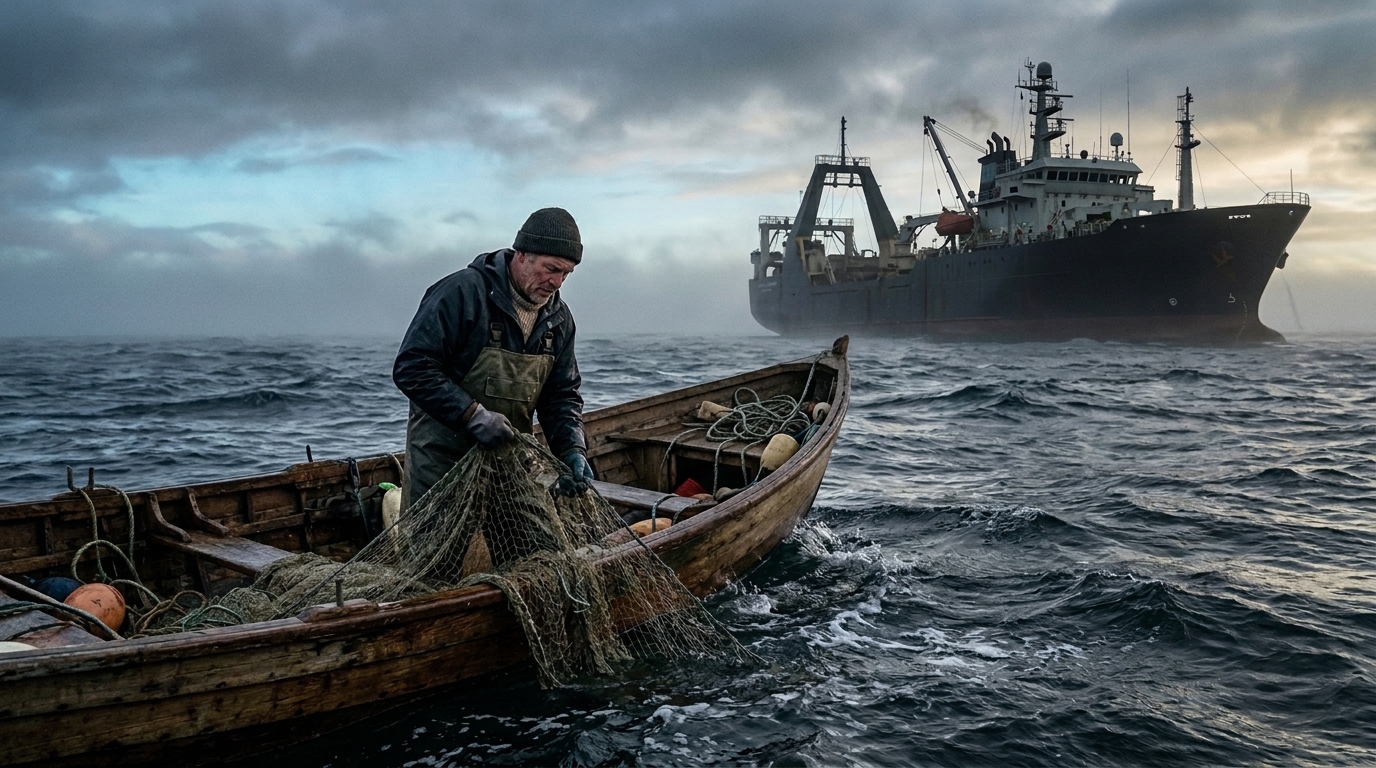
A new global index has identified the coastal countries where small-scale fishing communities are most vulnerable to conflict with industrial fishing fleets, and the results point sharply to one region. Developed by researchers at the University of Massachusetts Dartmouth and Stanford University, the Small-scale and Industrial Fisheries Interaction Index, or SIFI Index, compares vulnerability across 126 coastal countries and finds that the highest vulnerability is concentrated in Africa, followed by parts of Oceania and Asia. No European or North American country fell into the highest-vulnerability group. The work, published in Nature Food, offers the first global framework to bring together the social, economic and governance conditions that determine whether industrial fishing pressure becomes manageable in one country and devastating in another.
The problem the researchers set out to solve is both widespread and surprisingly hard to quantify. Small-scale fisheries support millions of people through employment, income, nutrition and cultural identity, yet small-scale fishers increasingly share coastal waters and fish stocks with larger industrial fleets. These interactions can contribute to declining catches, damaged fishing gear, safety risks and open conflict, but their consequences are not evenly distributed. The same level of industrial fishing pressure may be tolerable in one country and highly disruptive in another, depending on how strongly people depend on small-scale fisheries and their ability to respond to change. Until now, the authors note, there was no global framework that brought these dimensions together in a single comparable measure.
The SIFI Index is built on three dimensions commonly used in vulnerability assessments: exposure, sensitivity and adaptive capacity. Exposure represents the potential for small-scale and industrial fisheries to overlap, drawing on spatial data that describe industrial fishing activity close to shore and the contribution of the small-scale sector to national catch. Countries score highest on exposure when both the density of large-scale fishing activity within 25 kilometres of shore and the national importance of small-scale production are high. Sensitivity captures the importance of small-scale fisheries for employment, economic value, subsistence and nutrition within a country. Adaptive capacity reflects the broader governance and human-development conditions that help countries and communities anticipate, manage or recover from change.
To construct the index, the team combined satellite-derived fishing information, fisheries statistics and socioeconomic indicators, and used structural equation modelling to evaluate relationships among the three dimensions. A notable technical challenge, the authors reveal in their account of the research, was harmonizing industrial fishing data from two complementary sources: the density of fishing vessels that broadcast their location, and the density of vessels detected by radar whose identity is unknown. Put together, these datasets capture different forms of potential interaction with small-scale fisheries, including vessels that do not publicly identify themselves. The index estimates national vulnerability using six indicators spanning the three dimensions, producing a score in which darker values indicate greater relative vulnerability to conflict between small-scale and large-scale fishing.
The resulting global picture is strikingly uneven. Vulnerability to conflict with industrial fishing, as reflected in the index, was highly uneven across the world, with the highest vulnerability observed in Africa, followed by parts of Oceania and Asia. Exposure to potential conflict was driven primarily by trawlers, which accounted for nearly 90 percent of identifiable industrial fishing operating in the nearshore areas most accessible to small-scale fishers. That figure matters because it identifies a specific, identifiable class of vessel as the dominant source of spatial overlap, rather than industrial fishing in general, and gives regulators a concrete target when considering nearshore access rules.
Perhaps the most consequential finding concerns what actually makes countries vulnerable. Countries were most vulnerable to conflict with industrial fishing when their coastal populations depended heavily on small-scale fisheries catch for nutrition, and when they had limited capacity to respond to disruptions such as overfishing, market shocks and inequitable foreign fishing agreements. In other words, vulnerability is not simply a function of how many industrial vessels operate near a coast; it emerges from the collision of heavy dependence and weak capacity to absorb shocks. The authors report that a key turning point in their analysis came when it showed that countries with fewer resources to respond were often those most dependent on small-scale fisheries, reinforcing that the potential for conflict cannot be understood from vessel activity alone.
The index also delivered a counterintuitive result about existing protections. Countries with preferential access areas for small-scale fisheries were more vulnerable than countries that do not have such regulations in place. The researchers interpret this as evidence that these protections, although often located where they are most needed, are not sufficient to address the underlying drivers of vulnerability. Preferential access zones may exist precisely in the places where dependence is deepest and adaptive capacity is weakest, so their presence does not guarantee protection from the social and economic conditions that make conflict damaging. The finding suggests that governance responses focused only on spatial access may leave the root causes of vulnerability untouched.
The stakes for the communities involved are considerable. For people who rely heavily on fishing for food, income, identity and cultural continuity, losing access to fishing grounds or resources can represent an existential threat. Small-scale fishers are also on the front lines of ocean change and hold generations of knowledge about marine species, ecosystems and environmental conditions. In many places they play important roles as stewards of marine biodiversity, and when fishing communities are displaced or disappear, knowledge useful for ecosystem management might be lost with them. Conflict with industrial fishing fleets is one of the most common concerns raised by small-scale fishers, yet it is difficult to measure consistently or to separate from other stressors acting on the same communities.
The authors position the SIFI Index as a first step rather than a final answer. It provides a way to identify where concerns about industrial fishing warrant further focused research and policy attention. Future advances showing where conflict might be occurring at a subnational level, and its effects on specific communities and groups of fishers, will become increasingly urgent as the blue economy expands and a growing number of industries compete for marine space and resources. Combining the index with interviews, local fisheries data and finer-scale spatial analyses, the researchers argue, will help determine where competition becomes conflict, what is threatened by such conflicts, and which governance responses can support both fishing communities and marine ecosystems in increasingly industrialized oceans.
The study arrives at a moment when equity in fisheries governance is under growing scrutiny. By demonstrating that similar levels of fishing conflict can have very different consequences depending on underlying social, economic and governance conditions, the work shifts the policy question from simply where industrial vessels fish to who bears the cost when they do. The researchers hope the index will highlight priorities for equitable fisheries governance, directing attention and resources toward the coastal nations where fishing supports the most livelihoods and essential needs, and where the margin for error is thinnest. An independent expert assessment described the paper as well conceived, clearly written, thorough and thoughtful, noting that the methods support the results and the assumptions seem reasonable.
Subject of Research: A global vulnerability index for interactions between small-scale fisheries and industrial fishing fleets across 126 coastal countries.
Article Title: When conflict with industrial fishing threatens coastal communities
Article References: When conflict with industrial fishing threatens coastal communities. (2026). Nature Food. https://doi.org/10.1038/s43016-026-01430-0 (Author names are not included in the publisher’s citation export.)
Image Credits: AI Generated
DOI: 10.1038/s43016-026-01430-0
Keywords: small-scale fisheries, industrial fishing, SIFI Index, fisheries conflict, coastal communities, vulnerability assessment, adaptive capacity, fisheries governance, trawlers, ocean resources, food security, Nature Food
News Source: Alan Morgan. (November 5, 2026). New global index maps where small-scale fishers face greatest conflict risk with industrial fleets. Scienmag.