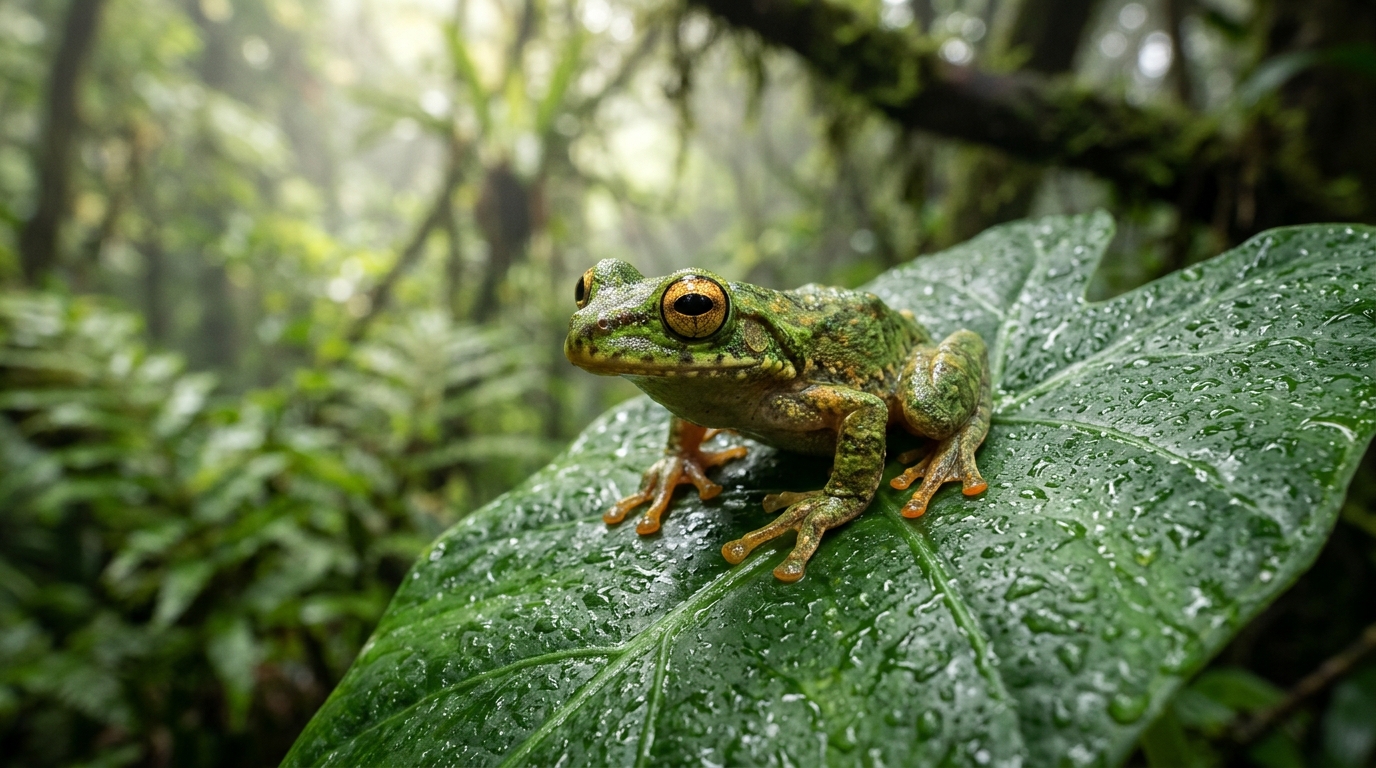
A new species of frog has been formally described from Hainan Island in southern China. The animal, named Rana hainan and nicknamed the Hainan Groove-toed Frog, was identified from twelve specimens collected in the Shangxi Provincial Nature Reserve in Wanning City and on Mt. Diaoluo in Lingshui County. Researchers from Hainan Normal University, Shenyang Normal University and Sun Yat-sen University combined DNA sequencing with detailed body measurements to show that the Hainan frogs form a lineage that is clearly separate from their closest relatives on the mainland.
The discovery matters because Hainan’s frogs have carried a string of different scientific names since the 1970s. Liu and colleagues first reported a frog from Mt. Jianfengling in 1973 that they tentatively called Rana varians, flagging their own uncertainty with a question mark. Dubois later moved Chinese populations of that species into Rana nigrotympanica, and subsequent surveys expanded the taxon’s supposed Hainan range to sites including Mt. Jianfengling, Danzhou, Dongfang, Baisha, Tunchang, Qiongzhong, Mt. Diaoluo and Mt. Wuzhi. In 2007, Wang and colleagues confirmed the frog’s presence on the island using newly collected specimens from Mt. Diaoluo. Two years later, Fei and colleagues added Rana johnsi to the Hainan herpetofauna, and in 2011 Shi and colleagues reassigned the same Mt. Diaoluo specimens to Rana johnsi while also adding a record from Mt. Yinggeling.
That shifting history left the island’s brown frogs in taxonomic limbo. The new study, published in the journal ZooKeys, argues that the Mt. Diaoluo animals were never Rana johnsi at all. Instead, they belong to a distinct species within the Rana johnsi group of the subgenus Rana, a lineage defined by lateroventral grooves on the flattened toe tips and a triangular black patch on the temporal region. The researchers collected their specimens between January 2024 and April 2026 from montane tropical rainforest, euthanized them with the anesthetic MS-222, fixed them in buffered formalin and preserved them in ethanol, depositing the vouchers at three Chinese institutions.
To test whether the Hainan frogs were truly different, the team turned to genetics. They amplified three mitochondrial markers: partial 16S ribosomal RNA, the COI gene and cytochrome b. Combined with sequences downloaded from GenBank, the final dataset spanned 2,515 base pairs from 99 individuals across 44 species, with Rana shuchinae serving as the outgroup. Bayesian Inference and Maximum Likelihood analyses produced identical topologies. All samples of the Rana johnsi group formed a strongly supported monophyletic clade, and within it the Hainan population emerged as a distinct, well-supported lineage, with a Bayesian posterior probability of 1.00, an SH-aLRT value of 96.5 and an ultrafast bootstrap support of 96. That lineage sits as sister to the clade containing R. johnsi, R. wuyiensis and R. sangzhiensis.
The genetic distances were substantial. Using Kimura 2-parameter distances, the Hainan lineage diverged from all recognized congeners in the analysis by 1.50 to 10.85 percent at 16S, 5.90 to 20.09 percent at COI and 7.37 to 21.29 percent at cytochrome b. The phylogeny also revealed a clear geographic structure: R. johnsi ranges from central Vietnam to Guangxi in southern China, R. sangzhiensis occurs mainly in central and southwestern China including Hunan and Sichuan, and R. wuyiensis is restricted to the Wuyi Mountains of Fujian. Each lineage occupies a separate montane region, a disjunct pattern that the authors suggest points to geographic isolation as an important driver of diversification in the group.
Morphology told the same story. Because females were scarce, the statistical analyses used only males: three from Hainan, ten R. johnsi, 27 R. sangzhiensis and four R. wuyiensis. Seventeen measurements, from snout-vent length to tibia width, were log-transformed and adjusted for body size before analysis. Univariate comparisons found significant differences between the Hainan population and the other taxa in head length, snout length, interorbital distance, upper eyelid width, eye diameter, tympanum diameter, lower arm width, thigh length and tibia width. A principal component analysis placed the Hainan frogs clearly apart, with the first two components explaining 43.3 percent of the variance. Discriminant analysis of principal components went further, showing the Hainan individuals forming a completely isolated cluster with no overlap with any other taxon.
A permutational multivariate analysis of variance confirmed the pattern statistically. The Hainan population differed significantly from R. johnsi, with an F value of 7.971 and an adjusted p value of 0.0306, and from R. sangzhiensis, with an F value of 11.336 and an adjusted p value of 0.0006. The comparison with R. wuyiensis did not reach significance after correction, with an adjusted p value of 0.1714, though the two were separated in the ordination analyses. Taken together, the authors conclude that the Hainan population is morphologically distinct from most of its congeners.
The species itself is a medium-sized frog. Adult males measure 44.4 to 45.4 millimeters in snout-vent length, averaging 44.9 millimeters, while adult females range from 45.4 to 57.5 millimeters, averaging 51.2. The head is longer than it is wide, and a distinct triangular black patch covers the temporal region, edged in front by a pale border. In life the dorsum is reddish brown with a transverse stripe of black speckles between the upper eyelids, dark transverse bars on the limbs and a bicolored iris divided by a sharp horizontal boundary. The dorsolateral folds run straight and narrow from the upper eyelid to the groin, the toe tips carry connected lateroventral grooves, tarsal folds are absent, and breeding males bear a continuous grayish-white nuptial pad on the first finger densely covered with tiny spines. Males also possess a pair of internal subgular vocal sacs.
The type series comprises a male holotype collected at Shangxi Provincial Nature Reserve at 350 meters elevation in January 2026, along with eleven paratypes from the same reserve and from Mt. Diaoluo at 950 meters. The species inhabits evergreen broadleaf tropical rainforest with fern-rich understories and rocky streams, where breeding occurs in seasonal pools and slow-flowing backwaters. Tadpoles were observed in November, and males collected from October to April consistently showed nuptial pads, suggesting the breeding season falls within that window. A female collected in April had an empty abdominal cavity and contracted ovaries, consistent with the late stage of the reproductive season.
Sorting out the historical records remains a work in progress. The authors reassign the earlier Mt. Diaoluo records to the new species, but they conservatively treat the remaining Hainan records, including the Mt. Jianfengling population, as Rana cf. johnsi pending further study, because those localities lack verifiable voucher specimens or molecular data. The taxonomic status of R. nigrotympanica itself has long been contested, and following Ohler’s 2007 treatment it is currently considered a junior synonym of Hylarana cubitalis, a species not known from Hainan, which means the old Hainan records under that name also require re-evaluation.
Subject of Research: Taxonomic description of a new frog species, Rana hainan, from Hainan Island, China, based on molecular phylogenetics and morphometrics
Article Title: A new species of Rana ( Amphibia , Anura , Ranidae ) from Hainan, Southern China
Article References: Wang, H.-T., Huang, M.-H., Liao, C.-X., Qiu, X.-C., Song, H.-M., Qi, S., Ding, D.-E., Zhuo, S.-B., Wang, W., Wu, J., Wang, B., Wang, Y.-Y., Li, P.-P., & Wang, J.-C. (2026). A new species of Rana (Amphibia, Anura, Ranidae) from Hainan, Southern China. ZooKeys, 1296, 185-208. https://doi.org/10.3897/zookeys.1296.211503
Image Credits: AI Generated
DOI: 10.3897/zookeys.1296.211503
Keywords: Rana hainan, Hainan Island, new species, amphibian taxonomy, mitochondrial DNA, phylogenetics, morphometrics, Ranidae, tropical rainforest, China, ZooKeys, herpetology
News Source: Drew Townsend. (November 5, 2026). New Frog Species Hidden on Hainan Island Gets a Name. Scienmag.