Credit: D. J. Rasmussen, Maya K. Buchanan, Robert E. Kopp, Michael Oppenheimer
Scientists agree that sea levels will continue to rise this century, but projections beyond 2050 are much more uncertain regarding exactly how much higher ocean levels will be by 2100. While actions to protect against 2050 sea-level rise have a secure scientific basis, this range in late-century estimates makes it difficult for coastal communities to plan their long-term adaptation strategies.
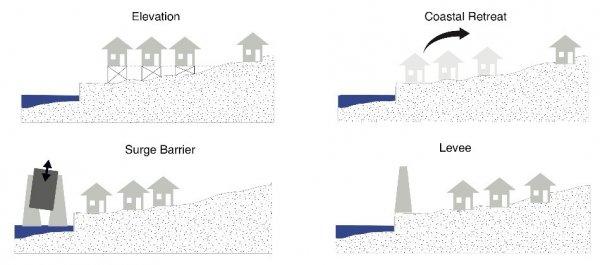
Princeton University researchers at the Center for Policy Research on Energy and the Environment have developed a new framework allowing urban planners and policymakers to consider a combination of responses to sea-level rise (e.g., levees, storm surge barriers, elevating buildings, retreat) and, if hard structures, how high these protections should be built, depending on their tolerance for risk and the projected financial losses to a particular area due to flooding. The paper was published in Earth’s Future.
Over the past 100 years, relative sea level measured at The Battery, the historic park at the southernmost tip of Manhattan Island, New York, has increased by 0.285 meters or just under 1 foot, according to the National Oceanic and Atmospheric Administration. Because of global warming, scientists expect this rate of sea-level rise to accelerate in the coming decades. However, there is uncertainty regarding how much greenhouse gas emissions will change and how much of Antarctica will melt in response to a warming climate.
Scientific perspectives on these issues result in different projections of global average sea-level rise. For example, local sea levels at the Battery are expected to rise between 0.6 m and 1.8 m from the beginning of this century to 2100. “We will be contending with more frequent, extreme flooding from coastal storms and high tides. These ‘100-year floods’ will become much more frequent – in some places, as often as once per year,” added co-author and leading climate scientist, Michael Oppenheimer.
Existing frameworks for calculating how high to elevate structures to avoid future floods only consider extreme water levels, not the damages that flooding can cause. This may lead to under- or over-estimates in terms of how high to raise a structure.
The authors introduce a new “flood damage allowance” approach that connects extreme water levels with projected damages, incorporating both uncertainty regarding sea-level rise, as well as people’s individual tolerance of risk.
“Our approach allows decision-makers to specify their own acceptable level of risk, a protection strategy type – such as elevation, storm surge barrier, or coastal retreat – and their assumptions about how much the Antarctic Ice Sheet will melt,” said D.J. Rasmussen, lead author and a Ph.D. candidate at the Woodrow Wilson School of Public and International Affairs at Princeton. “Our framework could help inform the Army Corps of Engineers’ efforts to design climate change adaptation projects.”
The authors use Manhattan as an example to illustrate their framework. New York City has experienced tremendous losses due to flooding, as it is among the top global cities exposed to coastal flood threats; just in Manhattan, there are over $50 billion of assets are currently within the 100-year flood plain. Some of the key responses the flood damage allowances approach explores are:
While planners will still need to do more detailed assessments of the feasibility of various sea defense models in a particular location, this simpler model can identify promising strategies before planners invest in further, more complex engineering and financial models. Because of the study’s modeling simplifications, the authors do not propose specific recommendations for how NYC should respond; rather, the framework illustrates that under different circumstances, some approaches may have certain advantages over others.
For example, in the wake of Hurricane Sandy, the Army Corps of Engineers is currently exploring the use of storm surge barriers to protect New York City from future sea-level rise and more frequent coastal floods. A key question is, “How high to build the barriers?” The answer depends on input from the engineers and expert judgments about how much and how quickly Antarctica will melt. The authors’ framework can facilitate estimates of how high to build the storm surge barriers and allow planners to explore the impact of different factors on recommended surge barrier heights.
“As coastal cities and communities prepare for a changing coastline and climate in the coming decades, tools like this one that incorporate uncertainty and integrate oceanographic and financial information will help planners develop a more thorough analysis of their best defense options,” the researchers said; “In the end, a variety of strategies will be needed to protect most coastal cities.”
###
Code for generating the flood damage allowances is available on Github. This research was supported by the Woodrow Wilson School at Princeton University, grants from the National Science Foundation (ICER-1663807 and 1520683) and the National Aeronautics and Space Administration (80NSSC17K0698). The paper, “A flood damage allowance framework for coastal protection with deep uncertainty in sea-level rise,” was first published January 27, 2020 in Earth’s Future.
Media Contact
Keely Swan
[email protected]
609-258-9308
Related Journal Article
http://dx.