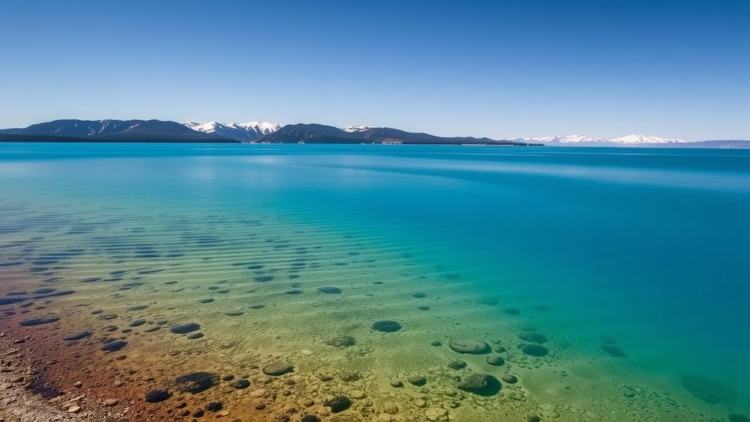
Deep in the steppes of southern Siberia, a lake that almost never mixes completely did exactly that, and scientists were waiting. Lake Shira, a land-locked meromictic lake, normally keeps its waters permanently stratified, with an oxygen-rich upper layer floating above sulfide-laden depths. When a rare episode of holomixis, a whole-lake overturn, broke that ancient arrangement, an international research team seized the opportunity to watch, layer by layer, how an entire microbial ecosystem collapses and rebuilds itself. The results, published in the journal Microbiome, offer one of the most detailed genome-resolved portraits ever assembled of microbial recovery after catastrophic physical disruption of a lake.
Meromictic lakes are natural laboratories for studying how chemistry shapes life. Unlike ordinary lakes that mix seasonally, meromictic lakes maintain persistent stratification, with sharp gradients in oxygen, sulfide, salinity, and light. These gradients carve the water column into distinct microbial niches: phototrophs and aerobic sulfur oxidizers dominate the sunlit, oxygenated surface; dense communities of sulfate-reducing bacteria and anaerobic nitrogen transformers occupy the dark, sulfidic bottom; and the chemocline, the narrow redox transition zone between the two, hosts some of the most metabolically versatile microbes in the system. Because these niches depend on physical stability, a complete overturn is, for the microbial residents, an event of almost apocalyptic proportions.
The research team, led by Ya-fan Chan of Soochow University and Sen-Lin Tang of Academia Sinica in Taiwan, together with Denis Rogozin and Vladimir Zykov of the Siberian Branch of the Russian Academy of Sciences, tracked Lake Shira across four hydrodynamic regimes: transitional holomixis, complete holomixis, developing meromixis, and stable meromixis. From August 2015 to February 2019, they collected depth-resolved samples spanning the oxic surface, the chemocline, the anoxic deep waters, and the water-sediment interface. This multi-year, multi-layer sampling design allowed them to follow not just a snapshot of disruption but the full arc of collapse and reassembly, a temporal resolution that is rarely achieved in microbial ecology.
The first analytical tool was 16S rRNA amplicon sequencing, a standard method for cataloguing which microbes are present in a sample. The data showed that complete holomixis homogenized the water column, erasing the depth structure that had organized the community. Taxa that had been confined to sulfidic depths were suddenly scattered throughout the lake, and the sharp vertical partitioning of the community dissolved. For a time, Lake Shira resembled an ordinary, well-mixed lake, its microbial geography flattened by the physical churning of the overturn.
What happened next was the heart of the study. As the lake entered the developing meromixis phase and then settled into stable meromixis, strong vertical partitioning re-emerged with remarkable speed. Anaerobic lineages, including members of the phylum Desulfobacterota, recovered their dominance in the sulfidic deep waters, while organisms adapted to the redox transition became enriched at the chemocline. The microbial map of the lake, once thought to require long periods to re-establish, redrawn itself in a fraction of the time many ecologists might have predicted. The community did not simply drift back to its former state by passive redistribution; instead, specific functional groups reassembled in the specific chemical niches where their metabolisms could operate.
To understand the functional logic behind this recovery, the team turned to nanopore metagenomics, a long-read sequencing approach that makes it possible to reconstruct near-complete genomes directly from environmental samples. From the Lake Shira datasets, they recovered 401 metagenome-assembled genomes, or MAGs, each representing a distinct organism captured in the samples. The genomic analysis revealed stage- and layer-specific functional repertoires that matched the redox zonation of the lake with striking precision. Genomes from the oxic regime were enriched in genes for sulfur oxidation and phototrophy-related traits, while genomes from the anoxic regime carried an overrepresentation of genes for sulfate reduction and anaerobic nitrogen transformation.
Among the 401 reconstructed genomes, the researchers identified a conserved set of core MAGs that persisted across all four hydrodynamic regimes. Notable among these were members of the genus Yoonia, a lineage of abundant aquatic bacteria. The persistence of these core organisms through the complete disruption of the lake suggests that they function as a backbone for the ecosystem, a seed population of metabolically capable survivors from which the stratified community can rapidly regrow. Rather than waiting for new colonists to arrive from outside, the lake’s recovery appears to be driven largely by the persistence and redistribution of its own resident specialists.
The authors emphasize that microbial succession after holomixis is not simply a return of the former community composition. Instead, their evidence points to a process of functional reorganization: the persistence of core MAGs, the re-establishment of redox-specific assemblages, and the redistribution of shared metabolic modules together restore the stratified ecosystem functions that define a meromictic lake. In other words, the lake recovers its function even as its exact taxonomic inventory shifts, a distinction with broad implications for how ecologists think about resilience in microbial systems everywhere.
The findings resonate far beyond a single Siberian lake. Microbial communities underpin the cycling of sulfur, nitrogen, and carbon in lakes, oceans, wetlands, and sediments worldwide, and physical disturbances, from storms and floods to seasonal turnover and climate-driven mixing anomalies, are becoming more frequent and intense. Demonstrating that a complex, redox-structured microbial network can reassemble rapidly after total homogenization provides a measure of reassurance about the intrinsic resilience of these systems. It also provides a mechanistic framework: resilience is carried by persistent core taxa, by the chemical templates that re-form as stratification returns, and by the modular metabolic capabilities distributed across the community.
The study also showcases the power of combining long-term, depth-resolved field sampling with long-read metagenomics. By reconstructing hundreds of genomes across time and depth, the researchers could link specific organisms to specific metabolic functions and track how those functions migrated through the water column as the lake restratified. As climate change alters mixing regimes in lakes around the world, the lessons of Lake Shira suggest that the microbial engines of biogeochemical cycling may be more robust than feared, capable of rebuilding their intricate vertical architecture from a persistent core of survivors once the physical structure of their world is restored.
Subject of Research: Microbial community resilience and functional reorganization after whole-lake overturn in a meromictic lake
Article Title: Resilience and re-establishment of sulfide- and redox-structured microbial networks after holomixis in a meromictic lake
Article References: Chan, Y.-F., Chiang, P.-W., Lim, S. L., Rogozin, D., Zykov, V., Ye, C.-H., & Tang, S.-L. (2026). Resilience and re-establishment of sulfide- and redox-structured microbial networks after holomixis in a meromictic lake. Microbiome. https://doi.org/10.1186/s40168-026-02515-5
Image Credits: AI Generated
DOI: 10.1186/s40168-026-02515-5
Keywords: meromictic lake, Lake Shira, holomixis, microbial ecology, metagenomics, metagenome-assembled genomes, sulfur cycling, redox stratification, Desulfobacterota, Yoonia, microbial resilience, Siberia
Cite Scienmag News
APA MLA Chicago
Morgan Morrow. (September 26, 2026). Siberian Lake Reveals How Microbial Communities Rebuild After a Rare Full Overturn. Scienmag. https://scienmag.com/siberian-lake-reveals-how-microbial-communities-rebuild-after-a-rare-full-overturn/
Morgan Morrow. “Siberian Lake Reveals How Microbial Communities Rebuild After a Rare Full Overturn.” Scienmag, 26 September 2026, https://scienmag.com/siberian-lake-reveals-how-microbial-communities-rebuild-after-a-rare-full-overturn/. Accessed 26 September 2026.
Morgan Morrow. “Siberian Lake Reveals How Microbial Communities Rebuild After a Rare Full Overturn.” Scienmag. September 26, 2026. https://scienmag.com/siberian-lake-reveals-how-microbial-communities-rebuild-after-a-rare-full-overturn/
Copy citation Download RIS
Tags: anaerobic sulfur bacteria ecosystemchemistry-driven microbial habitatsDesulfobacterotaholomixisimpact of lake overturn on microorganismsLake ShiraLake Shira holomixismeromictic lakemeromictic lake microbial community recoverymetagenome-assembled genomesmetagenomicsmicrobial ecologymicrobial genome-resolved analysismicrobial niches in meromictic lakesmicrobial resiliencemicrobial resilience in stratified lakesmicrobial succession after physical disruptionmicrobiome response to lake overturnredox stratificationredox transition zones in lakesSiberiastratified lake ecosystemsulfur cyclingYoonia