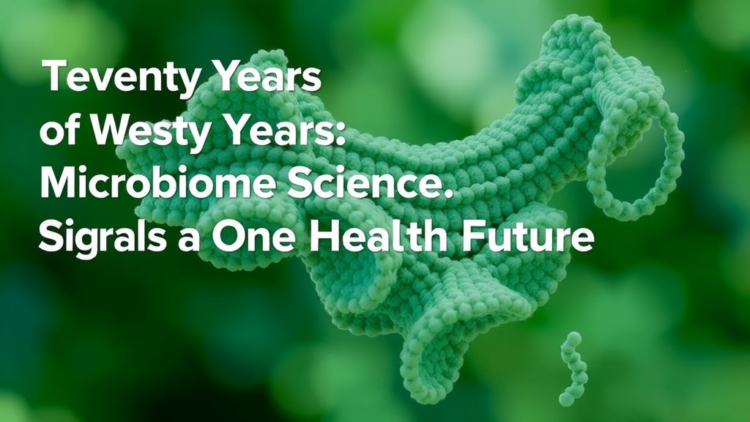
Trillions of microorganisms live on and inside the human body, in the soil that grows our food, and in the rivers, oceans and air that surround us. While microbes are most often discussed in the context of infection and disease, the vast majority of these organisms are neither harmful nor incidental. They participate in digestion, train the immune system, cycle nutrients through ecosystems, suppress plant pathogens and break down pollutants. A newly published review in the journal Microbiome and One Health now traces how Chinese scientists have spent more than seven decades building a research discipline around this insight, a field known as microecology, and argues that the knowledge accumulated over that period could become a cornerstone of the global One Health agenda, which recognizes that the health of people, animals and the environment is inseparable.
The review, authored by researchers including Chunling Xiao of Wenzhou Medical University’s School of Public Health, documents a scientific journey that began in the 1950s. At that time, Chinese researchers put forward an idea that was ahead of its era: that disruptions to the body’s normal microbial communities, rather than the actions of any single pathogen, could contribute to illness. This early framing anticipated what is now a central theme of microbiome science worldwide, namely that health depends on a balanced community of microbes and that disease can emerge when that balance is disturbed. What started as a conceptual proposal has since matured into an empirical research program spanning medicine, agriculture and environmental science.
The technological transformation that propelled the field forward came from DNA sequencing. Before high-throughput sequencing became affordable, microbiologists could culture only a small fraction of the microorganisms present in any sample, leaving most of the microbial world invisible. Sequencing technologies changed that. Researchers could now catalog entire microbial communities directly from their DNA, identifying species that had never been grown in a laboratory. As the review describes, these advances allowed Chinese microecology research to move beyond simply listing which microbes are present toward studying how microbial communities interact with their hosts and with the surrounding environment, a shift from inventory to mechanism that defines modern microbiome research.
Today, the scope of microecology research in China extends across an unusually broad set of domains. In human health, investigators study how gut and other body-site microbiomes influence metabolism, immunity and disease risk, feeding into efforts in precision medicine that aim to tailor treatments to an individual’s microbial profile. In agriculture, researchers examine how soil and plant-associated microbial communities can support crop productivity while reducing dependence on chemical fertilizers and pesticides. Environmental restoration has emerged as another major application, with microbial communities harnessed to degrade contaminants and rehabilitate degraded ecosystems. The review also notes the integration of traditional Chinese medicine into this research landscape, an area where microbial explanations for long-observed therapeutic effects are being actively explored.
What distinguishes the current moment, according to the review’s authors, is the arrival of a new generation of tools that could convert descriptive microbiome data into predictive, actionable science. Artificial intelligence and machine learning methods can sift through the enormous datasets generated by microbiome studies, identifying patterns that predict how a microbial community will behave under changing conditions. Multi-omics approaches, which combine genomics with measurements of metabolites, proteins and other molecules, provide a more complete picture of what microbial communities are actually doing rather than merely which organisms are present. Synthetic biology adds a further layer, offering the possibility of engineering microbial communities or their functions for specific therapeutic, agricultural or environmental purposes.
The promise of these tools is considerable. In medicine, predictive microbiome models could support more personalized health care, identifying patients likely to respond to particular treatments or flagging microbial signatures of disease before symptoms appear. In agriculture, a deeper understanding of beneficial soil microbes could enable lower-chemical farming systems that maintain yields while reducing environmental damage. In pollution remediation, engineered or managed microbial communities could offer new approaches to breaking down persistent contaminants in soil and water. Because each of these applications touches human health, animal health or ecosystem health, they align naturally with the One Health framework that the review places at the center of its argument.
Yet the review is candid about the obstacles standing between current research and real-world impact. Many microbiome studies, in China and elsewhere, still demonstrate associations between microbial patterns and health outcomes without establishing clear causal relationships. A correlation between a particular community composition and a disease state does not reveal whether the microbes drive the disease, the disease reshapes the microbes, or both are effects of a third factor. Resolving causation requires controlled experiments, longitudinal studies and mechanistic work that are more difficult and expensive than observational surveys, and the field’s rapid growth has not yet closed this gap.
Practical and structural barriers compound the scientific ones. The review points to inconsistent data standards across studies, which makes it difficult to compare results, pool findings and build the large integrated datasets that artificial intelligence methods require. Limited clinical evidence remains a bottleneck for translating laboratory discoveries into validated diagnostics and therapies, a challenge familiar to every translational field but particularly acute in microbiome science, where interventions must contend with enormous individual variation. Uneven regulation adds further friction, since products based on live microorganisms or microbial engineering often fall into unclear categories between drugs, supplements and environmental agents, slowing their path to market and to clinical use.
The authors’ response to these challenges is a call for stronger interdisciplinary collaboration and international data-sharing frameworks. Microecology is inherently a boundary-crossing discipline: it draws on microbiology, immunology, ecology, computational science, agronomy and clinical medicine, and its applications inevitably span the human, animal and environmental domains that One Health seeks to unify. No single laboratory, institution or country can assemble the full range of expertise and data needed to move the field from correlation to causation and from causation to intervention. Shared standards, open datasets and cross-border research partnerships would allow the accumulated knowledge of seven decades, including the substantial body of work produced in China, to be combined and applied at the scale the problems demand.
The trajectory traced by the review, from a 1950s hypothesis about microbial balance to a twenty-first-century research enterprise spanning precision medicine, sustainable agriculture and environmental restoration, illustrates how a scientific idea can grow into infrastructure for solving practical problems. The authors’ conclusion is forward-looking: by linking research across humans, animals and the environment, and by deploying artificial intelligence, multi-omics and synthetic biology with appropriate rigor and regulation, microecology could deliver solutions that simultaneously advance human health, food security and ecological resilience. In a century defined by pandemics, antibiotic resistance, soil degradation and pollution, the microscopic communities that sustain life on Earth may prove to be among the most important subjects science has ever undertaken to understand.
Subject of Research: The historical development and One Health applications of microecology research in China
Article Title: China’s microecology journey points to a one health future
Article References: China’s microecology journey points to a one health future. (n.d.). Original publication
Image Credits: AI Generated
DOI: Not provided
Keywords: microecology, microbiome, One Health, China, artificial intelligence, synthetic biology, multi-omics, precision medicine, sustainable agriculture, environmental restoration, DNA sequencing, traditional Chinese medicine
Cite Scienmag News
APA
MLA
Chicago
Morgan Morrow. (September 26, 2026). Seventy Years of Microbiome Science in China Signals a One Health Future. Scienmag. https://scienmag.com/seventy-years-of-microbiome-science-in-china-signals-a-one-health-future/
Morgan Morrow. “Seventy Years of Microbiome Science in China Signals a One Health Future.” Scienmag, 26 September 2026, https://scienmag.com/seventy-years-of-microbiome-science-in-china-signals-a-one-health-future/. Accessed 26 September 2026.
Morgan Morrow. “Seventy Years of Microbiome Science in China Signals a One Health Future.” Scienmag. September 26, 2026. https://scienmag.com/seventy-years-of-microbiome-science-in-china-signals-a-one-health-future/
Copy citation
Download RIS
Tags: Artificial IntelligenceChinaChinese microbiome research milestonesDNA sequencingenvironmental microbiology and pollutionenvironmental restorationhistory of microbiome science in Chinahuman microbiome and immune systemintegration of microbiome science into global health strategiesmicrobial contributions to nutrient cyclingmicrobial ecology and ecosystem healthmicrobiomemicrobiome and plant healthMicrobiome research in Chinamicroecologymulti-omicsOne HealthOne Health ApproachPrecision medicinerole of microbes in disease preventionsoil microbiology and agriculturesustainable agriculturesynthetic biologytraditional Chinese medicine