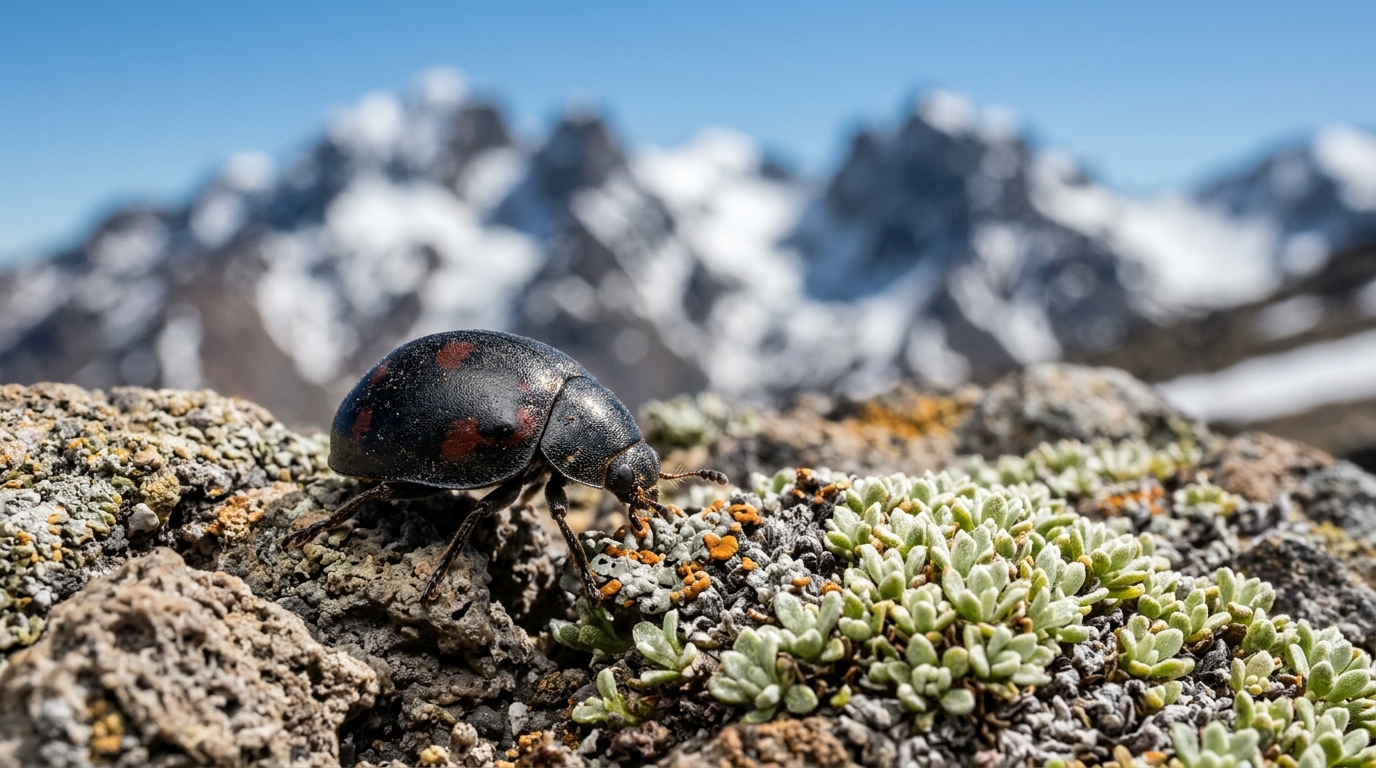
A ladybird beetle that cannot fly has turned up in one of the driest, highest corners of South America, and it turns out to be a species new to science. Described from the Chilean Andes of the Atacama Region, the beetle has been named Eriopis maricunga, after the Salar de Maricunga salt flat near which it lives. The discovery, published in the journal Alpine Entomology, includes not only adult beetles but also larval records, giving researchers a first look at how this tiny predator makes a living around high-altitude salty lagoons more than 3,700 meters above sea level.
The new species belongs to the family Coccinellidae, the ladybird beetles, and to the genus Eriopis, a group of 24 species distributed mainly along the Andes and adjacent valleys of South America, from Chile and Argentina northward to Colombia, with a few species reaching eastern South America including Argentina, Uruguay and Brazil. Eleven of those species occur in Chile, where the genus has been recorded in every political region of the country. Eriopis species are predominantly aphidophagous, meaning they feed on aphids, and are often abundant in agricultural crops, although some occur only in native vegetation. In northern Chile, between 19 and 32 degrees south latitude, the genus was previously represented by five species: E. andina, E. altiplanica, E. concordia, E. loaensis and E. minima.
The beetles were collected during recent surveys of high-Andean environments in the Atacama Region of northern Chile, conducted between 3,600 and 4,400 meters above sea level within Nevado del Tres Cruces National Park, the Ramsar Site Complejo Lacustre Laguna del Negro Francisco y Laguna Santa Rosa, and adjacent areas outside the protected area. The surveys covered several high-Andean wetlands within the Maricunga basin. At the southern end of the Salar de Maricunga, a network of brackish lagoons comprises five water bodies: Laguna Sur, Laguna Este, Laguna Mirador, Laguna Santa Rosa and Laguna Norte, the southernmost distribution of this type of wetland within the Altiplano ecoregion, which extends in Chile between the Arica y Parinacota and Atacama regions.
Specimens were collected using pitfall traps designed to capture insects and other terrestrial invertebrates. Each trap consisted of a container of roughly 500 milliliters filled with about 250 milliliters of pure propylene glycol as a preservative, fitted with a funnel at the top to prevent small vertebrates from falling in. The traps were arranged in groups of five in a cross-shaped configuration, with four traps oriented toward the cardinal directions and one at the center, and remained active from 1 December 2025 to 31 March 2026. The examined material was collected specifically around Laguna Sur and Laguna Mirador, two salty lagoons located at approximately 3,750 meters above sea level, and at Laguna Verde, a hypersaline lagoon at 4,350 meters near the Argentine border, roughly 100 kilometers from the Maricunga localities. At Laguna Verde, traps were installed in patches of high-Andean wetland vegetation away from areas of human activity, while additional specimens were collected manually near the mountaineering refuge used by climbers ascending Ojos del Salado; for safety reasons, no traps were installed at that locality.
The type locality of the new species is Laguna Sur, in Copiapó Province within Nevado del Tres Cruces National Park, at approximately 3,750 meters elevation. The holotype, a male, was collected there on 17 January 2026. Forty paratypes were designated from the three localities, and eleven additional specimens and four larvae were also examined. The larvae, representing first, third and fourth instars, were found at Laguna Mirador and Laguna Sur, and their occurrence indicates that the species is reproducing at the surveyed sites. The species appears to be abundant in the vicinity of the high-Andean salty lagoons, and it represents the southernmost coccinellid species recorded above 4,000 meters in South America, based on the Laguna Verde records.
Morphologically, Eriopis maricunga is a small beetle with a black body marked in yellow to orange. Each elytron carries seven spots arranged in a 2:2:2:1 pattern, and the pronotum bears small basal and apical spots with yellow lateral margins. Several anatomical characters support its placement in Eriopis: the prosternal carinae and the metaventral and abdominal postcoxal lines are absent, the tarsal claws are bifid with a very short basal tooth, the pronotum has a posterior marginal bead, and the metathoracic wings are reduced and non-functional. What sets it apart from its relatives is a combination of fine details: its small body size; small, rounded discal elytral spots separated by roughly 1.5 to 2.0 times their diameter; median lateral elytral spots that sit very close together, narrow and elongate, frequently connected along both the lateral and inner margins so that they enclose a dark area; and a shark-fin-shaped apical spot whose apex points toward the elytral disc.
The species most closely resembles Eriopis minima in size and colour pattern, and the two share a high-Andean distribution and reduced metathoracic wings. But E. minima differs in having larger elytral spots, with the discal spots usually very close to each other and separated by less than half their diameter, and a semicircular rather than shark-fin-shaped apical spot. The male genitalia also differ markedly: males of E. minima have a penis guide with a bell-shaped apex, while E. maricunga has regularly curved lateral margins converging toward the apex. The holotype male measures between 2.9 and 3.5 millimeters in total length, and the species includes the smallest individuals so far recorded within the genus, with a minimum total length of 2.9 millimeters. By comparison, other high-altitude species such as E. lawalawani and E. minima reach a minimum length of 3.1 millimeters, while species occurring at lower elevations have larger minimum body sizes, approximately 4.5 millimeters in E. connexa and E. chilensis.
Several traits of the new species echo features previously associated with high-Andean ladybird beetles: small body size, brachyptery, and dark colouration. Brachyptery, the reduction of the metathoracic wings, has been linked to the reduced efficiency of flight under the low temperatures and reduced oxygen availability prevailing at high elevations. Yet reduced wings do not necessarily mean a restricted range, as E. minima, which also has reduced wings, occurs across four countries with a north-south distribution extending over more than 2,000 kilometers. The predominantly dark colouration of E. maricunga, resulting from the relatively small extent of its pale markings, may likewise represent an adaptation to high-altitude conditions, where increased exposure to ultraviolet radiation can be an important environmental constraint. The species also shows a relatively constant dorsal colour pattern across individuals, with the elytral ground colour sometimes including yellowish-brown areas and the spots varying from yellow to orange with slight variation in size and shape.
The habitat of the new species is as distinctive as the beetle itself. At Laguna Sur, the beetles were found in a degraded bofedal transitioning into vega vegetation, dominated by the juncaceous Triglochin concinna and the grass Puccinellia frigida, with patches of the sedge Zameioscirpus atacamensis and the ranunculaceous Halerpestes exilis; the traps were installed in an area with abundant Juncaceae. At Laguna Mirador, the habitat is a mosaic of bofedal, vega and wet grassland, and the beetles were observed more frequently in areas dominated by wet grassland vegetation. At Laguna Verde, extensive microbial mats of various textures and colours occur and support abundant Diptera, thermal springs are present around the lagoon margins, and vegetation cover is generally sparse except at the lagoon outlet, where incipient bofedal patches dominated by Oxychloe andina occur. The specific epithet maricunga refers to the Salar de Maricunga, near which the vegetated habitats occupied by the new species occur.
The discovery carries a conservation warning. High-Andean salt flats are ecosystems under severe anthropogenic pressure because they harbor some of the largest lithium reserves on the planet, and the biodiversity associated with them may be increasingly threatened by mining activities. Water extraction associated with mining has been documented as particularly relevant, since both ground and surface water extraction can lower water availability and reduce groundwater inputs to surface water bodies and wetlands, leading to declines in water availability and changes in the hydrological conditions that sustain these ecosystems. Livestock grazing and associated overgrazing represent an additional, although apparently less important, pressure. At Laguna Verde, a Special Lithium Operation Contract is currently undergoing administrative processing following its submission by the Ministry of Mining on 10 March 2026, and for the Salar de Maricunga, a 2017 decree remains in force establishing requirements and conditions for a special operating contract for lithium exploration, extraction and processing. Based on currently known records, E. maricunga has a highly restricted distribution, with known collecting sites encompassing an estimated area of five square kilometers and separated by approximately 100 kilometers. Under IUCN criteria the species could potentially qualify as Endangered under criterion B1a, given its apparently restricted extent of occurrence and the small number of known locations, but the authors regard such an assessment as preliminary and consider Data Deficient the most appropriate provisional categorization until more information on distribution, population trends and threats becomes available. Increased sampling effort in basins adjacent to the national park is required, and the discovery highlights the need to increase biological exploration and biodiversity inventories in high-Andean environments, whose ecological singularity contrasts with both the limited biological knowledge currently available and the magnitude of the pressures they face.
Subject of Research: Description of a new high-altitude Andean ladybird beetle species, Eriopis maricunga, from the Atacama Region of Chile
Article Title: A new high-altitude Andean species of Eriopis ( Coleoptera , Coccinellidae ) from Atacama Region, Chile
Article References: González, G., Wallem, K. P., de la Fuente, J., & Tello, F. (2026). A new high-altitude Andean species of Eriopis (Coleoptera, Coccinellidae) from Atacama Region, Chile. Alpine Entomology, 10, 185-193. https://doi.org/10.3897/alpento.10.214498
Image Credits: AI Generated
DOI: 10.3897/alpento.10.214498
Keywords: Eriopis maricunga, ladybird beetles, Coccinellidae, high-Andean wetlands, Atacama Region, Chile, Salar de Maricunga, brachyptery, lithium mining, new species, taxonomy, conservation
News Source: Drew Townsend. (November 5, 2026). New flightless ladybird beetle discovered in Chile’s high Andes. Scienmag.