


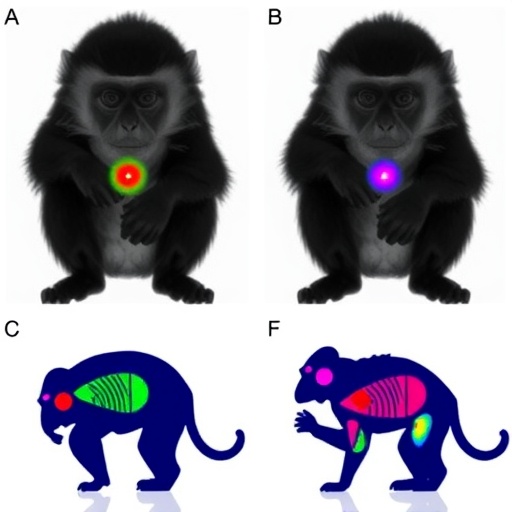
In groundbreaking developments within the field of neuroimaging, a recent study introduces a novel radiotracer that has shown promise in tracking amyloid-beta (Aβ) plaques in the brains of aged vervet monkeys. This study, conducted by a team of researchers spearheaded by Bhoopal, Frye, and Miller, aims to enhance our understanding of age-related neurodegenerative diseases, particularly Alzheimer’s disease. Utilizing positron emission tomography (PET), the study explores the efficacy of the newly synthesized radiotracer, [^18F]FC119S, highlighting its utility in detecting Aβ deposits, which are believed to play a critical role in the pathogenesis of Alzheimer’s disease.
The quest to develop effective imaging agents for neurodegenerative conditions has led many researchers to explore Aβ as a biomarker. The accumulation of amyloid plaques in the brain is one of the hallmarks of Alzheimer’s disease, and visualizing these lesions can offer vital insights into disease progression and therapeutic efficacy. The newly developed radiotracer, [^18F]FC119S, exhibits high selectivity and affinity for Aβ deposits, making it a strong candidate for further investigation as a diagnostic tool for Alzheimer’s disease in clinical settings.
The study employed aged vervet monkeys as a model organism, providing an ideal comparison for human aging, particularly regarding neurodegenerative mechanisms. Previous animal models may not accurately reflect the complexity of human neurological conditions, which necessitates the use of aging primates in this context. The choice of vervet monkeys—primate species with sophisticated cognitive capabilities and a cognitive aging profile similar to humans—enables researchers to gather relevant data that may translate effectively into human studies.
In the study, participants underwent PET scans following the administration of [^18F]FC119S. The imaging process revealed significant accumulation of Aβ plaques, indicating that the radiotracer is able to effectively bind to its targets in vivo. The imaging results were consistent across various brain regions, particularly in areas known for substantial plaque accumulation in both monkeys and humans. This finding validates the methodology and suggests that [^18F]FC119S could serve as a robust imaging agent for assessing Aβ pathology in neurological research.
An exceptional feature of [^18F]FC119S is its pharmacokinetic profile. The radiotracer demonstrated a rapid clearance from the bloodstream and high specificity for amyloid plaques, qualities that are crucial for minimizing background noise and enhancing image clarity. The researchers meticulously measured the binding affinity of [^18F]FC119S against amyloid plaques, resulting in a favorable comparison when juxtaposed with existing radiotracers. This aspect underscores the potential of [^18F]FC119S to be a game-changer in the realm of early Alzheimer’s diagnostics.
Another significant advantage of the study is its implications for therapeutic monitoring of Alzheimer’s disease. With an increasing number of clinical trials examining potential Aβ-targeting therapies, an effective imaging tool is paramount. The ability to visualize and quantify Aβ levels will not only aid in the identification of suitable candidates for such trials but also assist clinicians in assessing therapeutic interventions more accurately. The information derived from PET imaging with [^18F]FC119S could thus provide invaluable insights into the effectiveness of emerging treatments.
Additionally, the research team outlined the safety and tolerability profile of [^18F]FC119S during the study, observing no adverse reactions in the subjects. Understanding the toxicity and bioavailability of radiotracers is essential when considering their transition from animal studies to human clinical trials. The results indicate that [^18F]FC119S possesses favorable characteristics, which is essential for a radiotracer intended for widespread clinical application.
While the results are promising, the researchers emphasize the need for further exploration. Reproducibility in a larger sample size with diversification across other primate models, including genetically modified strains, is critical to underscore the robustness of the findings. Moreover, subsequent tests will investigate the efficacy of [^18F]FC119S relative to existing alternatives that have already made it to clinical environments, ensuring that any new radiotracer can be seamlessly integrated into current diagnostic pathways.
The ongoing study and forthcoming clinical applications also represent a monumental step towards a future marked by early detection of Alzheimer’s disease and related disorders. This pioneering work contributes significantly to a deeper understanding of the biological processes underpinning cognitive decline, potentially leading to the emergence of more effective interventions that could alter the course of Alzheimer’s disease and its ramifications.
As the scientific community continues to sift through extensive research on neurodegenerative diseases, radiotracers like [^18F]FC119S illuminate the path towards advanced diagnostic methods. The potential to visualize biological markers in real-time offers unparalleled opportunities for researchers and clinicians alike, paving the way for more personalized and timely therapeutic strategies for individuals grappling with cognitive impairment and memory loss.
In conclusion, the innovative work by Bhoopal and colleagues not only provides an essential leap in the PET imaging landscape but also lays the groundwork for future explorations aimed at deciphering the complexities of Alzheimer’s disease. As researchers eagerly await further findings from this pivotal study, the integration of [^18F]FC119S in the realm of neuroimaging heralds promising new avenues in understanding, diagnosing, and ultimately treating neurodegenerative disorders.
The study of [^18F]FC119S represents a crossroad in the field of translational medicine, signaling a shift towards more refined strategies for Alzheimer’s diagnosis, with the potential to inspire a new generation of researchers dedicated to tackling this pervasive health crisis.
In conclusion, the groundbreaking findings surrounding the [^18F]FC119S radiotracer herald a new age of neuroimaging, positioning it as a vital tool in the hunt for better therapeutic interventions and improved patient outcomes in Alzheimer’s disease.
Subject of Research: Aβ-tracking PET radiotracer [^18F]FC119S in aged vervet monkeys.
Article Title: PET imaging utility of a novel Aβ-tracking PET radiotracer, [^18F]FC119S in aged vervet monkeys.
Article References:
Bhoopal, B., Frye, B.M., Miller, M. et al. PET imaging utility of a novel Aβ-tracking PET radiotracer, [18F]FC119S in aged vervet monkeys.
J Transl Med 24, 42 (2026). https://doi.org/10.1186/s12967-025-07642-5
Image Credits: AI Generated
DOI: https://doi.org/10.1186/s12967-025-07642-5
Keywords: Alzheimer’s disease, amyloid-beta, PET imaging, radiotracer, neurodegenerative diseases.
Tags: age-related neurodegenerationaged vervet monkeys studyAlzheimer’s disease detectionamyloid-beta plaque visualizationAβ-tracking PET radiotracerbiomarker development for dementiaclinical implications of Aβ imagingNeurodegenerative disease researchneuroimaging advancementsnovel imaging agents for Alzheimer’spositron emission tomography applicationsradiotracer efficacy in diagnostics



