Credit: University of British Columbia
A new treatment for a common type of stroke may soon be possible, thanks to a discovery by an international team of researchers led by the University of British Columbia.
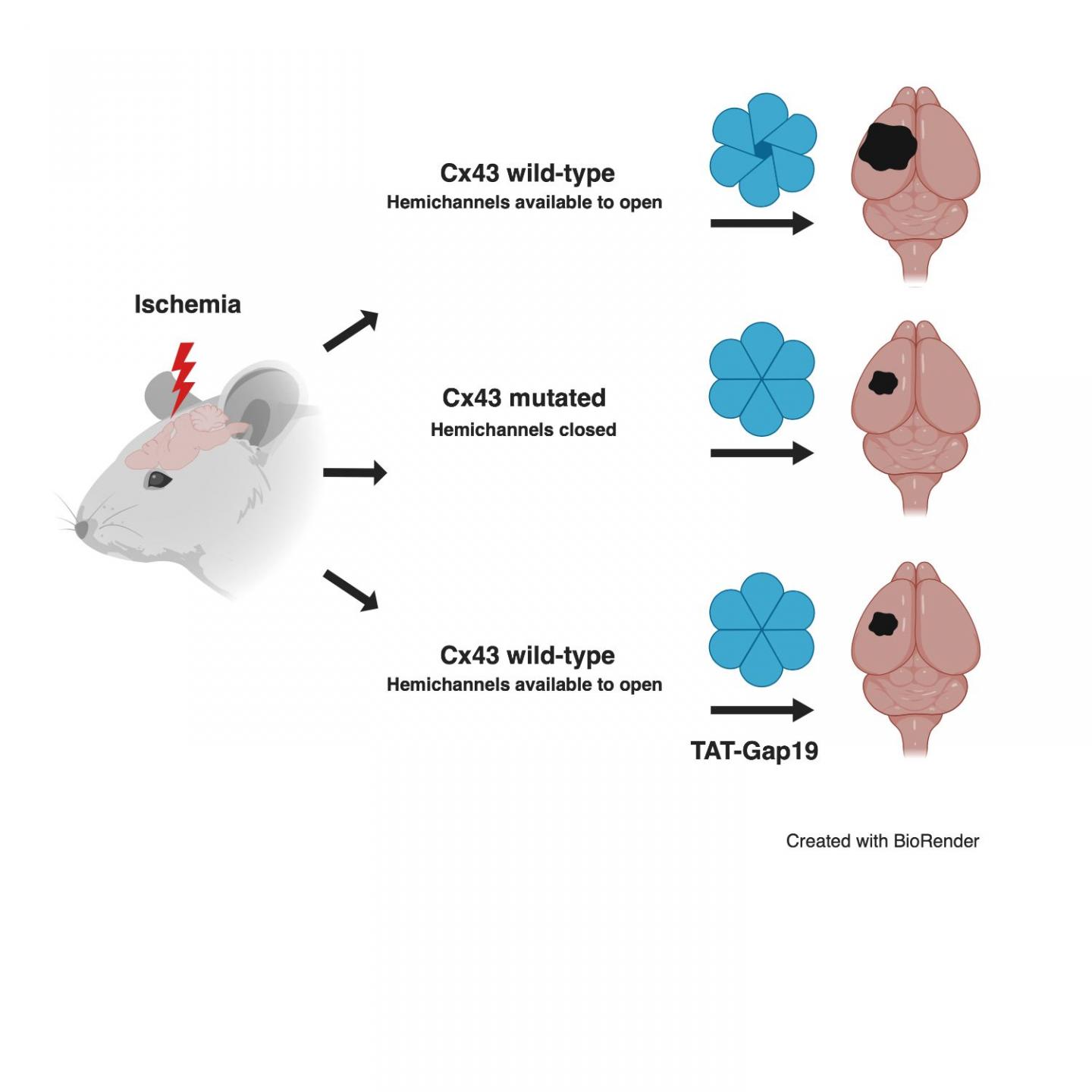
In a study published today in the Journal of Experimental Medicine, researchers successfully used a new approach that significantly minimized brain damage caused by stroke in mouse models. The new approach works by targeting hemichannels–pathways that allow for the flow of chemical ions and small molecules–that are expressed by astrocytes, cells that play a protective role for neurons in the brain.
When stroke occurs, these hemichannels open and can leak toxic molecules into the space outside the astrocytes, causing inflammation and damage to neurons.
“Our study definitively confirms that hemichannels are detrimental in stroke, and that we can block them to minimize damage to the brain,” said lead author Moises Freitas-Andrade, who conducted this study as a postdoctoral research fellow at UBC and currently is a research fellow at The Ottawa Hospital Research Institute. “It’s a different approach to stroke treatment. A lot of previous research has focused on trying to protect neurons, but here we sought a way to enhance the astrocyte’s ability to protect neurons in stroke.”
The researchers focused specifically on ischemic strokes, which occur when the arteries to the brain become narrowed or blocked, resulting in severely reduced blood flow. Ischemic stroke is the most common type, accounting for about 80 per cent of all strokes, according to the Heart and Stroke Foundation of Canada.
For the study, the researchers used a genetic approach that mutated the channel proteins, called connexins, in such a way that blocks the formation of hemichannels. This allows the astrocytes to protect the neurons, significantly reducing the size of the stroke injury in the brain. The researchers also used a molecule called Gap19 to block the hemichannels, in the same stroke model, which also resulted in smaller stroke damage. Together, the two approaches demonstrate that connexin hemichannel blockers could be used as a neuroprotective agent in stroke.
The researchers also attempted to mimic “real life” stroke conditions in the study, waiting two hours after the stroke occurred before administering the drug.
“It was important for us that we used a clinically realistic treatment window, especially if we were testing a drug that could potentially be used for treatment one day,” said the study’s senior author Christian Naus, professor emeritus in UBC’s department of cellular and physiological sciences, member of the Life Sciences Institute and an associate of the Djavad Mowafaghian Centre for Brain Health at UBC. “For the average person who has a stroke, two hours could easily elapse by the time paramedics arrive and the patient is taken to hospital and starts receiving treatment. This sets the stage for a combined approach where one could not only directly treat neurons in stroke, but could also enhance the astrocytes’ ability to protect neurons under stroke conditions.”
The researchers believe the approach could also have potential use for treating other neurodegenerative conditions such as traumatic brain injury and Alzheimer’s disease.
The study also involved researchers at the Fred Hutchinson Cancer Research Centre in Seattle and Ghent University in Belgium.
“This research is a great example of how the expertise from laboratories from three different countries could not only identify the importance of these connexin hemichannels but also discover the mechanisms involved and even identify possible avenues for treatment,” said study co-author Paul Lampe of the Fred Hutchinson Cancer Research Centre.
“Through the efforts of several labs, we were able to conduct in-depth explorations of channel protein function and its effect on disease treatment and outcome,” added Luc Leybaert of Ghent University.
###
This research was supported by grants from the Heart and Stroke Foundation of Canada, the Canadian Institutes of Health Research, the Canada Research Chairs program, the U.S. National Institutes of Health, the Fund for Scientific Research Flanders, the Interuniversity Attraction Poles Program, and the Geneeskundige Stichting Koningin Elisabeth.
Media Contact
Thandi Fletcher
[email protected]
Related Journal Article
http://dx.