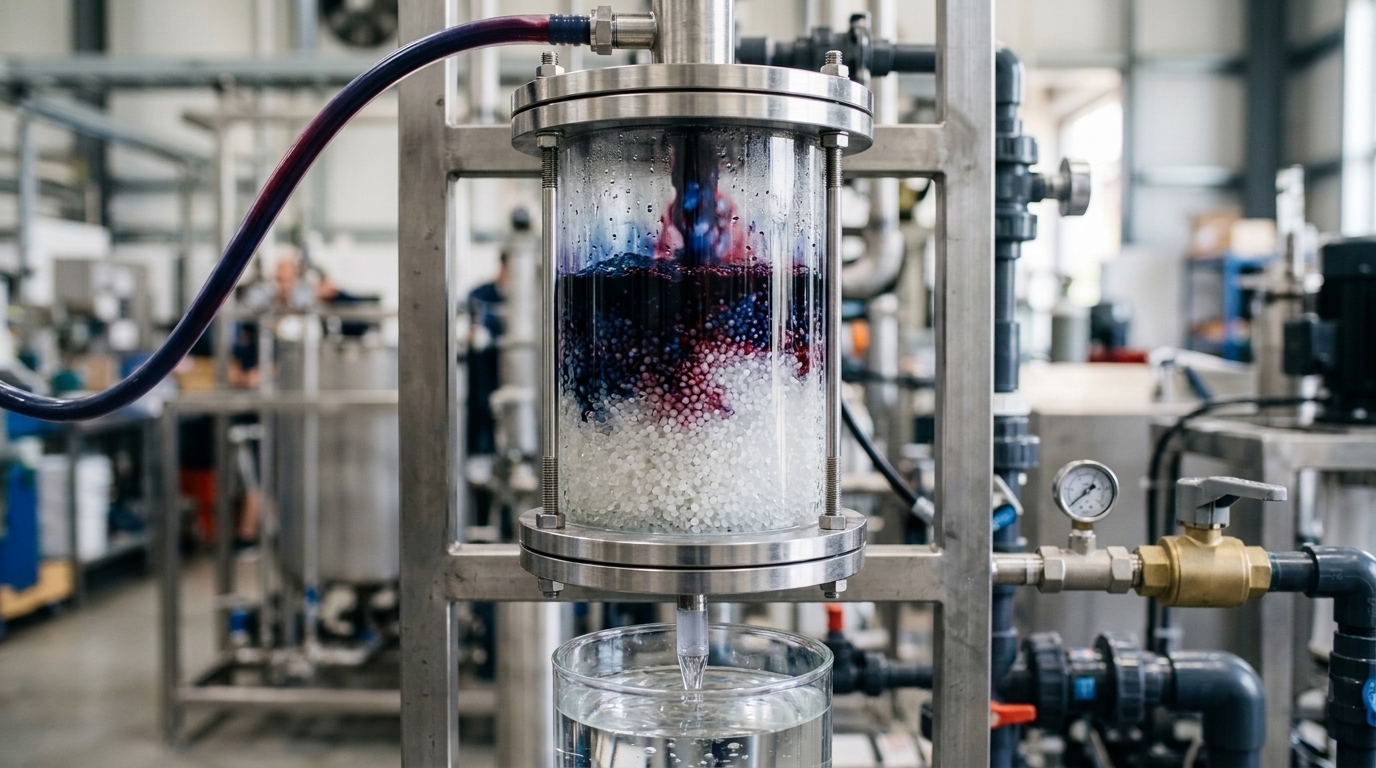
Researchers have developed a biocomposite adsorbent combining chitosan nanoparticles with low-density polyethylene to remove specific dyes from wastewater. Published in Discover Catalysis in November 2024, the study evaluates the effectiveness of this material, referred to as CHNP/LDPE, in treating water contaminated with Methylene Blue and Bromocresol Green. The investigation focuses on the physical and chemical interactions between the dye molecules and the nanoparticle surface, aiming to identify optimal conditions for efficient pollutant removal in industrial wastewater management.
The adsorbent material consists of chitosan nanoparticles incorporated into a low-density polyethylene matrix. Chitosan is a natural polysaccharide derived from chitin, which is found in fungal cell walls and crustacean exoskeletons. The study utilized nanoparticles sized at approximately 200 nanometers. The synthesis of the biocomposite involved a solvent casting method, a technique that allows for the integration of the chitosan nanoparticles within the polyethylene structure. This combination creates a material with properties suitable for adsorption, leveraging the biocompatibility of chitosan and the structural stability of the polymer.
The experimental design involved batch experiments conducted at ambient temperature to assess the impact of several key parameters on dye removal. These parameters included adsorbent dosage, contact time, temperature, pH, and initial dye concentration. The researchers used UV–Visible spectrophotometry to measure the concentration of dyes in the solution before and after the adsorption process. Specific wavelengths were selected for each dye based on their peak absorbance: 609 nanometers for Methylene Blue and 616 nanometers for Bromocresol Green. This method allowed for precise quantification of the amount of dye removed from the water by the biocomposite.
One of the critical factors examined was the pH of the solution, which significantly influences the surface charge of the adsorbent. The study found that a pH of 5 was optimal for the removal of Methylene Blue, while a pH of 6 yielded the best results for Bromocresol Green. At these optimal pH levels, the adsorbent achieved maximum removal efficiencies of 89.0% for Methylene Blue and 77.8% for Bromocresol Green. The effectiveness at lower pH levels is attributed to the protonation of the chitosan component, which introduces positive charges to the surface. These positive sites facilitate the interaction with the dye molecules, enhancing the adsorption process.
Contact time also played a crucial role in determining the efficiency of dye removal. The researchers observed that the adsorption process reached its peak at 90 minutes for Methylene Blue and 60 minutes for Bromocresol Green. At these durations, the removal efficiencies were 95.6% for Methylene Blue and approximately 97.8% for Bromocresol Green. The adsorption process exhibited two distinct stages: an initial rapid increase in removal efficiency followed by a slight decrease as the system approached equilibrium. This pattern suggests that the active sites on the adsorbent surface become saturated over time, limiting further adsorption.
The initial concentration of the dye in the wastewater also affected the adsorption performance. The study indicated that the maximum adsorption occurred at an initial concentration of 45 mg/L for both dyes, with efficiencies of 98.8% for Methylene Blue and 96.2% for Bromocresol Green. As the initial concentration increased beyond this point, the percentage removal declined. For example, at higher concentrations, the removal efficiency for Methylene Blue dropped from 92.4% to 58.8%, while for Bromocresol Green, it decreased from 79.5% to 69.4%. This decline is explained by the saturation of available binding sites on the adsorbent surface, which restricts the capacity to remove additional dye molecules.
Temperature was another variable investigated in the study, with the optimal adsorption efficiency recorded at 30 degrees Celsius. At this temperature, the removal efficiencies were 95% for Methylene Blue and 91% for Bromocresol Green. Thermodynamic analysis of the adsorption process revealed that it was exothermic, as indicated by the negative Gibbs free energy change. This suggests that the adsorption process is spontaneous and favorable under the tested conditions. The positive enthalpy values imply that the process involves an endothermic nature, where heat is absorbed during the adsorption, although the overall free energy change remains negative, driving the reaction forward.
The adsorption behavior of the dyes onto the CHNP/LDPE biocomposite was analyzed using isotherm models. The data conformed closely to the Langmuir isotherm model, which describes monolayer adsorption on a homogeneous surface. The correlation coefficient values for Methylene Blue and Bromocresol Green were 0.993 and 0.996, respectively, indicating a strong fit to the Langmuir model. This suggests that the dye molecules form a single layer on the surface of the adsorbent, with each site occupied by one molecule. The maximum adsorption capacities were determined to be 147 mg/g for Methylene Blue and 142.8 mg/g for Bromocresol Green, highlighting the high capacity of the biocomposite for these pollutants.
Kinetic studies further clarified the mechanism of adsorption. The data aligned with the pseudo-second-order kinetic model, suggesting that the rate-limiting step involves chemisorption. This type of adsorption involves the sharing or exchange of electrons between the dye molecules and the active sites on the adsorbent. The equilibrium capacity values derived from the kinetic model were 185.18 mg/g for Methylene Blue and 192.30 mg/g for Bromocresol Green. The conformity to the pseudo-second-order model indicates that the adsorption process is governed by chemical interactions rather than physical forces, providing insight into the nature of the binding between the dyes and the biocomposite.
The study concludes that the CHNP/LDPE biocomposite is a promising material for the removal of dyes from wastewater. The optimal conditions identified, including specific pH levels, contact times, and temperatures, provide a framework for optimizing the adsorption process. The high adsorption capacities and the fit to the Langmuir isotherm and pseudo-second-order kinetic models underscore the effectiveness of the biocomposite. While the study focuses on specific dyes, the findings suggest that similar materials could be developed for the treatment of other industrial pollutants, contributing to more sustainable wastewater management practices.
Beyond evaluating contact time and solution acidity, the researchers systematically varied the biocomposite dosage to observe its effect on dye uptake. Testing quantities from 0.01 grams to 0.05 grams demonstrated that dye removal scaled directly with adsorbent mass. Because greater quantities of the biocomposite provided a larger surface area and an expanded number of accessible binding sites, removal efficiency increased until reaching equilibrium at 0.05 grams. At this dosage, the system achieved a removal efficiency of 96.8 percent for Methylene Blue and 97.7 percent for Bromocresol Green, reflecting the exhaustion of active sites across the biocomposite surface. Statistical verification through a one-sample t-test confirmed the significance of this dosage dependency, yielding two-tailed P values below 0.0001 alongside partial eta squared values of 0.9942 for Methylene Blue and 0.9973 for Bromocresol Green.
To further characterize surface behavior, the authors evaluated their equilibrium measurements against the empirical Freundlich isotherm equation, which models multi-site adsorption across heterogeneous surfaces. Although the experimental data showed moderate correlation to the Freundlich model, with coefficient of determination values of 0.9172 for Methylene Blue and 0.9446 for Bromocresol Green, the system conformed far more closely to the Langmuir model. In the Freundlich evaluation, the calculated exponent value n remained below 1, indicating that uptake was driven by chemical bonding rather than physical deposition. Furthermore, separation factor values fell below 1 for both pollutants, denoting favorable adsorption across the operational range. Comparing these isotherm profiles led the team to conclude that single-layer chemisorption on a homogeneous surface predominated over multilayer heterogeneous retention.
The kinetic evaluation similarly contrasted competing theoretical frameworks to determine the rate-limiting mechanism. When tested against the Lagergren pseudo-first-order model, the experimental measurements failed to achieve an acceptable statistical fit. In each dye trial, the correlation coefficient remained below 0.99, and substantial discrepancies emerged between calculated equilibrium values and empirical results. Conversely, adherence to the pseudo-second-order model confirmed that the process followed chemisorption kinetics. The authors attributed this chemical rate control to valence forces involving the sharing or exchange of electrons with nitrogen atoms located within the chitosan polymer matrix. They noted that such second-order adsorption behavior typically reflects two-site or bicontinuum reaction pathways that proceed either in series or in parallel.
Thermodynamic modeling using Van ‘t Hoff plots provided quantitative insight into the energy exchanges driving the biosorption reaction. The analysis yielded negative Gibbs free energy values for both Methylene Blue and Bromocresol Green, confirming that adsorption was thermodynamically feasible and spontaneous under the investigated conditions. The authors recorded identical Gibbs free energy values for both substances, indicating an equivalent degree of spontaneity. Meanwhile, positive enthalpy values demonstrated that the fundamental sorption reaction was endothermic, absorbing heat as adsorbate molecules gained thermal energy to overcome activation barriers. Concurrently, negative entropy values revealed a decrease in disorder at the solid-solution interface as dye molecules organized upon the composite surface.
The study also documented the specific preparation and material sources used to fabricate the biocomposites. Chitosan nanoparticles were obtained from Indorma Eleme Petrochemicals Limited, while low-density polyethylene granules were acquired from Polyflex Industry Limited in Nigeria. During solvent casting, the authors adjusted solvent ratios, mixing parameters, and drying conditions to optimize nanoparticle dispersion throughout the polyethylene matrix. In discussing broader remediation mechanisms, the authors noted that chitosan nanoparticles may foster an environment conducive to microbial growth, potentially enabling biological decomposition of dye molecules alongside physical and chemical adsorption. Such dual mechanisms address critical industrial challenges, as textile processing alone accounts for 93 billion cubic meters of annual water consumption, although the investigators emphasized that further studies are needed to isolate specific bioabsorption pathways.
Subject of Research: Adsorption of Methylene Blue and Bromocresol Green dyes from wastewater using chitosan/low-density polyethylene nanoparticle biocomposites.
Article Title: Biosorption of dyes in wastewater using chitosan/polyethylene nanoparticle as adsorbent
Article References: Adelaja, O. A., Babaniyi, B. R., Aransiola, S. A., Rodríguez-Díaz, J. M., Maddela, N. R., & Prasad, R. (2024). Biosorption of dyes in wastewater using chitosan/polyethylene nanoparticle as adsorbent. Discover Catalysis, 1(1), Article 3. https://doi.org/10.1007/s44344-024-00003-2
Image Credits: AI Generated
DOI: 10.1007/s44344-024-00003-2
Keywords: chitosan nanoparticles, low-density polyethylene, wastewater treatment, Methylene Blue, Bromocresol Green, adsorption isotherms, Langmuir model, pseudo-second-order kinetics, biocomposite adsorbents, dye removal, UV-Visible spectrophotometry, thermodynamic analysis, pH optimization, industrial effluent, surface charge interactions, chemisorption, Discover Catalysis, nanoparticle synthesis, environmental remediation, batch experiments
News Source: Bethany Barker. (November 18, 2026). Chitosan-Polyethylene Nanoparticles Remove Dyes from Wastewater. Scienmag.