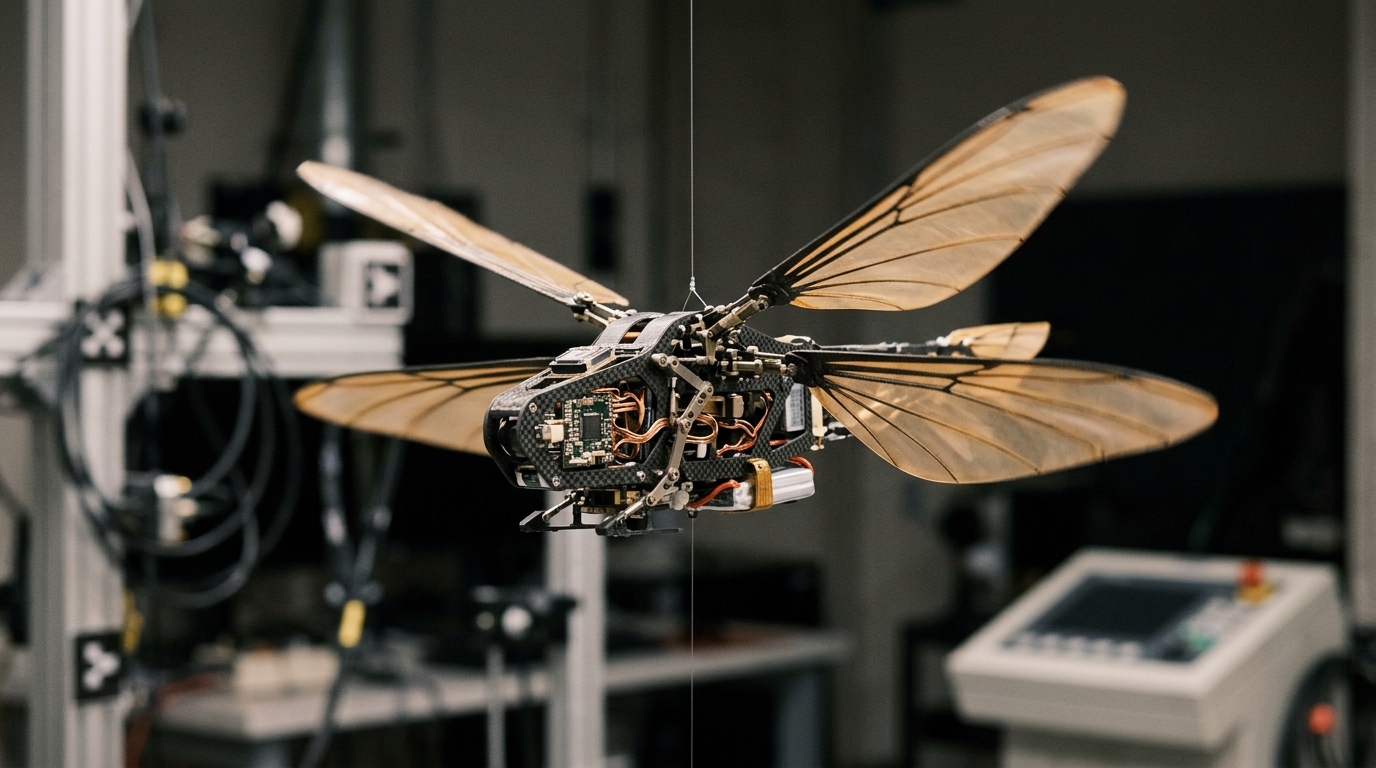
In a Highlight perspective published in the peer-reviewed Chinese Journal of Aeronautics, researchers Hao Li and Jianghao Wu from Beihang University have outlined a theoretical and computational framework that bridges the gap between mechanical airframe agility and flight control intelligence in bioinspired aerial vehicles. The analysis demonstrates how embedding unsteady fluid mechanics and energy-based analytical stability constraints directly into neural control architectures can establish low-level physical and sensorimotor embodiment. Rather than prioritizing high-level visual navigation or semantic task planning, the authors address the underlying physical challenge of coupling autonomous control policies with compliant wings, underactuated multibody dynamics, and rapid, unsteady airflow patterns to achieve reliable flight in complex environments.
The motivation for developing flapping-wing micro air vehicles stems from the severe operational boundaries encountered by conventional uncrewed aerial platforms. As uncrewed aerial vehicles transition from open outdoor airspace into cluttered indoor rooms, dense forest canopies, and narrow urban canyons, traditional multi-rotor quadrotors face fundamental physical constraints. High-speed spinning rotor blades generate intrusive acoustic noise, present dangerous collision hazards when operating in proximity to human populations, and suffer a significant drop in aerodynamic efficiency at low Reynolds numbers ranging from 100 to 10,000. Flapping wings offer an effective bioinspired alternative for this low-Reynolds-number flight regime, uniquely combining structural mechanical compliance and low-frequency acoustic signatures with the continuous generation of unsteady vortex lift.
Over the past decade, substantial engineering progress in flexible lifting surfaces, precision micro-transmissions, and wing-abdomen coupled actuation mechanisms has produced remarkable physical agility in bioinspired airframes. Drawing on twenty-five years of foundational bioflight research, the Bioflight and Bioinspired Aerial Vehicles Team at Beihang University has engineered a diverse suite of untethered platforms, including hover-capable hummingbird-scale vehicles, clap-and-fling multi-wing flyers, and hybrid coupled flapping-rotary systems. Among these platforms, the BH-Fly prototype demonstrated extreme mechanical responsiveness by executing a full 360-degree roll in just 0.18 seconds. However, translating such rapid airframe agility into stable autonomous navigation under unpredictable real-world airflow conditions has remained an unresolved bottleneck, driven primarily by a persistent mismatch between agile physical bodies and low-level flight-control intelligence.
Existing robotic control strategies have struggled to govern this regime effectively, as both classical model-based controllers and unconstrained model-free reinforcement learning algorithms present severe operational shortcomings. Traditional controllers founded on quasi-steady aerodynamic averages routinely omit historical wake effects and erroneously treat turbulent gusts as mere external disturbances that must be resisted and suppressed. In contrast, purely data-driven neural networks approach the intricately coupled fluid-structure interaction system as an opaque black box. Because these black-box policies are trained via trial and error without fundamental aerodynamic or energetic constraints, they require massive sample sizes and frequently lose dynamic stability during aggressive maneuvers or when undergoing simulation-to-real transfer into real atmospheric conditions.
To overcome these systemic limitations, Li and Wu propose shifting toward a glass-box paradigm of physics-embedded artificial intelligence operating across two integrated technical fronts. The first front focuses on explicitly modeling transient aerodynamics so flight controllers can actively anticipate and harness strong unsteady fluid phenomena rather than fighting them. At low Reynolds numbers and high angles of attack, every stroke of a flapping wing produces leading-edge vortices that interact nonlinearly with the wake shed during previous wingbeats. Because quasi-steady equations completely miss this spatio-temporal memory and full computational fluid dynamics solvers require too much computational power for iterative optimization, the proposed framework couples lattice-Boltzmann fluid-structure interaction simulations with differentiable sequence neural surrogates to deliver physically grounded gradient feedback regarding vortex shedding, wing elastic deformation, and wake capture.
The second front integrates rigorous analytical stability constraints and structural compliance directly into the underlying neural architecture. Biological flyers take advantage of elastic wing hinges that operate as passive mechanical filters, storing and releasing elastic energy near resonance to absorb gust impacts while coordinating with neuromotor feedback loops to dissipate excess disturbance energy. The authors translate this biological architecture into neural design using Port-Hamiltonian dynamics and passivity-based energy shaping via input convex neural networks. By constructing positive-definite energy potential functions integrated with dynamic damping injection, the control network guarantees intrinsic energy dissipation and provable stability constraints. When integrated with differentiable central pattern generators that smoothly bridge low-frequency guidance commands and high-frequency stroke cycles, the controller coordinates with structural compliance to ensure robust low-altitude hovering and confined-space trajectory tracking.
By coupling intelligent algorithms with compliant physical hardware through differentiable aerodynamic surrogates and energy-constrained control architectures, this physics-embedded approach establishes the groundwork for biological-level flight agility in turbulent micro-environments. The overarching objective articulated by the authors is to transition from reactive flight stabilization to systems that anticipate and actively orchestrate transient aerodynamics, effectively riding turbulent gusts rather than merely attempting to survive the flow. Beyond flapping-wing micro air vehicles deployed for confined-space search, rescue, and structural emergency inspection, the authors conclude that this physics-embedded control blueprint provides a scalable technical foundation for morphing-wing aircraft, cross-medium unmanned vehicles, and coordinated self-organizing autonomous drone swarms.
Subject of Research: Physics-embedded artificial intelligence and sensorimotor control for bioinspired flapping-wing aerial robots
Article Title: From black-box trial and error to glass-box flight: Physics-embedded AI for flapping-wing robots
Article References: From black-box trial and error to glass-box flight: Physics-embedded AI for flapping-wing robots. Original publication (Bibliographic details unavailable.)
Image Credits: AI Generated
DOI: Not provided
Keywords: Flapping-wing micro air vehicles, Physics-embedded artificial intelligence, Sensorimotor embodiment, Unsteady aerodynamics, Energy-based stability constraints, Port-Hamiltonian dynamics, Input convex neural networks, Differentiable central pattern generators, Lattice-Boltzmann fluid-structure interaction, Bioinspired aerial robotics, Low Reynolds numbers, Vortex lift, Leading-edge vortices, Simulation-to-real transfer, Passive mechanical filters, Beihang University, Chinese Journal of Aeronautics
News Source: Katie Riggs. (November 18, 2026). Physics-Embedded Artificial Intelligence Framework Enhances Flight Stability for Flapping-Wing Aerial Robots. Scienmag.