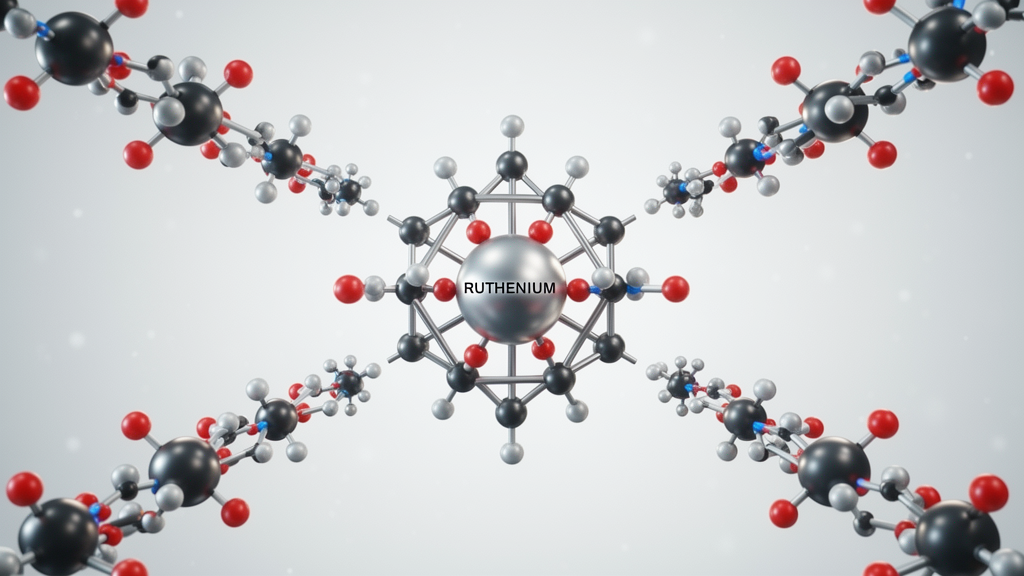
The chemical transformation of carbon dioxide into high-value feedstocks, including formic acid, formaldehyde, and methanol, has emerged as a cornerstone in the global effort to mitigate greenhouse gas emissions and facilitate a transition toward a circular low-carbon economy. This fundamental challenge involves overcoming the inherent thermodynamic stability of carbon dioxide through the use of highly active, selective, and sustainable catalytic systems. Recent research conducted over the past six years has focused extensively on heterogeneous ruthenium-based catalysts, evaluating their potential for various hydrogenation pathways. The scientific effort has characterized how ruthenium’s unique electronic structure, characterized by versatile oxidation states and high electronic density, facilitates the activation of C-O and C=O bonds. This review synthesizes advancements in ruthenium nanoparticle dispersion, catalyst support engineering, and reaction conditions that optimize efficiency and stability in industrial applications.
Ruthenium distinguishes itself as a highly effective catalyst compared to other noble metals due to its superior activity, selectivity, and relatively lower cost. Its catalytic performance is largely linked to the presence of the Ru(001) crystallographic plane, which exhibits oxophilic characteristics that are essential for the strong adsorption of hydroxyl groups during hydrogenation. In terms of environmental and economic impact, ruthenium-based systems often function effectively at lower pressures and temperatures than traditional alternatives, directly reducing energy consumption. Heterogeneous configurations are particularly valued in industrial settings for their ability to be recovered and reused, although challenges such as particle leaching and agglomeration remain active areas of research. By optimizing support interactions, scientists are working to address these stability issues while maximizing the catalytic output of these ruthenium-based systems.
Formic acid synthesis represents one of the primary targets for carbon dioxide hydrogenation due to its utility in agriculture, textiles, and renewable energy storage. Because the conversion of carbon dioxide to formic acid is thermodynamically unfavorable, researchers utilize aqueous bases to favor the formation of salts, which shifts the reaction toward an exergonic state. Recent breakthroughs in ruthenium nanoparticles immobilized on ionic liquids have established them as among the most promising catalysts in this field. These systems use ionic liquids to create protective nanoreactors that control the diffusion of reagents and stabilize the formation of formate species through hydrogen bonding. Experimental evidence indicates that these supported ionic liquid phases enable significant improvements in turnover numbers, positioning them as highly effective candidates for industrial scale-up.
The synthesis of bimetallic alloys and mixed-oxide systems has further expanded the capabilities of ruthenium catalysts. By incorporating a secondary metal such as cobalt or nickel, researchers have successfully induced synergistic effects that improve electronic distribution and strengthen surface basic sites, which are critical for CO2 activation. For instance, amorphous RuCoB alloys have demonstrated enhanced performance compared to monometallic counterparts, exhibiting both higher surface areas and greater catalytic activity. Simultaneously, research into mixed-oxide supports like RuO2/ZrO2 and RuO2/Co3O4 has focused on creating systems that leverage the intrinsic acidity of the support to activate zwitterionic carbamate intermediates.
Single-atom catalysts represent a frontier in maximizing the efficiency of ruthenium by stabilizing isolated metal atoms on nitrogen-doped carbon materials or complex porous structures. This atomic-level dispersion effectively combines the benefits of high efficiency typically associated with homogeneous catalysts and the stability and recoverability of heterogeneous systems. Studies have utilized N-doped graphene and carbon spheres to anchor ruthenium, finding that nitrogen-doped sites play a crucial role in preventing metal nanoparticle agglomeration. Computational density functional theory simulations have provided further insights into these systems, indicating that the desorption of formic acid may serve as the rate-determining step. By tailoring the density and type of nitrogen sites on the support, researchers can optimize the local coordination environment of the ruthenium atom, thereby enhancing its catalytic performance for hydrogenation reactions.
Layered double hydroxides provide an additional, versatile platform for ruthenium-based catalysis, particularly because these materials can act simultaneously as a structural support and a soft base. This dual functionality eliminates the requirement for external additives like triethylamine or phosphorous-based ligands, which are commonly necessary in other reaction protocols. Kinetic assessments of ruthenium-modified hydrotalcite catalysts have reported performance benchmarks comparable to homogeneous ruthenium complexes, with the additional benefit of long-term stability across multiple catalytic cycles.
Formaldehyde production through carbon dioxide hydrogenation remains a highly challenging chemical process, characterized by a lack of extensive research compared to formic acid or methanol synthesis. The competitive formation of formic acid frequently complicates the selectivity toward formaldehyde. However, new studies focusing on Ru-layered double hydroxide catalysts, utilizing glycerol as an alternative hydrogen source, have identified viable pathways for formaldehyde synthesis. These mechanisms involve the dehydrogenation of glycerol, followed by the adsorption of carbon dioxide onto hydroxyl groups of the support. Competitive oxidation processes, however, can reduce the desired yield, emphasizing the need for precise temperature control. Future research in this area is increasingly focusing on the development of catalysts with specialized oxygen vacancies that can facilitate the necessary intermediate reductions without triggering unwanted side reactions.
Methanol production is arguably the most significant industrial application of carbon dioxide hydrogenation, serving as a critical pathway for energy storage and the development of a low-carbon fuel economy. While industry currently relies heavily on Cu/ZnO/Al2O3, this catalyst is notoriously prone to deactivation caused by surface water and low-temperature inefficiency. Ruthenium-based catalysts offer a robust alternative, often serving as promoters in bimetallic systems or as highly active single-metal phases when supported on oxygen-deficient materials like In2O3. The synergy observed between ruthenium and indium oxide, particularly in the presence of zirconium oxide, illustrates the importance of creating oxygen vacancies that assist in the chemisorption and activation of CO2. By blocking pathways that would otherwise lead to methane formation, these advanced ruthenium-based systems ensure higher selectivity and methanol production rates.
The role of structural evolution in catalytic performance is highlighted by recent studies on intermetallic phases, such as In3Ru1. Patent literature reflects this industry focus, with recent filings detailing sophisticated methods for preparing multi-metallic composites and plasmonic nanomaterials capable of photocatalytic synthesis. These patents underscore a broader move toward using advanced technological approaches—such as supercritical fluid deposition and plasma-enhanced synthesis—to achieve precise control over metal-support morphology. This trend suggests that the industrial viability of ruthenium-based methanol synthesis is being bolstered by a combination of high-precision materials science and innovative reactor configuration.
Moving forward, the field faces the clear imperative to transition from standard impregnation techniques to more sophisticated synthesis methods, such as combustion synthesis or hydrotalcite reconstruction, which promise superior metal dispersion. The exploration of supports with complex topologies, including metal-organic frameworks and carbon nanotubes, will likely be essential for facilitating the selective diffusion of reagents. As the integration of density functional theory calculations and advanced experimental characterization becomes standard, the development of next-generation catalysts will be guided by an increasingly granular understanding of the catalytic cycle. By addressing the current gaps in catalyst synthesis and optimizing support-metal interactions, the ongoing research in ruthenium-based systems continues to provide the essential evidence needed to scale these sustainable valorization technologies for wider industrial adoption.
Subject of Research: Heterogeneous ruthenium-based catalysts for carbon dioxide hydrogenation
Article Title: Exploring heterogeneous Ru-based catalysts: CO2 hydrogenation towards formic acid, formaldehyde, and methanol
Article References: Cárdenas-Acero, A., Álvarez-Romero, C., Daza, C., Álvarez, A., & Baquero, E. A. (2024). Exploring heterogeneous Ru-based catalysts: CO2 hydrogenation towards formic acid, formaldehyde, and methanol. Discover Catalysis, 1(1), Article 4. https://doi.org/10.1007/s44344-024-00004-1
Image Credits: AI Generated
DOI: 10.1007/s44344-024-00004-1
Keywords: Ruthenium catalysts, CO2 hydrogenation, Formic acid synthesis, Methanol production, Heterogeneous catalysis, Nanoparticle dispersion, Single-atom catalysts, Layered double hydroxides, Carbon economy, Sustainable chemistry, Catalytic mechanisms, Ionic liquids, Metal-support interaction, Renewable energy, Process intensification, Green chemistry, Catalyst stability, Formylation, Thermodynamic optimization
News Source: Bethany Barker. (November 18, 2026). Ruthenium Catalysts Advance Efficient Carbon Dioxide Conversion to Value-Added Chemicals. Scienmag.